Master the Grid Drawing Method
Comprehensive tutorials and guides to help you learn and perfect the grid drawing technique.
Whether you're a beginner or experienced artist, our step-by-step tutorials will help you improve your drawing accuracy and master proportion techniques used by artists for thousands of years.
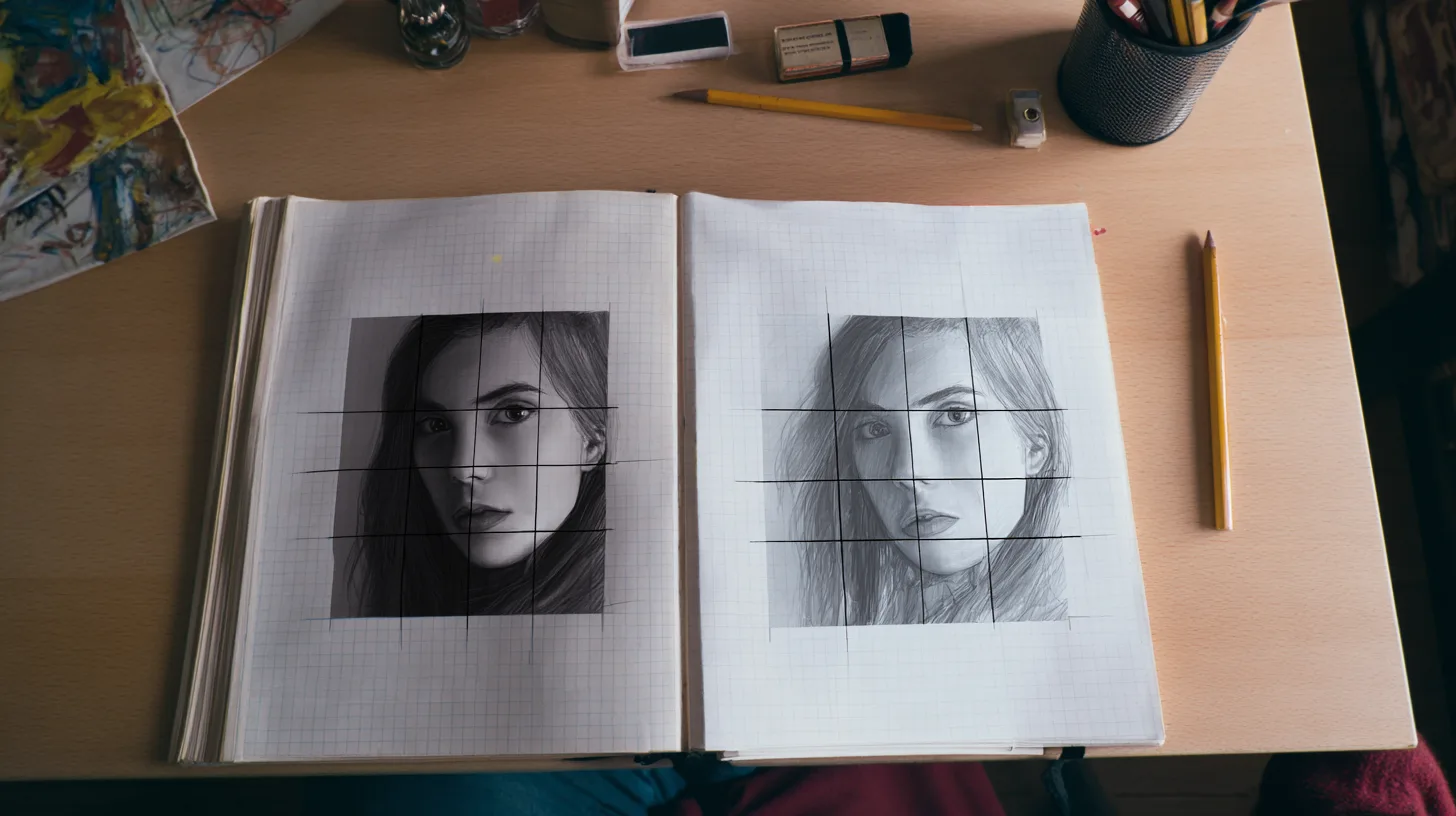

The Complete Grid Drawing Guide
Master accurate proportions with our comprehensive step-by-step guide covering everything from basic setup to advanced techniques. Perfect for artists of all skill levels who want to improve their drawing accuracy.
How-to: using the tool
Short, illustrated walkthroughs of one job each. Every page ends in the tool, set up and guided.
Transfer a grid to paper
Print the matching empty grid at true size, or use ruler marks for canvas you cannot print on.
Print a grid over multiple pages
Tile a reference across several sheets with cut lines and glue strips, for wall-sized work.
Use composition overlays
Rule of thirds, golden ratio and the draggable spiral, read against your subject and baked into the export.
Check your drawing against the reference
Align the two images, then read mirror, squint and difference to find where the proportions drifted.
Crop a photo to your canvas ratio
Decide what the drawing is about before the grid is fixed, instead of letting the leftover margin decide it.
Share a grid setup with a link
Configure the grid once and hand the link to a class. Settings travel, photos never do.
Turn a photo into outlines
Reduce a reference to its edges so you can see the shapes you are about to draw.
Use grid coordinates to find a cell
Give every cell an address, so "look at B4" means one square for everyone.
Focus on one cell at a time
Dim everything except the cells you are drawing, in the fullscreen view.
Make grid worksheets for a class
Set the paper and the cell size, switch on coordinates and a name line, download thirty sheets as one PDF and share the link.
Draw in perspective from a photo
Read the vanishing points out of your own picture, lay a one, two or three point grid on them, and print the construction.
Check the real print size
What your file declares about its own resolution, and why pixels are not a length.
Guides to the grid method
Shorter reads than the tutorials above: each takes one way of working with grids and explains it end to end.
Alberti's veil, Dürer's grid, the arithmetic of scale and cell size, and the two places the method stops helping.
Four ways to get a picture onto paper, what each teaches and hides, and a straight answer to whether any of it is cheating.
grid for drawing
What a drawing grid does, which cell size suits your subject, and how to get it onto paper.
grid maker for drawing
Why the transfer matters more than the grid, written for artists working from printed references.
grid generator
Exact cell sizes, fractional columns and rows, and what full control over every line is good for.
image grid generator
Putting a grid on any photo, including edge detection and why the processing happens in your browser.
grid art
How photorealist portraits and murals are built cell by cell: Chuck Close, muralists, and how to start a piece.
add a grid to a photo
The short route from photo to gridded reference, in three steps.
Perspective
One rule, four views. Each page shows its construction live, with the points to drag, and ends in an exercise you can do today.
Perspective drawing: one rule, four views, and where you stand
Parallel lines converge to a vanishing point; the count of points is a standpoint, not a style. The horizon as eye level, where the points really go, printable grids, and the history from Brunelleschi to Alberti.
One-point perspective
The view faced square on: depth converges on a single point, horizontals and verticals stay put. Live construction and an exercise with measurements.
Two-point perspective
The corner view, and why the two points belong outside the paper: how far, and what goes wrong when they are forced onto the sheet.
Three-point perspective
Looking up or down: the verticals converge on a third point, the horizon slides off the frame, and nothing in the picture is vertical.
Curvilinear perspective
The wide view in which straight edges bow: what a four-point grid is, what stays straight, and why a fisheye lens sees this way.
The horizon line
Your eye level as a line: where it goes in each view, how to find it in any photograph, and the two places it is put that ruin a drawing.
Composition
Four guides, four questions. Each page draws its overlay live over a public-domain picture, says where the guide comes from, and ends in an exercise.
Composition: what the guides decide, and what they cannot
Rule of thirds, golden ratio, diagonals and symmetry as measuring lines, drawn live over Hokusai's Great Wave; which claims are arithmetic and which are habit.
The rule of thirds
What it asks, its origin in a 1797 book on landscape, and when the centre is the better answer.
The golden ratio
The number and its geometry, the art claims that did not survive measurement, and how to use the spiral so it can be wrong.
Leading lines and diagonals
What carries the eye and where it arrives; dynamic symmetry and the eyes of the rectangle.
Symmetry and balance
Visual weight, the axis, and how a picture as lopsided as the Great Wave stays level.
Ready to Practice?
Put your learning into practice with our free grid generator tool. Upload your reference image and start drawing with precision today.
Try Grid Maker Free