Leading Lines and Diagonals: What Carries the Eye, and Where It Arrives
A leading line is any edge or direction in a picture that carries the eye: a road, a railing, an outstretched arm, the curl of a wave. The eye follows lines, and it follows diagonals faster than horizontals or verticals, because a diagonal is going somewhere in the frame while a horizontal only rests. Where the lines arrive is the composition's claim about what matters. The armatures of dynamic symmetry, a rectangle's diagonals with perpendiculars dropped onto them from the corners, are a way of drawing the strongest of those directions before the picture exists, and of finding the points, the "eyes" of the rectangle, where they meet.
The Armature, Live
Below is the root-two armature over our picture after Hokusai's Great Wave: the two diagonals of the frame and, from each corner, the perpendicular dropped onto the opposite diagonal. Where a diagonal and a perpendicular meet is an eye of the rectangle; there are four. Now follow the wave. Its great claw sweeps down from the upper left along a direction close to the falling diagonal, its foam fingers point towards the small, still Fuji, and the boats run under it on the opposite slope. Whether Hokusai drew any such lines is not known and does not matter. The picture has them.
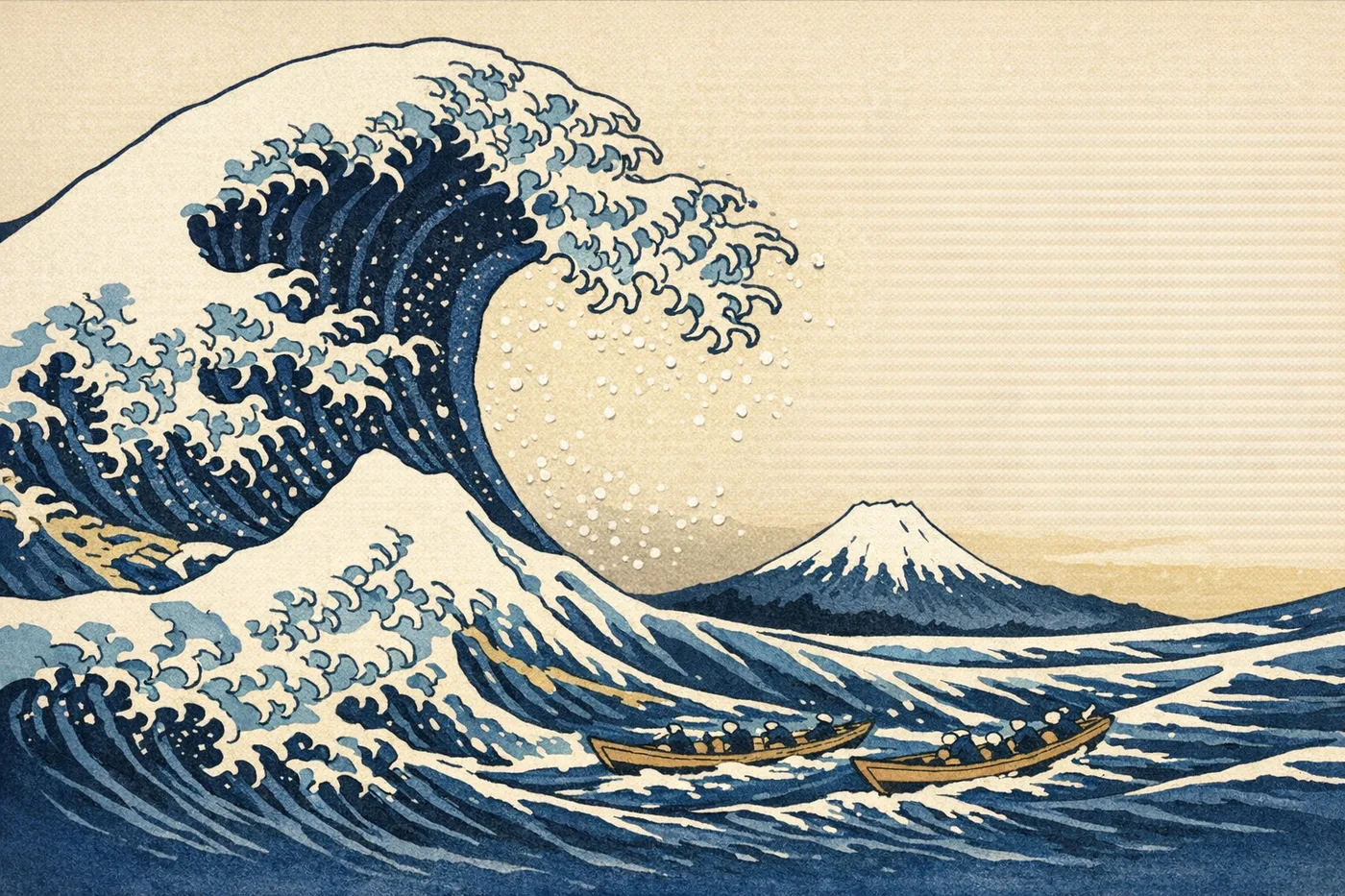

Switch to the root-three armature, which adds a second pair of reciprocals, and to the golden spiral. Three different constructions find three different things to sit on. The lesson is not that one is right; it is that a picture with strong directions gives every armature something to agree with, and a picture without them gives none of them anything.
What a Diagonal Does
A horizontal line in a frame is at rest: it runs parallel to the top and bottom edges and stops at the sides, and the eye rests with it. A vertical stands. A diagonal does neither; it runs from one region of the frame to another and the eye goes with it, which is why a road entering at a bottom corner and running into the picture pulls the viewer in, and the same road running straight across the frame is a wall. The angle matters less than the fact of crossing: any line that connects two parts of the frame is a path, and the eye takes the path.
Where the path ends is what the picture is about. A leading line that arrives at the subject delivers the eye to it. A line that arrives at an edge delivers the eye out of the frame, which is the commonest fault in pictures with strong lines: a fence, a shoreline or a pointing arm that runs out of the picture takes the viewer with it. The fix is rarely to remove the line; it is to give it somewhere to arrive, or to cross it with another line that turns the eye back.
Curves lead too, and more slowly. A river, a path, a curl of hair carries the eye at the pace of its bends, and a spiral, like the wave here, carries it in a way a straight line cannot: it tightens. That is the honest core of the golden spiral as a guide, once the mathematics is set aside: a spiral leads inward.
Dynamic Symmetry and the Eyes of the Rectangle
In 1920 the American artist Jay Hambidge published Dynamic Symmetry: The Greek Vase, proposing that Greek design was built on "root rectangles", rectangles whose sides are in the ratio of one to the square root of two, three, four or five, and on the armature each of them generates. The armature is simple to draw: the diagonal of the rectangle, and from a corner not on it, a line perpendicular to that diagonal. In a root-two rectangle that perpendicular, the reciprocal, cuts off a smaller rectangle of the same proportion, and the point where diagonal and reciprocal cross is the eye.
Whether the Greeks worked this way is disputed, and Hambidge's historical claims should be read with the same care as the golden ratio's. What survives is the tool. The armature gives a picture four points that are neither the centre nor the thirds, each connected to two corners by the strongest lines the frame can hold, and a subject placed at one of them is already tied to the frame by two directions. Painters and photographers who have never heard of Hambidge use the diagonal and its perpendicular by eye; the overlay simply draws it.
The overlay tool draws the root-two and root-three armatures over any frame, whatever its proportion, so the lines are the diagonals and reciprocals of your frame, not of an ideal rectangle. That is the honest version: it measures the picture you have.
The Exercise: Find the Path, Then Draw It
You need a sketchbook, a soft pencil, a straightedge, and three pictures: a photograph of your own with a road, river or fence in it, a reproduction of a painting you admire, and a blank frame. Forty minutes.
- Trace the paths on the photograph. Lay tracing paper over it and, without drawing the objects, draw only the lines the eye follows: edges of the road, the top of the fence, the direction of a figure's gaze. Five to eight lines. Mark with a dot where each one arrives.
- Count the exits. How many of your lines arrive at the subject, and how many at an edge of the frame? If more arrive at edges, the picture is leaking. Mark where a second line, or a change of crop, would turn the eye back.
- Do the same for the painting. Trace only the directions. Then load the reproduction into the composition overlay tool, switch on the root-two armature, and see how many of the painter's lines run near a diagonal or a reciprocal, and whether the subject sits near an eye. Write down the count; do not round it up.
- Compose in the blank frame. Rule a 12 by 8 centimetre rectangle and draw its two diagonals and four reciprocals lightly. Place a single figure at one eye and give it one leading line from a corner. Then move the figure to the centre with the same line. Compare which drawing the eye enters and which it merely looks at.
The habit this builds is the only rule of leading lines worth having: before drawing anything, ask where the eye will go, and make sure the answer is inside the picture.
The Mistakes That Send the Eye Out
- A line that leaves. A shoreline, a road or a fence that runs to the frame edge and stops. The eye follows it out and does not come back unless something turns it.
- A gaze into the frame edge. A figure looking or pointing towards the near edge has its strongest line cut off. Give the gaze room, which usually means the figure on the far side of centre from where it looks.
- Parallel lines only. A picture made of horizontals and verticals is stable and still, which is a choice; but if it feels lifeless, the missing element is a diagonal, one line that crosses.
- Two competing paths. Two strong lines arriving at two different points make two subjects. Decide, and weaken one.
- An armature obeyed instead of read. Placing the subject on an eye of the rectangle does nothing by itself. The eye is a place where lines meet; the lines have to be in the picture for the place to matter.
Next
The resting lines the diagonals cross: the rule of thirds. The spiral that leads inward, and the mathematics it does not need: the golden ratio. What holds a picture still once the eye has arrived: symmetry and balance. All four guides together on the composition overview.
Frequently Asked Questions
- What are leading lines in composition?
- Edges and directions in a picture that the eye follows: roads, railings, shorelines, the line of a gaze or an arm, the curl of a wave. Where they arrive is what the picture says matters. Lines that arrive at the subject deliver the eye to it; lines that arrive at an edge take the eye out of the frame.
- Why are diagonals stronger than horizontals?
- A horizontal runs parallel to the frame edges and rests; a vertical stands; a diagonal connects one region of the frame to another, and the eye travels along it. Any line that crosses the frame is a path, and the eye takes the path.
- What is dynamic symmetry?
- Jay Hambidge's system of 1920, built on root rectangles, whose sides are in the ratio one to the square root of two, three, four or five, and on the armature of each: its diagonals and the perpendiculars dropped onto them from the corners. His claim that Greek design used it is disputed; the armature itself is a useful set of lines.
- What are the eyes of a rectangle?
- The four points where a diagonal of the rectangle meets a perpendicular dropped onto it from one of the other corners. Each is tied to two corners by strong lines, which makes it a natural place for a subject; it is neither the centre nor a third.
- How do I stop a leading line from taking the eye out of the picture?
- Give it somewhere to arrive inside the frame, cross it with a second line that turns the eye back, or change the crop so that it ends at the subject rather than at an edge. Removing the line is rarely the answer.
- Can I draw the diagonal armature over my own photo?
- Yes. The composition overlay tool draws the root-two and root-three armatures over any frame, using the diagonals and reciprocals of your frame's own proportions, and can include them in the exported grid.
Sources
- Dynamic Symmetry: The Greek Vase, Jay Hambidge, Yale University Press, 1920. The root rectangles, their diagonals and reciprocals, from which the dynamic symmetry overlays are drawn.
- Under the Wave off Kanagawa (The Great Wave), The Metropolitan Museum of Art. Katsushika Hokusai, ca. 1830 to 1832, woodblock print.
- Remarks on Rural Scenery, John Thomas Smith, 1797. The earliest known use of the phrase 'rule of thirds', proposed for the proportions of a landscape and its light and shade.