Composition in Drawing: What the Guides Decide, and What They Cannot
Composition is the arrangement of a picture: where the subject sits in the frame, where the eye lands first and where it goes next, what weighs against what. The guides drawn over pictures to talk about it, the rule of thirds, the golden ratio, the diagonals of dynamic symmetry, the axis of symmetry, are not laws that good pictures obey. They are measuring lines. Each one asks a question the eye finds hard to answer on its own, and each has a history, a reason, and a limit. This area takes them one at a time, drawn live over a picture composed after the print that has had every guide in the book laid on it, Hokusai's Great Wave.
One Picture, Every Guide
Below is our picture after Hokusai's Great Wave with the rule of thirds over it. Press the buttons to switch to the golden section, the golden spiral, the diagonals of a root-two rectangle, or the axis of symmetry, and to take the guide away again. Notice how much each guide seems to explain, and then notice that the print it follows was made around 1830 by a man who had read none of the books these guides come from. The guides describe the picture; they did not make it.
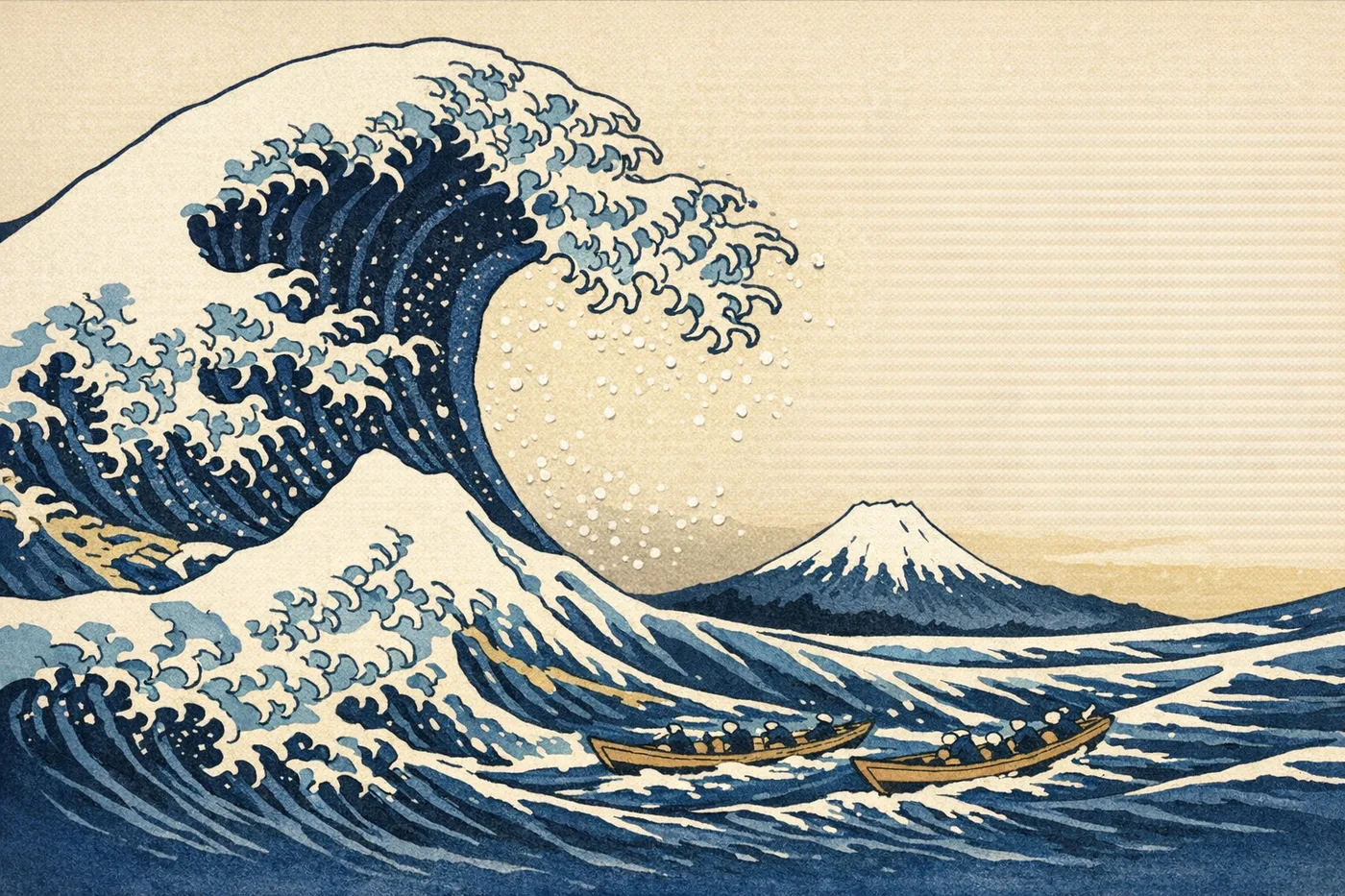

That is the first thing to know about composition guides. A guide that fits a picture proves that the picture has that structure, not that the structure is why the picture works, and a guide that fits everything, as the golden spiral tends to when it is stretched to the frame, explains nothing. The guides earn their place as questions: is the horizon really where I want it, does the eye go where I meant it to, is the weight on one side answered by anything on the other.
Four Guides, Four Questions
Each guide in the overlay tool asks one question well. The pages of this area take them one at a time, with the history, the measurement and the limit.
| Guide | What it draws | The question it asks | Where it comes from |
|---|---|---|---|
| Rule of thirds | Two lines each way at one and two thirds | Is the horizon, or the subject, parked in the middle by accident? | Named in 1797 by John Thomas Smith for the proportions of a landscape; adopted by photography as a framing default |
| Golden ratio and spiral | Lines at 0.382 and 0.618 of the frame; a spiral in nested golden rectangles | Where should the focal point sit, and does the eye travel towards it? | A real number with a real geometry, and a reputation in art that mostly does not survive checking |
| Leading lines and diagonals | The diagonals of the frame and their perpendiculars, meeting at the "eyes" of the rectangle | What carries the eye into the picture, and where does it arrive? | Jay Hambidge's dynamic symmetry of 1920, built on root rectangles |
| Symmetry and balance | The centre axis and the mirrored halves | Is the picture balanced, and if it is not symmetrical, what does the balancing? | As old as ornament; the bilateral and radial overlays make the axis visible |
What Is Measured, and What Is Habit
Some of what the guides say is arithmetic. The thirds are at 33 and 67 percent of the frame; the golden section falls at 38 and 62 percent; the two sets of lines are five percent of the frame apart, which on a Letter sheet is 14 millimetres. That is the whole difference between the two grids, and it is smaller than the margin most eyes can judge unaided. The diagonal of a rectangle and the perpendicular dropped onto it from a corner meet at a point that is fixed by the rectangle's proportions and nothing else. These things can be drawn, checked and disagreed with in numbers.
Some of what is said about the guides is habit, repeated from book to book without anyone going back to the source. The rule of thirds was proposed in 1797 as a proportion for landscape, one third land to two thirds water and sky, one third dark to two thirds light, and became a framing grid for cameras a century and a half later. The golden ratio is said to govern the Parthenon, the Great Pyramid and the Mona Lisa, and when a mathematician measured those claims in 1992 none of them held. A guide's history matters because the history is where the authority comes from, and a guide with an invented history is being obeyed for no reason.
None of this makes the guides useless. It puts them where they belong: as a check you run on a picture you have already composed by looking, to see whether what you wanted is what you drew.
Using a Guide on Your Own Reference
The composition overlay tool lays any of nine guides over a photograph in the browser, adjustable in colour and weight, with the golden spiral free to move onto the focal point instead of being stretched to the frame. The how-to walks through reading a guide against a subject. Once the crop is decided, the same picture takes a drawing grid, and the grid method carries the composition onto paper with its proportions intact. The overlay decides the picture; the grid transfers it.
Working order matters. Compose by looking first: move the frame until the picture feels right. Then switch a guide on and ask its one question. If the answer surprises you, you have learned something about your own eye. If it confirms what you saw, switch the guide off and draw.
Frequently Asked Questions
- What is composition in art?
- The arrangement of the elements of a picture within its frame: where the subject sits, where the eye lands first and travels next, what balances what. Guides such as the rule of thirds or the golden ratio are ways of measuring and talking about that arrangement, not rules a good picture must follow.
- What is the difference between the rule of thirds and the golden ratio?
- Where the lines fall. The thirds divide the frame at 33 and 67 percent; the golden section divides it at 38 and 62 percent. The two grids are five percent of the frame apart, about 14 millimetres on a Letter sheet, which is less than most eyes can judge without a ruler.
- Is the golden ratio really used in famous paintings?
- Rarely, on the evidence. The number is real and its geometry is exact, but the claims that it governs the Parthenon, the Great Pyramid or the Mona Lisa were measured by George Markowsky in 1992 and did not hold. A golden spiral that fits a picture shows the picture has a spiral-like structure, not that the artist used the ratio.
- Where does the rule of thirds come from?
- John Thomas Smith named it in his Remarks on Rural Scenery of 1797, as a proportion for landscape painting: about one third land to two thirds water and sky, and one third dark to two thirds light. Its use as a framing grid for photographs came much later.
- Which composition guide should I use?
- The one that asks the question you have. The thirds catch a horizon or subject parked in the middle by accident; the diagonals show what carries the eye and where it arrives; the axis of symmetry shows what is balancing what. Compose by looking first, then switch a guide on to check.
- Can I put a composition overlay on my own photo?
- Yes. The composition overlay tool draws nine guides over any photograph in the browser, and the picture never leaves it. The guide can be included in the exported grid at print resolution, so the printed reference carries the same lines.
Sources
- Remarks on Rural Scenery, John Thomas Smith, 1797. The earliest known use of the phrase 'rule of thirds', proposed for the proportions of a landscape and its light and shade.
- Misconceptions about the Golden Ratio, George Markowsky, The College Mathematics Journal 23(1), 1992, pages 2 to 19. Tests the claims that the golden ratio governs the Parthenon, the Great Pyramid and famous paintings, and finds them unsupported.
- Dynamic Symmetry: The Greek Vase, Jay Hambidge, Yale University Press, 1920. The root rectangles, their diagonals and reciprocals, from which the dynamic symmetry overlays are drawn.
- Under the Wave off Kanagawa (The Great Wave), The Metropolitan Museum of Art. Katsushika Hokusai, ca. 1830 to 1832, woodblock print.