The Golden Ratio in Art: the Number, the Spiral, and the Claims That Do Not Hold
The golden ratio is the number 1.618, written phi, and it has one property that makes it special: cut a length so that the whole is to the larger part as the larger part is to the smaller, and the ratio is phi. A rectangle with sides in that ratio can have a square cut from it and leave a smaller rectangle of the same shape, for ever, and a curve drawn through those squares is the golden spiral. All of that is true and exact. The claim that great art is built on it is a different kind of statement, and when it has been measured it has mostly failed. This page keeps the two apart.
The Section and the Spiral, Live
Below are the golden section grid, with its lines at 38 and 62 percent of the frame, and the golden spiral, nested into the lower right corner of our picture after Hokusai's Great Wave. Switch to the rule of thirds and back: the lines move by five percent of the frame, which on this picture is a few millimetres. The spiral is the one that gets shared, because a wave is a spiral-like curve and the two look made for each other.
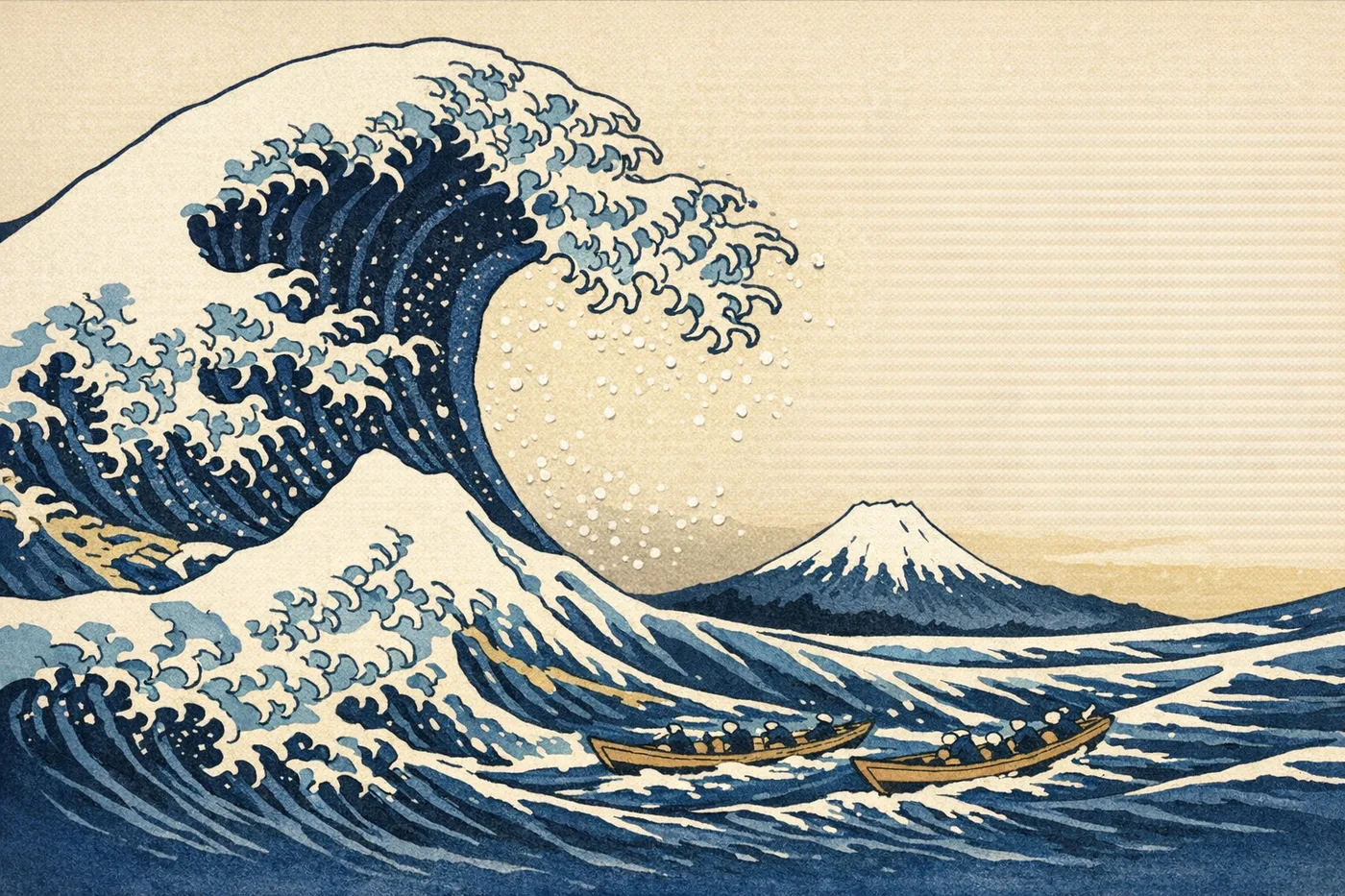

Look at what the spiral actually touches. Its outer arc follows the frame, because it was drawn to fill the frame; its inner turns land on whatever happens to be in that corner. Anchor it in another corner and it will find something to sit on there too. A spiral stretched to the frame fits every picture, and a guide that fits every picture tells you nothing about any of them. That is why the tool lets you move the spiral's eye onto the focal point instead: then it makes a claim that can be wrong.
What Is True: the Number and Its Geometry
Phi is the positive solution of x squared equals x plus one, which is 1.6180339. Its reciprocal is 0.618, and one minus that is 0.382; those two fractions are where the golden section grid divides the frame, the counterpart of the thirds at 0.333 and 0.667. The ratio appears in a regular pentagon, in the limit of the Fibonacci sequence, and in the golden rectangle, which is the only rectangle that leaves a rectangle of its own shape when a square is removed.
The spiral follows from the rectangle. Cut the square off, cut the next square off the remainder, and so on inward; a quarter circle drawn in each square joins into a curve that approximates a logarithmic spiral, tightening towards a point in the corner, the eye. The overlay tool draws exactly this, and in its filled mode it stretches the rectangles to the shape of the frame, which is why the arcs come out as ellipses on a picture that is not itself a golden rectangle. Hokusai's print, at roughly three to two, is not.
Every number in these two paragraphs can be checked with a ruler, and none of them is in dispute.
What Does Not Hold: the Parthenon, the Pyramid, the Mona Lisa
The claims about art are another matter, and it is worth knowing that they have been tested. In 1992 George Markowsky, a mathematician, went through the standard examples in a paper called Misconceptions about the Golden Ratio. The Parthenon fits a golden rectangle only if you choose which steps and which cornice to measure between, and other choices give other ratios. The Great Pyramid's proportions can be made to yield phi, and also pi, and also nothing, depending on the measurement selected. The rectangle drawn over the Mona Lisa's face is placed where it fits, with no evidence that Leonardo placed anything by it. Markowsky's conclusion is that the mathematics of phi is stated correctly almost everywhere and its history in art is mostly wrong.
The reason this matters for a drawing student is not pedantry. A guide borrows its authority from its history, and the golden ratio's authority in composition is borrowed from buildings and paintings that were not, on the evidence, built with it. Used as a check on a picture it is as good as the thirds, no better and no worse. Used as proof that a composition is right because a spiral can be laid on it, it is a way of not looking.
Hokusai is the clearest case. The print was made around 1830 by an artist working in a tradition with its own compositional habits, the spiral was laid over it on the internet nearly two centuries later, and the fit says only that the wave curls. It does.
The Exercise: Where the Spiral Makes a Claim
You need three photographs of your own with a clear focal point, the composition overlay tool, and twenty minutes.
- Load the first photograph and switch on the golden spiral in its default, filled state. Note what its eye lands on. Now change the corner. Note that again. In most pictures the eye lands on something in every corner, which is the first lesson: the filled spiral cannot miss.
- Move the spiral so that its eye sits exactly on your focal point, and scale it until the outer arc passes through the main shapes of the picture. Now it is making a claim: that the shapes lead in to the point along this curve. Look at whether they do. If the arc runs through empty space or cuts across the subject, the claim is false and the picture is composed some other way, which is fine.
- Switch to the golden section grid, then to the thirds. Measure with your eye how far the lines move. Decide whether you can tell the two apart at arm's length. Most people cannot, and that is the second lesson.
- Repeat with the other two photographs and write one sentence under each: what the spiral claimed, and whether the picture agreed.
The exercise does not teach you to compose with the golden ratio. It teaches you to tell a guide that describes your picture from one that merely fits it.
The Mistakes That Give It Away
- The stretched spiral as proof. A spiral drawn to the frame fits every picture. If it is offered as evidence that a composition works, the evidence is empty.
- Phi as a substitute for a decision. Placing the horizon at 62 percent because a book said so is the same undecided placement the rule of thirds exists to catch, with a more impressive number.
- Borrowed history. Telling a class that the Greeks built the Parthenon on phi. They may have used proportion carefully; the specific claim did not survive measurement.
- Confusing the rectangle with the picture. The spiral's geometry assumes a golden rectangle. On a 3:2 photograph or a 4:3 sheet the filled spiral is stretched into ellipses and is no longer the golden spiral at all.
- Mistaking a spiral-like subject for a spiral-built one. Waves, shells and staircases curl. A guide that follows the curl has found the subject, not the composition.
Next
The grid five percent away, with a history that is at least real: the rule of thirds. The other construction from the same era of proportion theory, and what it actually measures: leading lines and dynamic symmetry. Balance without a formula: symmetry and balance. All of it in one place on the composition overview.
Frequently Asked Questions
- What is the golden ratio?
- The number 1.618, called phi: the ratio at which a length is cut so that the whole is to the larger part as the larger part is to the smaller. A rectangle with sides in that ratio yields a smaller rectangle of the same shape when a square is removed, and a curve through those squares is the golden spiral.
- Is the golden ratio used in famous art?
- The standard claims, the Parthenon, the Great Pyramid, the Mona Lisa, were measured by George Markowsky in 1992 and did not hold; they depend on choosing where to measure. Some artists have used the ratio deliberately, but a spiral that fits a picture is not evidence that the artist did.
- What is the difference between the golden ratio and the rule of thirds?
- The golden section divides the frame at 38 and 62 percent, the thirds at 33 and 67. Five percent of the frame apart, which is about 14 millimetres on a Letter sheet and less than most eyes judge unaided. As composition checks they are interchangeable.
- How do I use the golden spiral properly?
- Move its eye onto the focal point and scale it so the outer arc runs through the main shapes, then look at whether the shapes really lead in along the curve. A spiral stretched to fill the frame fits every picture and shows nothing.
- Does the golden spiral fit Hokusai's Great Wave?
- It can be laid over it, as over most pictures with a curling shape, and the fit shows that the wave curls. The print was made around 1830 in a tradition with its own habits of composition; there is no evidence Hokusai used the ratio.
- Is a 3:2 photograph a golden rectangle?
- No. A golden rectangle is 1.618 to 1; a 3:2 frame is 1.5 to 1 and a 4:3 frame is 1.333 to 1. A golden spiral stretched to fill either frame is drawn in ellipses and is no longer the golden spiral.
Sources
- Misconceptions about the Golden Ratio, George Markowsky, The College Mathematics Journal 23(1), 1992, pages 2 to 19. Tests the claims that the golden ratio governs the Parthenon, the Great Pyramid and famous paintings, and finds them unsupported.
- Under the Wave off Kanagawa (The Great Wave), The Metropolitan Museum of Art. Katsushika Hokusai, ca. 1830 to 1832, woodblock print.
- Dynamic Symmetry: The Greek Vase, Jay Hambidge, Yale University Press, 1920. The root rectangles, their diagonals and reciprocals, from which the dynamic symmetry overlays are drawn.