The Rule of Thirds: What It Says, Where It Came From, and When to Break It
The rule of thirds divides a picture into three equal parts each way, with two lines across and two down, and says: put horizons and other strong lines on a third line rather than through the middle, and put the subject near one of the four crossings rather than in the centre. That is the whole rule. It is a default, not a law, and its real use is as a question: is this thing in the middle because I put it there, or because the middle is where things land when nobody decides?
The Grid, Live
Below, the thirds are drawn over our picture after Hokusai's Great Wave, which keeps the print's arrangement. The crest of the wave rises in the upper left third of the frame; Mount Fuji sits low and right of centre, its base on the lower third line; the boats ride the swell below it. Switch the overlay off and the arrangement is still there. Switch it on and you can say where things are in numbers.
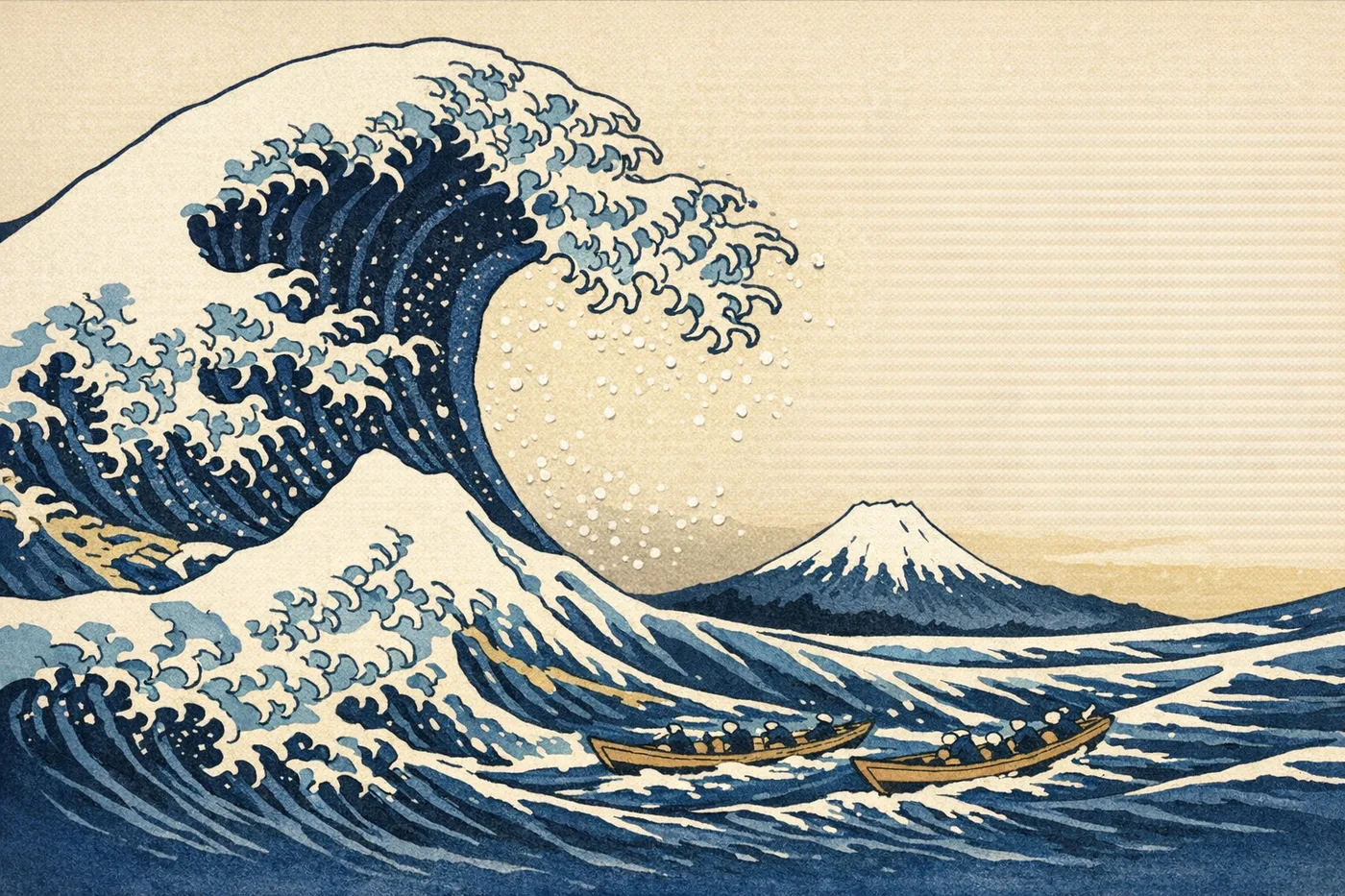

Try the centre cross as well. It marks what the rule of thirds is steering you away from: a horizon that cuts the picture in half, a subject dead centre with equal nothing on both sides. Neither is wrong, as the last section of this page argues, but both should be chosen, and the thirds are a way of noticing when they were not.
What the Rule Actually Asks
The rule has two parts, and they answer two different questions.
The lines are for the long horizontals and verticals of a picture: a horizon, a shoreline, a wall, a standing figure. A horizon through the middle gives sky and ground equal weight, which reads as indecision unless the equality is the subject. A horizon on the lower third gives the picture to the sky; on the upper third, to the ground. The rule says: decide, and the third lines are two decisions that usually work.
The crossings are for the focal point: the eye of a portrait, the head of a figure, the bright window in a dark room. A subject on a crossing leaves room on one side, and that room is where the picture gets to say something about where the subject is looking, moving or coming from. A subject in the centre leaves equal room on every side, and equal room says nothing.
Neither part is exact. Nobody can see the difference between 33 and 38 percent of a frame at arm's length, which is why the golden section grid, five percent away, works exactly as well or as badly. The thirds are easy to estimate without a ruler, and that is their advantage over every subtler division.
Where It Came From
The phrase is older than photography. In 1797 John Thomas Smith, an English engraver, published Remarks on Rural Scenery, a book of etched cottages with observations on the picturesque, and in it he proposed a "rule of thirds" for landscape: roughly one third land to two thirds water and sky, and one third dark to two thirds light, on the principle, which he takes from Joshua Reynolds, that equal divisions are the least pleasing. He was writing about proportion in a painting, not about where to put a horizon in a viewfinder.
The grid of two lines each way, and the four crossings for the subject, is a much later reading, taken up by photography manuals once cameras had frames to compose in and, eventually, screens to draw the lines on. Smith would recognise the idea of avoiding the half; the crossings would be news to him. It is worth knowing that the rule most people learn as ancient wisdom is a nineteenth and twentieth century simplification of a remark about landscape.
The Exercise: a Viewfinder and Twelve Frames
Cut a rectangle 9 by 6 centimetres out of a piece of card. Mark the thirds on its edges: 3 and 6 centimetres along the long sides, 2 and 4 along the short sides. Take a pencil and a small sketchbook and half an hour outdoors or at a window.
- Frame a scene with a horizon through the viewfinder at arm's length. Put the horizon in the middle, then on the lower mark, then on the upper mark. Draw the three as thumbnails, 4.5 by 3 centimetres each, nothing but the horizon and two or three shapes. Write under each which one you would keep and why.
- Frame a single object, a tree, a lamp, a person. Put it dead centre, then on a left crossing, then on a right crossing. Three more thumbnails. Notice what the empty side does in each.
- Break it on purpose. Find a subject that wants the centre: a doorway seen square on, a face looking straight at you, a symmetrical building. Draw it centred. Then move it to a crossing and draw it again. One of the two will look wrong, and it will not always be the centred one.
- Check with the overlay. Photograph the three scenes, load them into the composition overlay tool, switch the thirds on, and compare where things fell with where you meant them to fall. The gap between the two is what the exercise is measuring.
Twelve thumbnails, half an hour, and the rule has stopped being a rule and become three or four things you have seen for yourself.
When the Centre Is the Right Answer
- Symmetry. A face looking straight out, a facade seen head on, a reflection in still water. Symmetry is a composition in its own right, and it wants the axis in the middle. Moving it to a third breaks the one thing the picture has. The symmetry page takes this further.
- Confrontation. A subject placed centrally and close reads as direct, sometimes uncomfortably so. Portrait painters have used that for centuries; it is a choice, not a mistake.
- A frame within the frame. A view through a doorway or a window is often strongest with the opening centred and the scene beyond it doing the composing.
- Very small subjects. A single boat on a wide sea can sit anywhere the sea lets it; the thirds matter less than the amount of sea.
- Movement. A subject moving or looking into the picture wants room in front of it, which usually means a crossing on the side it is coming from. The rule agrees, but the reason is the room, not the line.
The test in every case is the same: was the placement decided? The rule of thirds is a way of catching the undecided middle. Once the middle is chosen, the rule has done its work and can be switched off.
Next
The grid five percent away from this one, and why its reputation is mostly borrowed: the golden ratio. What carries the eye across the lines rather than resting on them: leading lines and diagonals. The centre, taken seriously: symmetry and balance. All four guides in one place, with what each decides, on the composition overview.
Frequently Asked Questions
- What is the rule of thirds?
- A composition guide that divides the frame into three equal parts each way with two lines across and two down. Long lines such as horizons go on a third line rather than through the middle, and the subject goes near one of the four crossings rather than in the centre. It is a default that catches undecided placement, not a law.
- Who invented the rule of thirds?
- The phrase first appears in John Thomas Smith's Remarks on Rural Scenery of 1797, as a proportion for landscape painting: about one third land to two thirds water and sky, one third dark to two thirds light. The framing grid with four crossings for the subject is a later reading adopted by photography.
- Is the rule of thirds the same as the golden ratio?
- No, but they are close. The thirds fall at 33 and 67 percent of the frame; the golden section at 38 and 62 percent. Five percent of the frame apart, which is less than the eye judges unaided, so in practice they ask the same question.
- When should I ignore the rule of thirds?
- When the picture is symmetrical, when a centred subject is meant to confront the viewer, when a doorway or window frames the scene, and whenever the centre was chosen rather than defaulted to. The rule exists to catch the undecided middle, not to forbid the middle.
- Does the rule of thirds apply to drawing as well as photography?
- Yes. It came from painting before photography existed. In drawing it is applied when the crop of the reference is chosen, before the grid goes on: lay the thirds over the photograph, decide the frame, then transfer with the grid.
- How do I use the rule of thirds on my own photo?
- Load the photograph into the composition overlay tool, switch on the rule of thirds, and see where the horizon and the subject fall. Move the crop until they fall where you intend, then export with or without the lines.
Sources
- Remarks on Rural Scenery, John Thomas Smith, 1797. The earliest known use of the phrase 'rule of thirds', proposed for the proportions of a landscape and its light and shade.
- Under the Wave off Kanagawa (The Great Wave), The Metropolitan Museum of Art. Katsushika Hokusai, ca. 1830 to 1832, woodblock print.
- Misconceptions about the Golden Ratio, George Markowsky, The College Mathematics Journal 23(1), 1992, pages 2 to 19. Tests the claims that the golden ratio governs the Parthenon, the Great Pyramid and famous paintings, and finds them unsupported.