Symmetry and Balance: What Holds a Picture Still
Balance is the feeling that a picture would not tip over: whatever weight sits on one side is answered by something on the other. Symmetry is the simplest way to get it, a mirror across a vertical or horizontal axis, and the most demanding, because the eye finds the smallest departure from a mirror at once. Most pictures balance without symmetry. They set a large quiet shape against a small loud one, a mass against a distance, a dark against a light, and the scales come level without either side looking like the other. This page is about both, and about how to see which one a picture is using.
The Axis, Live
Below, the axis of bilateral symmetry is drawn over our picture after Hokusai's Great Wave. The arrangement could hardly be less symmetrical: the wave fills the left half and towers, the right half is sky and a small mountain. Yet it does not tip. Switch the overlay off and look at what answers the wave. Fuji is tiny, but it is the only still thing in the picture, it sits near the centre, and the whole wave points at it. Mass on one side, meaning on the other. That is balance without symmetry.
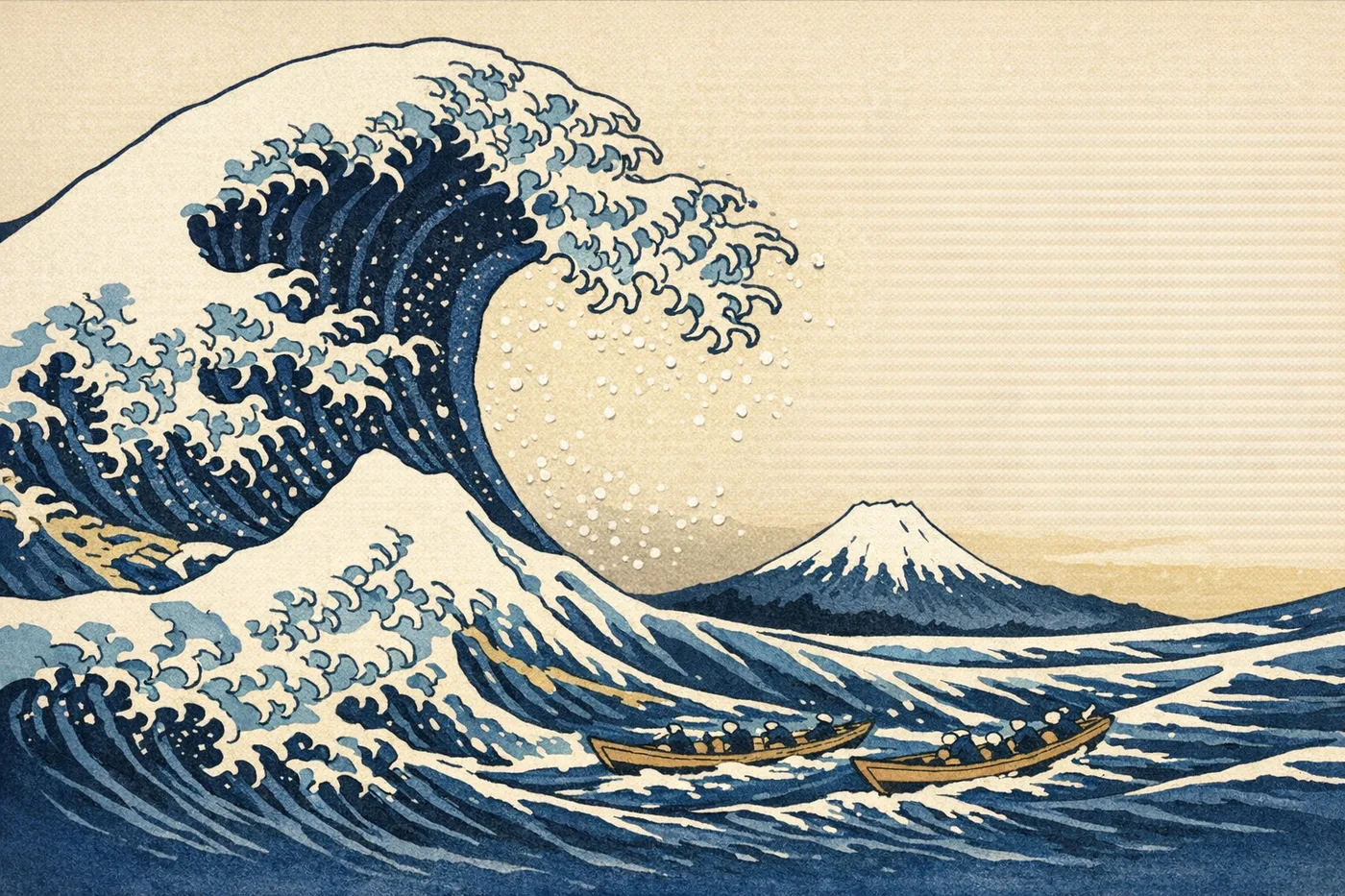

The radial overlay is for a different kind of picture, a mandala, a rose window, a flower seen from above, where the balance is around a centre rather than across an axis. Laid over the wave it shows how far this picture is from that: nothing here radiates. The overlays are diagnostic. They tell you which family a composition belongs to, and the wave belongs to the asymmetric one.
Visual Weight
Balance is about weight, and visual weight is not size. A shape weighs more when it is large, when it is dark against light or light against dark, when it is saturated, when it is detailed, when it is a face or a figure, and when it is far from the centre, because the centre is the fulcrum and a weight far from a fulcrum tips harder. A small dark figure at the edge of a frame can outweigh a large pale wall in the middle; a single red boat balances a grey sea.
This is why symmetry is the special case and not the rule. Two shapes of equal weight at equal distances from the axis balance, and that is a mirror. A large shape near the axis and a small shape far from it also balance, as a heavy child and a light one do on a see-saw, and that is most of the pictures ever made. The Great Wave is the see-saw with a huge child sitting almost at the pivot and a very small one at the far end: the wave is enormous and central, Fuji is minute and, as the one still, meaningful thing, weighs enough.
Weight can also be direction. A figure looking left pulls the eye left, and the space it looks into fills up with attention; that is why a portrait facing left wants room on the left and looks cramped without it. The leading lines page covers this as movement; here it is a weight to be answered.
Symmetry, Taken Seriously
When a subject is symmetrical, a face looking straight out, a facade seen head on, a vase, a reflection, the picture usually wants the axis in the middle, and the rule of thirds is the wrong tool. Symmetry is a composition, not a failure to compose; its effect is stillness, formality, confrontation, and it has been used for those effects since there were pictures. What it demands is exactness. The eye registers a departure from mirror symmetry of a few percent, so a nearly symmetrical picture reads as a mistake, where a frankly asymmetric one reads as a choice. Either be symmetrical or be clearly not.
The bilateral overlay in the tool draws the axis and marks the mirrored half-frames, which is the test: does the left half predict the right? A vertical axis is the common case; a horizontal one is the reflection in water, and the overlay can be turned to it. A symmetrical picture often carries one deliberate break, a single figure off axis, a shadow on one side, and the break is where the eye goes. That is a composition in which symmetry does the holding and one asymmetry does the pointing.
The idea that equal division is the least pleasing arrangement is older than any of these overlays; John Thomas Smith quotes Joshua Reynolds on it in 1797, in the same passage that names the rule of thirds. It is a useful default and a poor law, because the pictures that break it on purpose are among the most powerful there are.
The Exercise: Balance Three Shapes
Cut from black paper one large rectangle, about 6 by 4 centimetres, one medium circle, about 3 centimetres across, and one small square of 1.5 centimetres. Take a sheet of white paper, Letter or A4, and rule a light vertical axis through its centre. Twenty minutes and no glue until the end.
- Mirror it. Place the large rectangle on the axis and the circle and square at equal distances either side. It balances and it is dull. Note both.
- Tip it. Move the rectangle 4 centimetres to the left of the axis. The sheet tips left. Now find, by sliding, where the small square alone has to sit on the right to bring it level. It will be far out, near the edge: a small weight far from the fulcrum.
- Balance with weight rather than distance. Take the square away and use the circle instead. It balances closer to the axis. Measure both distances and write them on the sheet.
- Add a direction. Draw a small arrow on the square pointing left, towards the rectangle, and place it where it balanced before. Now point the arrow right, off the sheet. The second arrangement leaks; move the square until it stops. Direction is weight.
- Glue the one you like and photograph it. Load it into the composition overlay tool, switch on the bilateral axis and then the thirds, and see whether the arrangement you reached by feel lands anywhere near the lines. It often does not, and that is fine.
The exercise puts the see-saw in your hands. After it, "the picture feels heavy on the left" stops being a vague complaint and becomes a question with two answers: move something in, or put something out.
The Two Ways a Picture Falls Over
- Everything on one side. The subject, the darkest dark and the most detail all in one half, and nothing across the axis to answer them. The eye piles up on that side and the picture tips. The remedy is a counterweight: small, far from the centre, and if possible meaningful, as Fuji is.
- Everything in the middle. The subject centred, the tones even, no weight anywhere. The picture does not tip; it does not do anything. This is the failure the rule of thirds catches, and the remedy is to choose a side and then answer it.
- Almost symmetrical. A facade a few percent off axis, a face turned two degrees. Reads as an error because the mirror is promised and not kept. Either straighten it or turn it clearly.
- Weight ignored in favour of size. A large pale shape treated as heavy and a small dark one as light. Squint at the picture: what stays visible is what weighs.
- A gaze into the wall. A figure looking towards the near frame edge, with the empty space behind it. The weight of the look is unanswered and the space is wasted.
Next
The default that catches the undecided middle: the rule of thirds. What carries the eye across a picture before balance holds it: leading lines and diagonals. The number that promised more than it delivers: the golden ratio. All four guides in one place on the composition overview.
Frequently Asked Questions
- What is balance in composition?
- The sense that a picture would not tip: the visual weight on one side of the frame is answered on the other. Symmetry achieves it with a mirror; most pictures achieve it by setting unequal weights at unequal distances from the centre, like a see-saw.
- What is visual weight?
- How strongly a shape pulls the eye. Size, darkness against light, saturation, detail, being a face or figure, and distance from the centre all add weight. A small dark figure at the edge can outweigh a large pale wall in the middle.
- Is symmetry bad composition?
- No. Symmetry is a composition in its own right, with effects of stillness and formality that nothing else gives. Its demand is exactness: a nearly symmetrical picture reads as a mistake, a clearly symmetrical or clearly asymmetrical one reads as a choice.
- How does Hokusai's Great Wave stay balanced?
- The wave fills the left half and towers; Fuji on the right is tiny. But Fuji is the only still thing in the picture, sits near the centre, and the whole wave points at it. Mass on one side is answered by meaning on the other, which is balance without symmetry.
- When should a subject be centred?
- When the subject is symmetrical or meant to confront the viewer: a face looking straight out, a facade seen head on, a doorway. Centre it exactly. A subject nearly centred by accident is what the rule of thirds exists to catch.
- How do I check the balance of my own picture?
- Squint until the detail goes and see which side stays dark and heavy; then load the picture into the composition overlay tool, switch on the bilateral axis, and ask what on the light side answers the heavy side. If nothing does, add a small counterweight far from the centre or move the crop.
Sources
- Under the Wave off Kanagawa (The Great Wave), The Metropolitan Museum of Art. Katsushika Hokusai, ca. 1830 to 1832, woodblock print.
- Remarks on Rural Scenery, John Thomas Smith, 1797. The earliest known use of the phrase 'rule of thirds', proposed for the proportions of a landscape and its light and shade.
- Dynamic Symmetry: The Greek Vase, Jay Hambidge, Yale University Press, 1920. The root rectangles, their diagonals and reciprocals, from which the dynamic symmetry overlays are drawn.