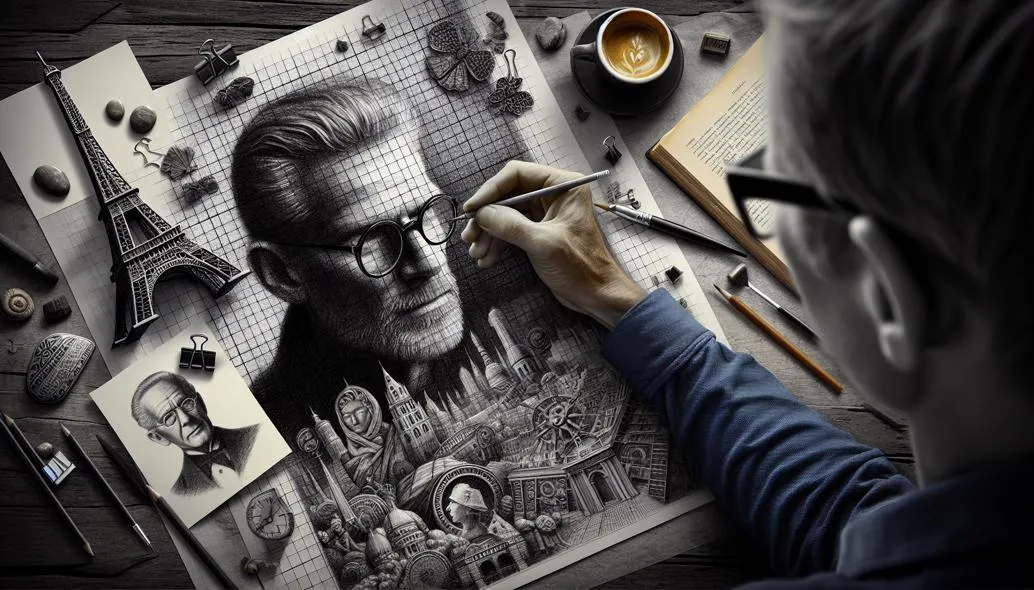
Charcoal's dramatic range and expressive qualities make it ideal for powerful drawings, yet controlling this medium requires precision. The grid method provides structure for achieving accuracy while preserving charcoal's spontaneous, gestural nature.
Charcoal stands as one of the oldest and most expressive drawing mediums known to artists. From prehistoric cave paintings to contemporary gallery works, charcoal continues to captivate artists with its immediacy, versatility, and dramatic potential. The medium's unique ability to produce everything from whisper-soft grays to velvety blacks makes it indispensable for creating powerful, emotive drawings. However, this very expressiveness can also present challenges—charcoal's bold nature and tendency to spread can make precise control difficult, especially for those developing their skills.
The grid method offers an elegant solution to these challenges, providing a structured framework that enhances accuracy without sacrificing the medium's inherent spontaneity. By combining the systematic approach of grid drawing with charcoal's expressive qualities, artists can achieve remarkable results that balance precision with artistic freedom. This comprehensive guide explores how to effectively integrate grid techniques into charcoal drawing practice, addressing everything from material selection to advanced application methods. For those new to grid methods, the basics of grid drawing for beginners provides essential foundations.
Understanding Charcoal as a Drawing Medium
If you’re working in charcoal, a grid helps you lock placement early so you can spend your energy on values and edges. You can create a reference grid with our grid for drawing.
Charcoal exists in several forms, each offering distinct properties and applications. Understanding these variations helps artists make informed choices when planning grid-based drawings.
The Nature of Charcoal
Charcoal consists of carbon residue produced by burning organic material in the absence of oxygen. This process, called pyrolysis, creates a drawing medium that transfers easily to paper while offering remarkable tonal range. The physical structure of charcoal—porous and friable—allows it to deposit particles into paper fibers, creating marks that can range from delicate wisps to bold, saturated strokes.
The medium's responsiveness to touch makes it particularly suited for expressive work. Slight variations in pressure, angle, or movement produce dramatically different effects. This sensitivity, while offering creative possibilities, also demands careful control—precisely where the grid method proves invaluable.
Types of Charcoal and Their Properties
Vine and Willow Charcoal represent the softest, most delicate forms of the medium. Created from grape vines or willow branches, these charcoals produce light, easily erasable marks ideal for initial sketching and grid establishment. Their gentle nature preserves paper surface, allowing for extensive reworking. Artists often begin grid layouts with willow charcoal, as mistakes can be corrected without damaging the drawing surface.
Compressed Charcoal offers intensity and permanence. Manufactured by combining charcoal powder with binding agents, compressed charcoal creates rich, velvety blacks that adhere strongly to paper. Available in various hardness grades, compressed charcoal excels at creating dramatic contrasts and deep shadows. However, its intensity requires confident application, as corrections prove more challenging than with willow charcoal.
Charcoal Pencils provide the control of traditional pencils with charcoal's distinctive qualities. Encased in wood or paper, charcoal pencils range from hard (H) grades for precise lines to soft (B) grades for broader coverage. These tools prove particularly useful for creating and maintaining grid lines, as they offer predictable, controlled application. The 2B-8B range serves most drawing needs, with harder grades (H-2B) reserved for initial grid work and fine details.
Powdered Charcoal enables coverage of large areas quickly and evenly. Applied with brushes, chamois, or fingers, charcoal powder creates atmospheric effects and smooth gradations. When working with grids, powdered charcoal can establish tonal foundations before detailed work begins. A discovery during a large mural project: applying powdered charcoal with a wide, soft brush across multiple grid squares simultaneously creates seamless atmospheric backgrounds that would take hours to achieve with stick charcoal.
Working Properties and Challenges
Charcoal's working properties present both opportunities and challenges. The medium's ability to cover large areas quickly makes it efficient for establishing values and creating dramatic effects. Its compatibility with various blending tools—from traditional stumps to household tissues—offers endless possibilities for creating subtle transitions and atmospheric effects.
However, charcoal also presents specific challenges. Its tendency to smudge requires careful hand positioning and protective measures. The medium produces considerable dust, necessitating proper workspace preparation and cleaning protocols. Additionally, charcoal's bold nature can overwhelm delicate details, requiring strategic planning to preserve areas of refinement within broader, expressive passages.
Essential Materials for Grid-Based Charcoal Drawing
Successful charcoal drawing with grids requires thoughtful material selection. Each component plays a crucial role in achieving desired effects while maintaining the precision that grid work demands.
Paper Selection and Preparation
The foundation of any charcoal drawing lies in paper choice. Charcoal performs best on papers with sufficient tooth (texture) to grip the medium's particles. However, excessive texture can interfere with grid visibility and precision.
Ideal Paper Characteristics include medium to rough tooth that provides adequate grip without overwhelming detail work. Papers weighing 140 pounds or heavier resist buckling and withstand extensive working and reworking. The surface should tolerate repeated erasure without deteriorating, as grid adjustments and corrections are inevitable parts of the process.
Toned Papers offer particular advantages for charcoal work. Light gray or cream papers provide a middle value, allowing artists to work both lighter (with erasure or white charcoal) and darker (with standard charcoal). This approach proves especially effective when using grids, as the toned ground helps unify the drawing while grid lines remain visible against the subtle background.
Surface Preparation can enhance charcoal reception and grid visibility. Some artists lightly sand papers to modify texture, while others apply fixative layers to create specific working surfaces. When preparing surfaces for grid work, consistency across the entire sheet ensures predictable charcoal behavior in every grid square.
Comprehensive Tool Selection
Beyond charcoal itself, successful grid-based drawings require supporting tools that enhance control and expand creative possibilities.
Blending Implements transform charcoal's granular deposits into smooth tones. Chamois leather excels at covering large areas quickly, creating atmospheric effects that can span multiple grid squares seamlessly. Blending stumps offer precision for smaller areas, allowing careful tonal transitions within individual grid sections. Soft brushes move charcoal powder without disturbing established marks, while facial tissues provide the gentlest blending option for subtle effects.
Erasure Tools serve dual purposes in charcoal grid work: correcting mistakes and creating highlights. Kneaded erasers lift charcoal gently without abrading paper, making them ideal for lightening values or creating soft highlights. Their moldable nature allows precise work within grid constraints. Vinyl erasers remove charcoal more aggressively, useful for recovering paper white or creating sharp highlights. Electric erasers offer ultimate precision, capable of creating fine lines and detailed highlights within complex grid arrangements. Erasure shields—thin metal or plastic templates—protect surrounding areas while allowing targeted erasure within specific grid sections.
Grid-Specific Tools enhance precision when working with charcoal. A breakthrough came from using a grid drawing app on a tablet positioned beside the easel. The digital grid could be adjusted instantly, zoomed for detail work, and overlaid with value notations without cluttering the actual drawing. This hybrid approach maintains traditional charcoal techniques while leveraging modern tools for planning and reference.
Drawing Aids enhance precision and efficiency. Rulers and straightedges ensure accurate grid creation, while proportional dividers help transfer measurements from reference to drawing. Viewing frames isolate specific grid sections for focused work, and value scales provide objective tonal references throughout the drawing process.
Strategic Grid Planning for Charcoal Work
The grid method's effectiveness in charcoal drawing depends largely on thoughtful planning and preparation. Unlike pencil or pen work, charcoal's bold nature and tendency to spread require specific considerations when establishing and maintaining grids.
Initial Grid Establishment
Creating grids for charcoal work demands balance between visibility and subtlety. Grid lines must remain visible enough to guide the drawing process yet not interfere with the finished work's impact.
Line Weight Considerations prove crucial. Hard charcoal pencils (2H or harder) create precise, light lines that won't compete with subsequent charcoal application. Some artists prefer using graphite pencils for grid lines, as their cooler tone distinguishes them from charcoal's warm blacks. The pressure applied when creating grid lines affects their persistence—light pressure allows lines to integrate naturally into the drawing, while heavier pressure may create distracting marks that resist coverage.
Grid Density Decisions depend on subject complexity and desired precision. Portrait work often benefits from finer grids (12x16 or more squares) to capture subtle facial features accurately. Figure drawings might use moderate grids (8x10 squares) that provide proportional guidance without constraining gestural freedom. Landscape or abstract subjects may require only basic grids (6x8 squares) for compositional placement.
Adapting Grids to Charcoal Techniques
Charcoal's various application methods require flexible grid approaches. The medium's ability to create both precise lines and broad atmospheric effects means grid usage must adapt to intended techniques.
For Linear Work, maintain crisp grid intersections as reference points. These markers help ensure accurate placement of contour lines and detailed features. Consider reinforcing key grid points with small dots that remain visible through subsequent charcoal application. When creating architectural drawings, using a T-square aligned with grid horizontals ensures perfectly straight structural lines while maintaining the drawing's organic quality in textural areas.
For Tonal Work, view grid squares as value zones rather than rigid boundaries. Plan value distribution across the grid, noting which squares will contain the darkest darks, lightest lights, and transitional middle values. This approach maintains overall compositional coherence while allowing organic tonal development. A value numbering system (1-10) noted lightly in each square's corner provides constant reference without interfering with the drawing's visual flow.
For Gestural Application, use the grid as a proportional guide while allowing marks to flow naturally across boundaries. The grid provides underlying structure without constraining the expressive qualities that make charcoal compelling. Key anatomical points or compositional elements should align with grid intersections, but connecting marks can move freely. During life drawing sessions, marking only major anatomical landmarks on the grid—shoulders, hips, knees—provides sufficient structure while preserving gestural energy.
Advanced Grid Strategies for Charcoal Drawing
Understanding how grids interact with charcoal's unique properties enables artists to develop sophisticated approaches that enhance both accuracy and expression.
Value Mapping Within Grid Structure
One of charcoal's greatest strengths lies in its tonal range. The grid method can enhance this capability by providing a framework for systematic value development.
Creating Value Maps involves analyzing reference images to identify value patterns across the grid. Each square receives a value designation from 1 (lightest) to 10 (darkest). This numerical approach removes guesswork from value placement and ensures proper tonal relationships throughout the drawing. During a complex still life with metallic objects, this systematic approach proved essential. The reflective surfaces created confusing value patterns that seemed random until mapped numerically across the grid. Once each square had its value assignment, the metallic forms emerged logically, with highlights and reflections falling precisely where physics demanded.
Progressive Value Building works particularly well with charcoal's layering capabilities. Beginning with middle values across all relevant grid squares establishes a tonal foundation. Subsequent passes deepen darks and refine lights, always maintaining awareness of how values in adjacent squares relate. This methodical approach prevents the common mistake of making areas too dark too quickly—a particular risk with charcoal's intensity.
Edge Quality Planning within the grid framework helps artists achieve sophisticated transitions. Charcoal excels at both sharp and soft edges, and planning these variations during grid setup enhances the drawing's visual impact. Note where crisp edges define forms and where soft transitions suggest atmosphere or rounded surfaces.
Maintaining Grid Reference During Work
As charcoal application progresses, maintaining grid visibility becomes increasingly challenging. Several strategies help preserve this crucial reference system.
Strategic Reinforcement involves periodically strengthening key grid intersections. Using a hard charcoal pencil or even a graphite pencil, artists can subtly reinforce important grid points without disrupting the drawing's tonal development. Focus on reinforcing intersections at major anatomical landmarks, compositional focal points, or areas requiring precise alignment.
External Grid References provide backup when drawing grids become obscured. A practical solution emerged during an intense workshop: creating acetate overlay grids. These transparent sheets, marked with the identical grid used on the drawing, could be placed over the work to check alignment without touching the charcoal surface. This tool proved particularly valuable when working on large-scale pieces where stepping back for perspective wasn't always possible.
Photographic Documentation serves multiple purposes. Regular progress photos not only track development but also preserve grid visibility at various stages. When grid lines become too faint, these photos provide reference for maintaining proportional accuracy. Digital images can be enhanced to reveal faint grid lines that might be difficult to see on the actual drawing.
Charcoal Application Techniques Within Grid Framework
The systematic nature of grid drawing combines powerfully with charcoal's expressive capabilities. Understanding how to apply charcoal within grid constraints while maintaining the medium's dynamic qualities distinguishes competent work from masterful execution.
Progressive Value Development
Charcoal's capacity for rich tonal variation makes it ideal for creating dimensional, atmospheric drawings. The grid method enhances this capability by providing structure for methodical value building.
The Foundation Layer establishes overall tonal relationships. Using willow charcoal or hard compressed charcoal, artists block in basic values across the entire grid. This stage focuses on general placement rather than refinement—each grid square receives its approximate value without concern for internal details. Working broadly at this stage prevents premature detail that might disrupt overall unity. A technique discovered through experimentation: using the side of vine charcoal held at a low angle creates consistent, even coverage across multiple grid squares, establishing unified tonal areas efficiently.
Middle Value Refinement forms the drawing's core structure. Using medium-grade charcoal, artists develop form within each grid square while maintaining awareness of adjacent values. This stage requires constant comparison—checking that values in one square relate properly to surrounding areas. The grid structure facilitates these comparisons by providing clear boundaries for evaluation.
Dark Accent Application brings drama and depth to the drawing. Compressed charcoal or soft charcoal pencils create the deepest values, applied selectively for maximum impact. The grid helps identify where these powerful darks belong—typically at points of deepest shadow or where maximum contrast enhances focal areas. Restraint proves crucial; charcoal's intensity means a little darkness goes far. The final application should use a harder pencil (2B) to solidify these dark passages and prevent smudging.
Highlight Development through erasure represents charcoal's unique advantage. Unlike media that require white pigment for lights, charcoal allows artists to retrieve paper brightness through strategic removal. Within the grid framework, highlights can be planned and executed precisely. Kneaded erasers lift charcoal gently for soft highlights, while electric erasers create sharp, brilliant accents. A critical insight: marking highlight locations with tiny dots before any charcoal application ensures these crucial light areas remain untouched and brilliant.
Working Methods for Grid Coherence
Different approaches to grid-based charcoal application suit various subjects and artistic goals.
The Sequential Method involves completing each grid square fully before moving to the next. This approach ensures thorough development and helps maintain concentration on specific areas. However, it requires careful planning to ensure squares integrate seamlessly. Artists using this method often complete squares in a specific order—perhaps following the path of light across the subject or working from focal points outward.
The Layered Approach treats the entire grid as a unified surface, building values gradually across all squares simultaneously. This method excels at creating atmospheric effects and ensuring tonal unity. Initial layers establish basic values throughout, with subsequent passes adding refinement and detail. This approach mirrors traditional painting techniques and suits artists comfortable with seeing the whole before refining parts.
The Hybrid Strategy combines both methods strategically. Perhaps backgrounds receive layered treatment for atmospheric unity, while focal areas like faces or hands benefit from square-by-square precision. This flexible approach adapts to subject requirements and leverages both methods' strengths.
Managing Charcoal's Physical Properties
Charcoal's tendency to spread and smudge requires specific handling strategies within grid frameworks.
Hand Position and Support prevent accidental smudging. A mahl stick or bridge support keeps the drawing hand elevated above the surface. When this isn't practical, a clean paper sheet placed under the hand protects completed areas. Some artists work systematically from top to bottom and left to right (reversed for left-handed artists) to minimize contact with finished sections.
Fixative Application between stages preserves work while allowing continued development. Workable fixatives permit additional charcoal application over fixed areas, essential for complex grid-based drawings requiring multiple sessions. Light fixative application between major value shifts prevents unwanted blending while maintaining the surface's receptivity to additional charcoal.
Dust Management keeps both drawing and workspace clean. Regularly tapping the drawing vertically allows excess charcoal dust to fall away rather than settling into unintended areas. Compressed air (used gently) can remove dust from specific grid squares without disturbing established work. A small vacuum or drafting brush helps maintain clean margins and prevents dust from migrating across grid boundaries.
Advanced Charcoal Grid Techniques
Mastery of basic grid and charcoal techniques opens doors to sophisticated applications that elevate drawings from competent studies to compelling artworks.
Creating Atmospheric Depth
Charcoal's tonal range makes it exceptionally suited for atmospheric perspective—the phenomenon where distant objects appear lighter and less distinct than near ones. The grid method enhances this effect by providing structure for systematic value gradation.
Foreground Development utilizes charcoal's full potential. Grid squares containing foreground elements receive the complete value range, from brilliant highlights to rich blacks. Textures appear at full intensity, with sharp edges defining forms clearly. The grid helps maintain consistent treatment across foreground areas, ensuring they read as a cohesive spatial plane.
Apply compressed charcoal boldly in foreground squares, allowing the medium's granular texture to suggest surface qualities. Sharp contrasts between adjacent values create visual weight that pulls elements forward. Edge quality remains crisp, with clear distinctions between forms. The grid structure helps artists resist the temptation to soften edges prematurely.
Middle Ground Modulation requires restraint and control. Values compress slightly—the darkest darks lighten while maintaining relationship to highlights. Edges begin to soften, though major forms retain definition. The grid provides checkpoints for ensuring middle ground elements remain properly positioned between foreground and background extremes.
Texture application becomes more selective in middle ground areas. Rather than rendering every detail, artists suggest surface qualities through strategic mark-making. The grid helps identify which details to include and which to subordinate, maintaining proper spatial hierarchy.
Background Treatment showcases charcoal's atmospheric capabilities. Values compress significantly—even the darkest background elements rarely approach the intensity of foreground darks. Soft edges predominate, with forms merging subtly. The grid structure, paradoxically, helps create seamless transitions by providing reference points for gradual value shifts.
Powdered charcoal or soft willow charcoal excel at background creation. Applied with broad strokes or soft tools, these materials create the hazy quality that suggests distance. Grid lines often disappear entirely in background areas, absorbed into atmospheric effects.
Developing Complex Textures
The grid method provides an organizational framework for rendering diverse textures—a particular strength of charcoal drawing.
Organic Textures benefit from charcoal's variable mark-making capabilities. Tree bark requires vertical strokes that follow growth patterns, with pressure variations creating the illusion of ridges and valleys. The grid helps maintain proper scale and direction across large areas of texture. Foliage masses build through accumulated marks—dots, dashes, and scribbles that suggest leaves without defining each one. Grid squares help artists balance detailed areas with more generalized passages.
Rock and stone textures emerge through angular mark-making combined with careful value modulation. The grid assists in mapping major planes and shadow patterns before textural details overlay these foundations. Charcoal's granular quality naturally suggests stone surfaces when applied with appropriate pressure and direction.
Fabric and Drapery present unique challenges that grid structure helps solve. Fold patterns follow consistent logic that grid lines can track. Major fold directions align with grid references, while secondary folds create rhythms within this framework. Value patterns on draped fabric—highlights on fold peaks, shadows in valleys—become easier to map when grid squares provide spatial reference.
Different fabric textures require varied approaches. Rough textures like burlap or canvas benefit from charcoal's granular application, while smooth fabrics like silk demand careful blending and subtle gradations. The grid helps maintain consistency in texture treatment across large fabric areas.
Skin and Hair Textures in portraiture require special consideration. Skin texture varies across facial features—smoother on foreheads and cheeks, more textured around eyes and mouth. The grid helps artists observe and replicate these subtle variations. Charcoal's blending capabilities excel at creating skin's soft transitions, while its linear potential captures hair's directional flow.
Hair rendering benefits particularly from grid organization. Overall masses establish first, with value patterns following skull curvature. Individual strands or locks overlay this foundation, with the grid ensuring proper placement and proportion. Highlights lifted with erasers create dimensional effects that bring hair to life.
Specific Subject Applications with Charcoal Grids
Different subjects demand unique approaches when combining charcoal's expressive qualities with grid precision. Understanding these specialized applications enables artists to leverage both tools effectively.
Portrait Drawing with Charcoal Grids
Portraiture represents one of the most demanding yet rewarding applications of grid-based charcoal drawing. The human face requires both accuracy and sensitivity—qualities the grid method and charcoal medium support beautifully. For detailed portrait techniques in another medium, see how grids can help you create accurate graphite portraits, which offers complementary insights.
Initial Structure and Proportion benefit enormously from grid planning. The face divides naturally into proportional units that align well with grid squares. Key landmarks—eye line, nose base, mouth placement—correspond to specific grid intersections. This mathematical foundation ensures accurate feature placement before expressive charcoal work begins.
Begin with a light grid that won't interfere with subtle facial modeling. Mark crucial points: eye corners, nostril wings, mouth corners, and ear placement. These anchor points, located precisely through grid reference, provide the framework for building the portrait. Even slight misplacement of these elements can destroy likeness, making grid accuracy invaluable.
Feature Development proceeds systematically within the grid framework. A commissioned portrait series taught an invaluable lesson about eye placement. After struggling with asymmetrical eyes, the solution emerged: using the grid to map not just eye corners but also pupil positions and highlight placements. This micro-grid approach within the larger framework ensured both eyes maintained proper relationship while allowing individual character. Within each eye's grid squares, charcoal's tonal range captures the complex interplay of light and shadow that brings eyes to life.
The nose presents unique three-dimensional challenges that grid reference helps solve. Its projection from the facial plane creates complex shadow patterns that change dramatically with lighting. Grid squares help artists map these shadow shapes accurately, while charcoal's blending capabilities create the soft transitions that make noses appear dimensional rather than flat.
Mouths demand subtlety that charcoal delivers beautifully. The grid ensures proper width and placement, while charcoal's ability to create soft edges captures lips' gentle curves. Avoid outlining lips—instead, model them through value changes within their grid squares. The subtle transition from lip to surrounding skin showcases charcoal's capacity for nuanced rendering.
Hair Treatment in charcoal portraits combines mass conception with linear detail. The grid helps establish the hair's overall shape and its relationship to the skull. Initial applications use broad charcoal strokes to establish value patterns—darker in recessed areas, lighter where hair catches light. Only after establishing these masses should individual strands or locks appear, and even then, restraint prevents overworking. The secret: work into the paper's tooth with vine charcoal to establish hair masses, then use charcoal pencils for select detail strands that suggest the whole.
Charcoal Underpainting with Grids
A lesser-known but highly effective technique involves using charcoal drawings as underpainting for oil paintings. The grid method ensures accurate transfer while charcoal's tonal range establishes value structure.
Canvas Preparation requires specific approaches. Draw the grid using thin, sharpened charcoal rather than pencil—charcoal integrates better with oil paint and won't cause long-term issues. The grid should be barely visible, created with minimal pressure. This technique proved invaluable when transitioning a detailed charcoal study to a large oil painting: the charcoal underpainting established all values and forms, allowing the oil application to focus purely on color and texture.
Sealing Considerations protect the charcoal while maintaining workability. A light spray of workable fixative prevents charcoal from mixing with initial paint layers. Some artists prefer using retouch varnish, which provides a stable surface while maintaining the drawing's visibility. The grid remains visible through these sealers, continuing to guide paint application.
Figure Drawing Applications
The human figure in motion or repose presents proportional challenges that grid methodology addresses effectively, while charcoal captures the energy and volume of human forms. For comprehensive figure drawing guidance, drawing human figures with the grid method provides essential techniques.
Gesture and Structure must balance in successful figure drawings. The grid provides proportional accuracy—ensuring correct head-to-body ratios, limb lengths, and joint placements. However, applying charcoal within this framework requires sensitivity to the figure's overall gesture. Begin with sweeping charcoal strokes that capture the pose's energy, using grid references to check proportions without constraining movement.
Anatomical Accuracy improves dramatically with grid assistance. Complex areas like hands and feet—notorious difficulty points—become manageable when broken into grid squares. Each finger segment, each toe, receives individual attention within its grid space while maintaining proper relationship to the whole. Charcoal's ability to suggest form through value makes it ideal for depicting the subtle plane changes that define anatomical structure.
Volume and Mass development showcases charcoal's strengths. The medium's tonal range captures how light reveals form, while the grid ensures forms maintain proper proportion. Large muscle groups occupy multiple grid squares, requiring artists to work across boundaries while maintaining form unity. Shadow patterns that define volume—core shadows, reflected light, cast shadows—map logically within the grid framework.
Landscape and Natural Subjects
Charcoal landscapes benefit from grid organization for compositional structure while exploiting the medium's atmospheric capabilities. When dealing with complex landscape compositions, how the grid method can help you break down complex drawings offers valuable strategies.
Compositional Planning through grid division helps artists create balanced, dynamic landscapes. The rule of thirds naturally emerges from grid structure, helping position horizons, focal points, and major landscape elements. Charcoal's ability to quickly cover large areas makes it ideal for establishing major value masses that define landscape structure.
Atmospheric Effects represent charcoal's particular strength in landscape work. The grid helps organize spatial planes—foreground, middle ground, background—while charcoal's tonal subtlety creates convincing atmospheric perspective. Distant mountains rendered in soft, light charcoal contrast with bold, dark foreground elements. The grid ensures these spatial relationships remain consistent throughout the drawing.
Natural Textures find full expression in charcoal landscape drawings. Different areas of the grid receive different textural treatments: rough bark, smooth water, billowing clouds, grassy fields. The organizational structure prevents textural chaos while allowing each area its unique character. Charcoal's versatility—from sharp lines to soft washes—captures nature's diverse surfaces convincingly.
Troubleshooting Common Charcoal Grid Challenges
Even experienced artists encounter difficulties when combining charcoal's expressiveness with grid precision. Understanding these challenges and their solutions improves both efficiency and results.
The Overworking Dilemma
Overworking represents charcoal drawing's most common pitfall. The medium's responsiveness tempts continued adjustment, but excessive manipulation destroys freshness and clarity.
Recognizing Overwork begins with understanding its symptoms. Drawings appear muddy, with indistinct grays replacing clear value relationships. Paper surface becomes slick and unreceptive to additional charcoal. The drawing loses the spontaneous quality that makes charcoal compelling. Grid squares that once showed clear value distinctions merge into uniform grayness.
Prevention Strategies start with planning. Establish clear value goals for each grid square before beginning. Work systematically rather than randomly returning to areas. Set time limits for each drawing session—fresh eyes often reveal when to stop better than tired ones. Document progress photographically, providing objective reference for whether continued work improves or deteriorates the drawing.
Recovery Methods exist for moderately overworked areas. Allow the drawing to rest completely—fixative application can stabilize existing work. Return with fresh charcoal to add decisive marks that restore clarity. In severe cases, radical erasure might salvage the drawing. Remove large areas of overworked charcoal, returning to near-white paper, then rebuild with greater restraint.
Maintaining Grid Integrity
Grid visibility presents ongoing challenges throughout charcoal drawing development. Too prominent, and grids distract from the finished work; too faint, and they fail to guide accurate drawing.
Initial Grid Establishment requires careful consideration. Test grid materials on paper samples to determine optimal visibility. Hard charcoal pencils (2H or 3H) create precise lines that remain visible without overwhelming subsequent work. Some artists prefer colored pencils for grid lines—the color distinction helps separate construction from drawing. Red or blue pencils work well, as they photograph differently than charcoal for documentation purposes.
Progressive Reinforcement keeps grids functional throughout drawing development. As charcoal application obscures grid lines, selective reinforcement maintains crucial references. Focus on major intersections rather than entire lines. Use a harder tool than the original grid—if drawn with charcoal, reinforce with graphite. This variation helps distinguish construction from drawing.
Alternative Reference Systems provide backup when drawing grids become unusable. Create duplicate grids on separate paper, marked with key landmarks corresponding to the drawing. Transparent overlay grids allow direct comparison without touching the drawing surface. Digital photography with grid overlay apps provides modern solutions to this traditional challenge.
Managing Charcoal's Physical Properties
Charcoal's dusty, smudge-prone nature requires specific handling strategies to maintain drawing clarity and workspace cleanliness.
Workspace Organization prevents many problems before they occur. Position drawings on slight inclines rather than flat surfaces—this encourages dust to fall away rather than settling. Keep cleaning materials readily available: soft brushes for dust removal, clean rags for hand wiping, and protective sheets for covering completed areas. Work areas should include adequate ventilation, as charcoal dust can accumulate in enclosed spaces.
Progressive Fixation stabilizes work between sessions without preventing continued development. Light applications of workable fixative preserve established values while maintaining surface receptivity. Apply fixative outdoors or in well-ventilated areas, using smooth, sweeping motions to prevent pooling. Allow complete drying before resuming work—rushing this step can create unwanted texture or resistance.
Hand Position Discipline prevents accidental smudging more effectively than any protective measure. Train yourself to work with elevated hand positions, using pinky fingers as bridges when necessary. For extended sessions, cloth gloves with cut-off fingertips protect the drawing while maintaining tactile sensitivity. Some artists work with drawing boards positioned vertically, making accidental hand contact less likely.
Professional Practices for Charcoal Grid Drawing
Developing professional-level charcoal grid drawings requires systematic approaches to time management, quality control, and presentation.
Strategic Session Planning
Professional charcoal drawing rarely happens in single sessions. Understanding how to structure work time maximizes both efficiency and quality.
Time Allocation Framework helps artists plan realistic schedules. Initial grid establishment and basic mapping typically consume 20% of total drawing time. This foundation stage includes creating the grid, analyzing the reference, and placing major landmarks. Rushing this stage compromises everything that follows.
Value establishment represents the drawing's core development, warranting 40% of total time. This phase transforms linear planning into dimensional form through systematic charcoal application. Working methodically through grid squares, artists establish the full value range while maintaining overall coherence. This stage determines the drawing's ultimate impact.
Refinement and detail development require approximately 30% of drawing time. With major values established, attention turns to subtleties: edge quality variations, textural development, and fine adjustments that enhance realism. The grid continues providing reference for accurate detail placement.
Final touches and corrections consume the remaining 10% of time. This stage involves removing construction lines, cleaning margins, and making final value adjustments. Often, less proves more during this phase—knowing when to stop prevents overworking.
Multi-Session Strategies acknowledge charcoal drawing's physical and mental demands. Plan natural breaking points—perhaps after establishing major values or completing specific areas. End sessions with light fixative application to preserve work. Begin subsequent sessions by reviewing the entire drawing with fresh eyes before resuming work.
Document progress photographically between sessions. These records serve multiple purposes: tracking development, maintaining consistency, and providing objective perspective on whether continued work improves the drawing. Date each photo and note specific accomplishments or planned next steps.
Quality Control Methods
Professional work demands consistent quality throughout the drawing process. Systematic checking prevents small errors from becoming major problems.
Value Coherence Checks ensure proper tonal relationships across the entire drawing. Step back frequently—distance reveals value patterns invisible at working range. Use value scales to verify that darks remain properly related to lights. Check that similar materials maintain consistent values across different grid areas.
Proportion Verification leverages the grid's mathematical foundation. Periodically measure key relationships: eye spacing, limb lengths, architectural elements. Small proportional errors compound quickly, making regular checking essential. The grid provides built-in verification—use it actively rather than passively.
Edge Quality Assessment distinguishes professional from amateur work. Charcoal excels at varied edges, from razor-sharp to atmospherically soft. Review edge treatments throughout the drawing, ensuring they support spatial relationships and material properties. Hard edges advance, soft edges recede—verify this principle operates consistently.
Presentation Excellence
The transition from working drawing to presented artwork requires careful attention to finishing details.
Grid Removal Strategies depend on how prominently grid lines appear in the finished work. Light grids often integrate naturally into the drawing, requiring no action. More visible grids need selective erasure—focus on open areas where lines distract. Use kneaded eraser gently, removing just enough to eliminate distraction without disturbing established charcoal.
Margin Treatment frames the drawing professionally. Clean margins with vinyl eraser, creating crisp boundaries between drawing and paper. Some artists prefer soft transitions, allowing charcoal to fade gradually toward edges. Either approach works, but consistency matters—maintain the chosen treatment throughout all margins.
Surface Protection preserves charcoal drawings for long-term display or storage. Final fixative application requires careful technique. Work in well-ventilated areas, holding the can 12-16 inches from the surface. Apply in light, even coats using sweeping motions. Multiple light coats prove superior to single heavy applications, which can create unwanted texture or shine.
Archival Considerations
Professional charcoal drawings deserve preservation methods that ensure longevity.
Material Quality affects drawing permanence significantly. Professional-grade charcoals contain pure carbon that resists fading. Quality papers with neutral pH prevent yellowing and deterioration. Archival fixatives avoid chemicals that might discolor over time. Initial investment in quality materials pays dividends in drawing longevity.
Storage Solutions protect finished drawings from environmental damage. Flat files provide ideal storage, preventing creasing or rolling. Interleave drawings with acid-free tissue or glassine to prevent charcoal transfer. Control temperature and humidity—extremes can affect both paper and medium. Never store drawings in direct sunlight or damp conditions.
Documentation Practices create permanent records beyond physical drawings. Photograph finished works in good lighting, capturing overall views and important details. Record technical information: paper type, charcoal brands, completion date, and any special techniques. This documentation proves invaluable for portfolio development, exhibition proposals, or reproduction needs.
Building Advanced Charcoal Grid Skills
Mastery develops through targeted practice that challenges both technical skills and artistic vision. These exercises progress from fundamental techniques to complex applications.
Structured Skill Development Exercises
Value Scale Mastery forms the foundation of tonal control. Create a grid of ten squares, each representing a step from white to black. Using various charcoal types, achieve smooth transitions between values. This exercise develops sensitivity to subtle tonal differences and control over charcoal application pressure. Repeat using different papers to understand how surface affects value rendering.
Advanced variations include creating value scales using only specific techniques: one using only line work, another using only blending, a third using only powder application. These constraints force creative problem-solving and expand technical vocabulary.
Texture Exploration Grids develop mark-making versatility. Create a grid of 16 squares, assigning different textures to each: tree bark, fabric, metal, water, skin, hair, stone, grass, and others. This exercise requires analyzing how different surfaces reflect light and developing specific techniques to represent each convincingly. A revelation came when creating a metal texture study: using compressed charcoal applied with varying pressure, then selectively erasing with a vinyl eraser cut to a chisel point, produced convincing metallic reflections within the grid structure.
Focus on how texture affects value perception. Rough textures often appear darker than smooth surfaces receiving identical light. The grid format allows direct comparison between different texture treatments, revealing which techniques prove most effective.
Edge Quality Studies refine one of charcoal's greatest strengths. Design exercises focusing on transitions: lost edges where forms merge with backgrounds, found edges where sharp contrasts define forms, and varied edges that create visual interest. Practice these within grid constraints, learning to soften or sharpen edges precisely where needed.
Create gradient grids where edges transition from sharp to soft across the drawing. This exercise develops control over charcoal's tendency to create both precise lines and atmospheric effects.
Grid Density Experiments explore how different grid sizes affect drawing approach. Create identical subjects using coarse (4x4), medium (8x8), and fine (16x16) grids. This exercise reveals how grid density influences both accuracy and artistic expression. Finer grids excel for precise portraits, while coarser grids better suit atmospheric landscapes or gestural figures.
Atmospheric Depth Experiments leverage charcoal's tonal range for spatial illusion. Create landscape grids with identical compositions but different atmospheric conditions: clear day, fog, storm approaching, dawn light. Each variation requires different value compression and edge treatment, developing sensitivity to how atmosphere affects perception.
Integrating Multiple Techniques
Professional charcoal work rarely relies on single techniques. Learning to combine approaches within grid frameworks elevates drawing sophistication.
Layered Application Strategies build complex surfaces through multiple techniques. Begin backgrounds with powdered charcoal applied with broad tools, creating atmospheric foundations. Add middle ground elements with compressed charcoal sticks, building form through value modulation. Develop foreground details with charcoal pencils, achieving precision within the established tonal framework. Finally, use erasure techniques to add highlights and refine edges.
The grid provides checkpoints throughout this layering process, ensuring each technique integrates properly with others. Regular assessment of value relationships across grid squares prevents any single technique from overwhelming the composition.
Mixed Media Integration expands possibilities while maintaining charcoal as the primary medium. White charcoal or chalk on toned paper adds highlighting options impossible with erasure alone. Graphite pencils can reinforce fine details or create cool-toned accents within charcoal's warm blacks. The grid helps maintain proportional accuracy when switching between media.
Advanced Project Development
Complex projects benefit from systematic approaches that grid methodology supports.
Multi-Session Planning acknowledges that ambitious charcoal drawings require sustained effort. Develop working schedules that align with project scope: perhaps one session for grid establishment and initial mapping, several for value development, additional sessions for refinement, and final sessions for finishing touches.
Document each session's goals and achievements. This record-keeping prevents redundant work and maintains momentum across extended timelines. The grid provides consistent reference points for resuming work after breaks.
Series Development uses grid consistency to explore variations on themes. Create multiple drawings of the same subject under different lighting conditions, from different angles, or at different scales. The grid method ensures proportional consistency across the series while allowing exploration of charcoal's expressive range.
Conclusion
The marriage of grid methodology with charcoal drawing techniques offers artists powerful tools for creating compelling, accurate drawings that balance precision with expression. The grid provides the structural foundation that frees artists to explore charcoal's full potential without sacrificing accuracy or proportion.
Success comes from understanding both tools deeply: respecting the grid's mathematical precision while embracing charcoal's organic, expressive nature. Neither should dominate; instead, they work in harmony to elevate artistic vision into realized drawings.
As skills develop, the grid becomes less visible in finished work, absorbed into the drawing's overall impact. Yet its influence remains, ensuring that even the most expressive charcoal drawings maintain the solid foundation that transforms good drawings into great ones.
Remember that mastery develops gradually through consistent practice. Each drawing teaches valuable lessons about balancing control with spontaneity, precision with expression. The grid method with charcoal offers a lifetime of exploration, with new discoveries awaiting at every skill level.
Common Questions About Charcoal Grid Drawing
For further study, explore grid shading techniques and grid drawing tutorial.
Ready to Try the Grid Method?
Put these techniques into practice with our free grid generator tool—trusted by 170,000+ artists worldwide.
Create Your Grid Now →