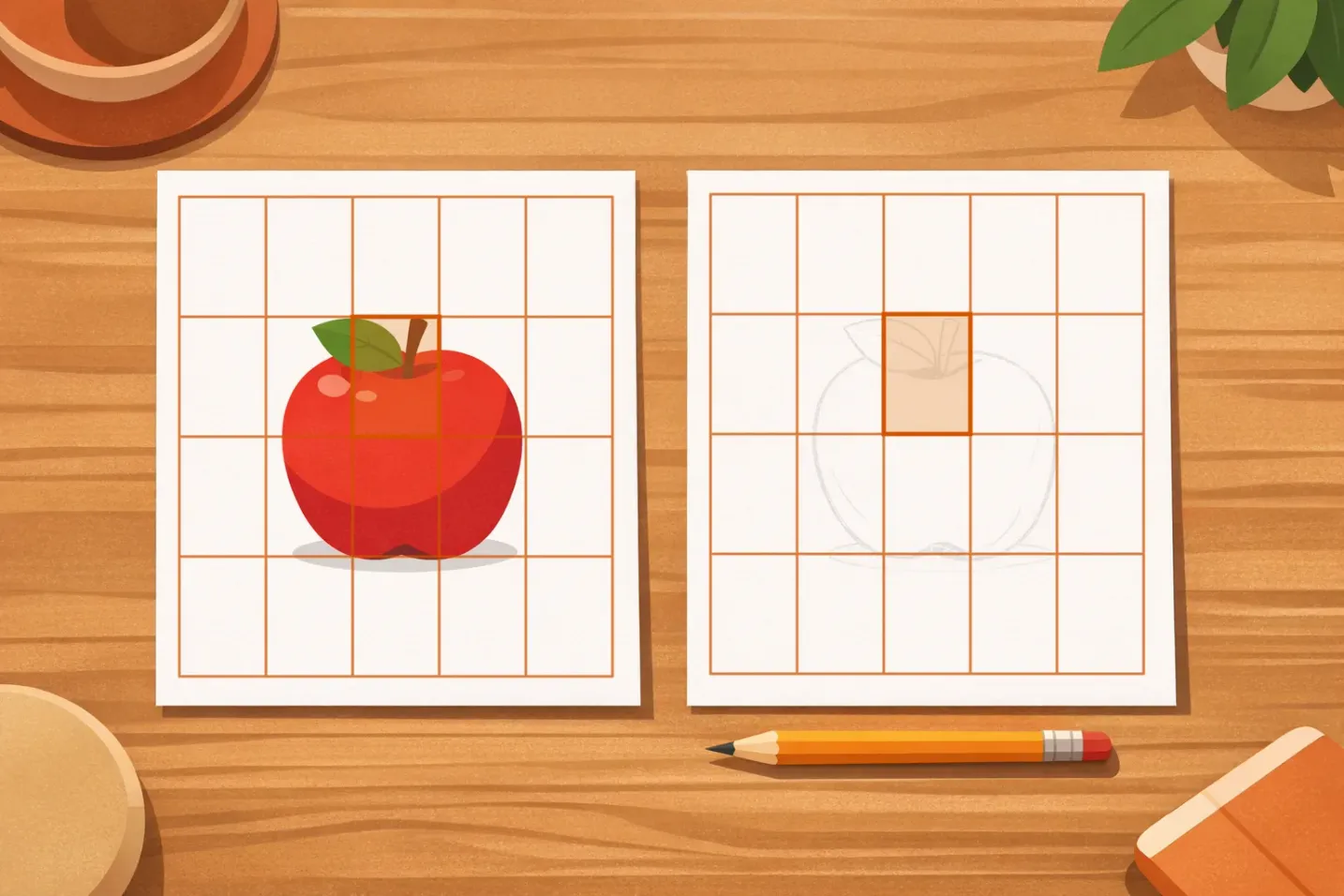

Grid drawing is a measuring system. You put a grid over your reference, draw a grid with the same number of squares on your paper, and copy the picture one square at a time. It fixes the most common beginner problem: proportions that drift until the drawing looks almost right but off. Start with a 4x4 or 5x5 grid on a simple object and finish it in one sitting. For the technique in depth, see our complete grid drawing guide.
What the Grid Method Is (In Plain Terms)
The method in three moves:
- Put a grid over a reference image.
- Draw the same grid count on your paper (same number of squares across and down).
- Copy what you see by placing edges and landmarks inside each matching square.
Each square is a checkpoint, and that is what stops proportions drifting.
If you want an even more detailed walkthrough, see our complete grid drawing guide.
The 3 Rules That Prevent Most Beginner Mistakes
- Match the grid count (example: 8 squares wide × 10 squares tall on both). If the count differs, your drawing stretches/squashes. Matching the count is not enough on its own: the reference crop and the paper have to be the same shape, or the squares stop being square. Crop the reference to the proportions of your drawing area before you grid either one.
- Keep the grid light (H/2H pencil). Dark grids overpower the drawing and are hard to erase cleanly.
- Use anchor points before details. Anchors are where edges touch/cross grid lines.
Tools You Actually Need
- Smooth paper (easier erasing)
- H/2H pencil for the grid + light sketch
- HB pencil for final line work
- Ruler + eraser (kneaded or white)
You can speed up reference prep with the grid maker online.
Step 1: Choose a Beginner-Friendly Reference
Pick a photo where shapes are easy to see:
- One clear light source
- Decent contrast (edges visible)
- Subject large enough to read (tiny faces are hard)
Avoid heavy filters or extreme shadows that hide edges.
Step 2: Choose a Grid Size You Can Finish
More squares = more checkpoints, but slower work.
- First practice: 4×4 or 5×5 on a simple object (mug, fruit, toy)
- Portraits: aim for 8–10 squares across the width of the head, measured cheekbone to cheekbone
If you're spending minutes per square just to understand the shapes, your grid is too fine for your current level.
Step 3: Draw the Matching Grid on Paper (Fast + Clean)
- Choose a square size on paper (often 2–4cm / ~1–1.5" is comfortable).
- Turn that size into a count: divide the width of your drawing area by the square size for the number of columns, and the height by the same size for the number of rows. Those two numbers are what has to match the reference. If either comes out with a part-square left over, nudge the square size up or down until both divide evenly.
- Make small tick marks along the top edge (columns) and left edge (rows).
- Draw the outer rectangle of your grid area.
- Draw vertical lines, then horizontal lines (light pressure).
- Label columns A–… and rows 1–… so you don't copy the wrong square.
Step 4: The Square-by-Square Method (Beginner Version)
The grid only helps if you use it like a measuring tool. In each square, use this repeatable process:
- Find anchor points (2–4 is enough):
- where an edge touches a grid line
- where it crosses the middle of the square
- where a curve turns (direction changes)
- Connect anchors with straight segments first.
- Refine curves after anchors look correct.
- Check continuity across borders: lines should line up between neighboring squares.
The "Fix It Before It Spreads" Check
After every 4–6 squares, pause for 30 seconds:
- compare big angles to the grid (does it tilt the same way?)
- confirm landmarks sit in the correct squares
- re-check the outer contour
If something looks wrong, it's usually one of these: wrong square, wrong anchor, wrong angle.
Step 5: Shading Without Killing the Drawing
Beginner-safe order:
- Keep line work light until proportions feel right.
- Block only 3 values at first: light, mid, dark.
- Deepen the darkest darks last (pupils, nostrils, cast shadows).
Erase grid lines gently near the end (kneaded eraser "press and lift" works well).
A Short Practice Plan You Can Actually Finish
- Session 1–3: simple object, 4×4 or 5×5 grid
- Session 4–6: still life of 2–3 objects (focus on contour + angles)
- Session 7+: portrait with good lighting (landmarks first, details last)
Troubleshooting
"My drawing looks stretched/squashed"
Your grid counts don't match. Fix the grid count (e.g., 8×10 on both), not the paper shape.
"It drifts as I go"
You're drawing without anchors. Re-check where edges touch/cross grid lines.
"It looks stiff"
Your placement is right, but every edge is treated equally. Vary line weight and soften edges in shadow.
Common Questions About Grid Drawing for Beginners
Next: grid a mug at 4x4 and finish it in one sitting. When that comes out right without re-measuring, move to two objects.
Ready to Try the Grid Method?
Put these techniques into practice with our free grid generator tool—trusted by 170,000+ artists worldwide.
Create Your Grid Now →