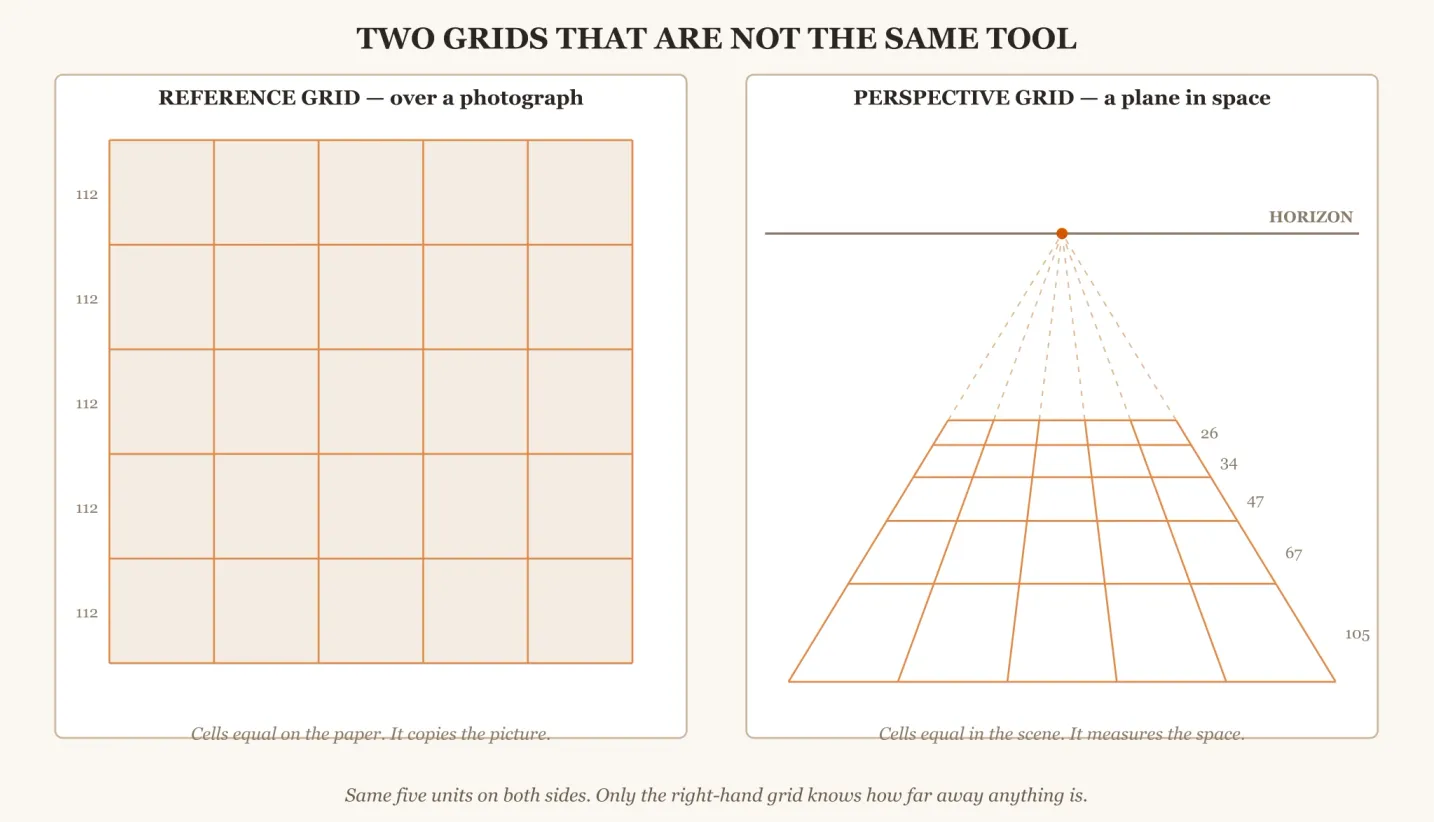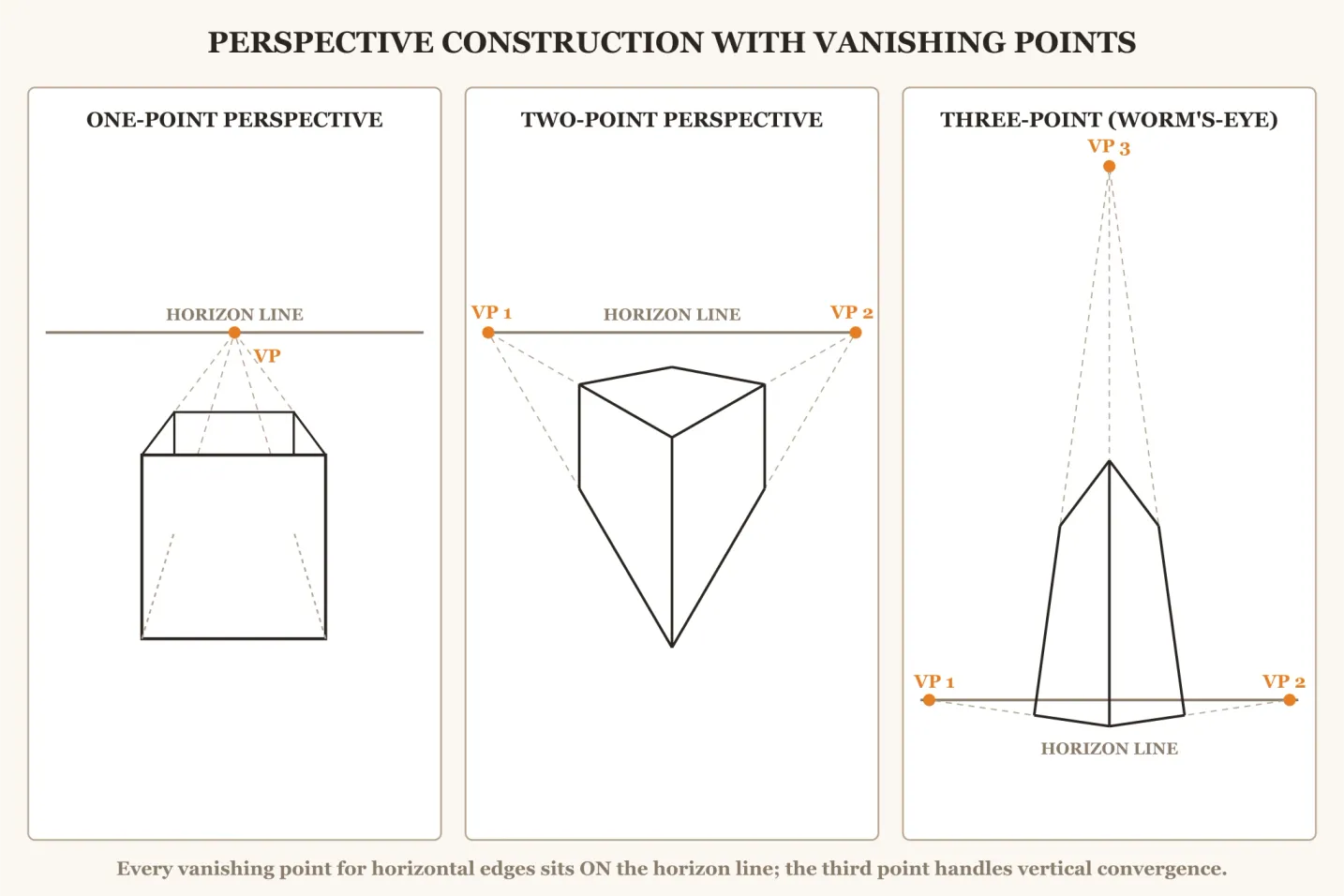

Perspective drawing forms the foundation of realistic representation in art. The grid method provides a systematic framework for understanding and applying perspective principles, transforming complex spatial relationships into manageable visual problems.
Understanding Perspective with Grid Drawing
When I first attempted a three-point perspective drawing of a cathedral, I spent four hours getting the vanishing points wrong. The spires leaned impossibly, the walls seemed to twist, and the entire structure looked ready to collapse. The grid method changed that - suddenly I could verify each angle mathematically. What had been guesswork became precision.
Perspective represents one of the most challenging yet essential skills in representational art. For centuries, artists have sought methods to accurately depict three-dimensional space on flat surfaces. The grid method offers a structured approach that demystifies perspective construction, providing measurable reference points that transform abstract concepts into concrete visual solutions.
Quickstart: Perspective With a Grid (Beginner Version)
If perspective feels confusing, don’t start with “theory.” Start with a repeatable construction:
- Draw your horizon line (eye level).
- Place your vanishing point(s) on the horizon line.
- Use grid intersections to place equal “units” in the foreground.
- Connect those points to your vanishing point(s) to build a guide.
- Build objects on top of that guide, checking convergence as you go.
If you want to quickly add a grid to a reference photo (for studies), use our image grid generator.
The Mathematical Foundation of Perspective
Perspective drawing relies on geometric principles that artists have refined since the Renaissance. The grid method makes these principles accessible by providing measurable reference points for constructing accurate spatial relationships. This systematic approach reveals perspective as a learnable skill rather than mysterious talent.
Understanding perspective begins with recognizing how parallel lines converge toward vanishing points on the horizon line. The grid serves as a measuring tool, helping artists plot these convergences accurately while maintaining proper proportions throughout the drawing. The mathematical relationships underlying perspective remain constant regardless of subject matter, making the grid an invaluable tool for visualizing these relationships.
Historical Development
The formal understanding of perspective emerged during the Italian Renaissance, with artists like Filippo Brunelleschi and Leon Battista Alberti establishing mathematical principles for spatial representation. These pioneers used various grid-like devices, including the "velo" - a gridded screen through which artists viewed their subjects. Modern grid methods build upon these historical foundations, offering accessible techniques for contemporary artists.
The evolution from Renaissance perspective machines to modern grid techniques demonstrates how fundamental principles remain unchanged while application methods have simplified. Today's artists benefit from centuries of refinement, with the grid method representing the distillation of complex mathematical concepts into practical drawing tools.
Optical Science and Visual Perception
Perspective drawing mimics how the human eye perceives space. Light rays travel in straight lines from objects to the eye, creating a cone of vision. The picture plane intersects this cone, capturing the image as it appears from a specific viewpoint. The grid method helps artists understand and replicate this optical phenomenon systematically.
Visual perception involves complex processes that the brain uses to interpret spatial relationships. The grid provides a framework that aligns with these perceptual mechanisms, helping artists create drawings that feel naturally correct to viewers. This alignment between artistic technique and human perception explains why properly executed perspective drawings appear so convincing.
One-Point Perspective Fundamentals
One-point perspective represents the foundation of all perspective systems. This method works when viewing objects or scenes with one face parallel to the picture plane. The simplicity of one-point perspective makes it ideal for beginners, yet its applications remain essential even for advanced artists.
Grid Application in Linear Perspective
The grid method transforms one-point perspective from abstract theory into practical application. By using a grid overlay, artists can precisely plot where lines converge and how objects diminish in size as they recede into space.
Key Elements:
- Single vanishing point positioned on the horizon line
- All parallel lines perpendicular to the picture plane converge to this point
- Vertical lines remain perfectly vertical
- Horizontal lines parallel to the picture plane stay horizontal
- The horizon line represents the viewer's eye level
Grid Strategy for One-Point Construction:
- Establish the horizon line across your grid, typically at eye level
- Mark the vanishing point at a grid intersection for precision
- Use grid squares to plot convergence angles systematically
- Maintain consistent diminishment rates by measuring against grid units
- Check accuracy by ensuring all receding lines pass through the vanishing point
- Use grid subdivisions to add architectural details proportionally
The grid serves as both a measuring tool and a verification system. Each grid square represents a unit of measurement that remains consistent throughout the drawing, allowing artists to calculate exactly how much smaller objects should appear as they recede.
During a workshop on railway perspectives, I watched students struggle with track spacing until we applied the grid method. The transformation was immediate - once they could measure the compression mathematically using grid squares, the guesswork disappeared. Railroad ties that had been randomly placed suddenly followed logical progression.
Mathematical Principles in Practice
One-point perspective follows predictable mathematical ratios. Objects reduce in size proportionally to their distance from the viewer. The grid method makes these calculations visual rather than numerical. For instance, if a wall section occupies four grid squares in the foreground, a similar wall twice as far away will occupy two grid squares.
This mathematical consistency extends to spacing between repeated elements. Fence posts, floor tiles, or windows that appear equal in reality must show progressive compression as they recede. The grid provides reference points for plotting this compression accurately.
Common One-Point Applications
Interior Spaces: Interior rooms viewed straight-on represent classic one-point perspective scenarios. The back wall remains parallel to the picture plane while side walls, floor, and ceiling converge toward the central vanishing point. The grid method excels here by helping artists maintain consistent wall angles and proportional furniture placement.
When drawing room interiors, the grid assists in:
- Plotting ceiling beams and floor boards
- Positioning doors and windows symmetrically
- Scaling furniture appropriately for its position
- Creating convincing depth through systematic size reduction
Transportation and Infrastructure: Railroad tracks, roads, and tunnels demonstrate one-point perspective dramatically. These subjects benefit particularly from grid application because their regular, repeating elements require precise spacing adjustments as they recede.
The grid helps artists accurately depict:
- Railroad tie spacing that compresses with distance
- Telephone poles that diminish predictably
- Lane markings that converge properly
- Bridge supports that maintain structural logic
Architectural Facades: Building fronts viewed straight-on utilize one-point perspective for depth elements while maintaining the flat facade. The grid method ensures windows align properly, architectural details remain proportional, and any receding elements like entry alcoves follow proper perspective rules.
Two-Point Perspective Mastery
Two-point perspective creates more dynamic and realistic representations than one-point perspective. This system applies when viewing objects at an angle, with no faces parallel to the picture plane. The added complexity requires greater precision, making the grid method particularly valuable for maintaining accuracy.
Complex Spatial Relationships
Two-point perspective introduces a more sophisticated spatial framework that better represents how we typically view the world. Rather than the frontal views of one-point perspective, two-point allows artists to depict objects from more natural, three-quarter viewing angles.
Fundamental Characteristics:
- Two vanishing points positioned on the horizon line
- Vertical lines remain perfectly vertical (in normal eye-level views)
- All horizontal lines converge to one of the two vanishing points
- Creates more dynamic compositions than one-point perspective
- Allows for more varied and interesting viewpoints
Advanced Grid Implementation:
- Establish the horizon line at appropriate eye level
- Mark both vanishing points, often extending beyond the drawing area
- Use grid intersections to plot initial construction lines
- Create a "perspective grid" by connecting vanishing points through grid intersections
- Check proportions at every grid intersection
- Verify that all parallel edges converge to the same vanishing point
- Use grid subdivisions for precise detail placement
The grid becomes even more critical in two-point perspective because vanishing points frequently fall outside the drawing area. Artists must project lines accurately across significant distances, and the grid provides essential reference points for maintaining proper angles.
My first commission for a corner building portrait taught me this lesson harshly. Without the grid, my vanishing points drifted throughout the drawing. The finished piece looked like two different buildings fighting for the same space. Now I pin string to distant vanishing points and use the grid to verify every convergence line.
Vanishing Point Placement Strategy
The position of vanishing points dramatically affects the drawing's appearance. Placing them too close together creates distortion, while positioning them too far apart flattens the perspective effect. The grid method helps artists experiment with vanishing point placement systematically.
Optimal Spacing Guidelines:
- Vanishing points should typically be separated by at least twice the drawing width
- Closer spacing creates more dramatic perspective
- Wider spacing produces subtler depth effects
- The grid helps visualize these relationships before committing to final placement
Constructing Complex Forms
Two-point perspective excels at depicting complex architectural forms and geometric objects. The grid method provides a systematic approach to constructing these forms accurately, breaking down complex shapes into manageable components.
Box Construction Method:
- Plot the nearest vertical edge using grid reference
- Project lines from this edge to both vanishing points
- Determine depth using grid proportions
- Complete the box by connecting appropriate points
- Use diagonals to find centers for further subdivision
- Add details maintaining consistent perspective
Architectural Applications
Architecture represents the most common application of two-point perspective. Buildings viewed from street corners, urban landscapes, and interior spaces with visible corners all require this perspective system.
Corner Views and Building Studies: When drawing buildings from corner viewpoints, each visible face recedes to its respective vanishing point. The grid method ensures that:
- Floor lines remain level and properly converged
- Window spacing compresses appropriately on each face
- Architectural proportions remain consistent
- Roof lines follow proper perspective rules
- Details like cornices and moldings align correctly
For more detailed architectural applications, see our guide on using grids to draw architecture accurately, which covers specific techniques for building facades and urban environments.
Complex Street Scenes: Urban environments present multiple challenges that the grid method helps resolve:
- Multiple buildings at various angles but sharing horizon line
- Consistent scale relationships between near and far structures
- Proper convergence for streets and sidewalks
- Accurate placement of street furniture and vehicles
- Maintaining atmospheric perspective while handling linear perspective
The grid provides a unifying framework that keeps all elements properly related in space. Each building follows the same perspective rules, creating a cohesive and believable scene.
Three-Point Perspective Dynamics
Three-point perspective represents the most complex and dramatic of the linear perspective systems. By adding a third vanishing point for vertical convergence, this method captures extreme viewing angles that create powerful visual impact. The grid method becomes indispensable for managing the increased complexity while maintaining accuracy.
Vertical Convergence Principles
Unlike one and two-point perspective where verticals remain parallel, three-point perspective acknowledges that vertical lines also converge when viewed from extreme angles. This system more accurately represents how we perceive very tall or deep subjects, adding an extra dimension of realism to drawings.
Fundamental Elements:
- Three vanishing points: two on the horizon plus one above or below
- No lines remain truly parallel in the composition
- Creates dramatic foreshortening effects
- Captures extreme viewing angles impossible with other systems
- Grid becomes essential for managing complex convergences
Advanced Grid Techniques for Three-Point:
- Establish horizon line and mark two vanishing points as in two-point perspective
- Determine position of third vanishing point based on viewing angle
- Use grid intersections as crucial checkpoints for accuracy
- Plot major vertical elements first, checking convergence to third point
- Subdivide forms using grid proportions
- Verify all three sets of parallel lines converge properly
- Use grid to maintain consistent proportions despite extreme foreshortening
The mathematical relationships in three-point perspective become highly complex. The grid method provides visual structure that makes these relationships manageable, allowing artists to achieve accurate results without complex calculations.
Determining the Third Vanishing Point
The position of the vertical vanishing point determines the intensity of the perspective effect. Placing it closer to the horizon creates more dramatic distortion, while positioning it farther away produces subtler effects. The grid helps artists visualize and test different placements before finalizing the composition.
Placement Considerations:
- Distance from horizon affects drama level
- Closer placement increases distortion
- Must balance impact with believability
- Grid helps preview effects systematically
Dramatic Viewpoints and Applications
Three-point perspective excels at creating dramatic architectural views and dynamic compositions. The system captures viewpoints impossible to represent accurately with simpler perspective methods.
Looking Up (Worm's Eye View): When viewing tall structures from ground level, vertical lines converge upward toward a vanishing point in the sky. This creates the dramatic effect of buildings looming overhead:
- Skyscrapers appear to lean inward dramatically
- Architectural details compress as they rise
- Creates sense of overwhelming scale
- Grid prevents excessive distortion
- Maintains structural believability
The grid method helps artists control this effect, ensuring buildings appear dramatically tall without looking unstable or incorrectly drawn. Each grid intersection provides a checkpoint for verifying proper convergence angles.
Looking Down (Bird's Eye View): Aerial perspectives utilize a vanishing point below the composition. This viewpoint creates equally dramatic effects:
- Buildings appear to spread at their bases
- Streets form dynamic patterns
- Verticals converge downward
- Creates vertiginous sensations
- Grid maintains proportional relationships
The grid becomes particularly valuable for aerial views because it helps organize complex urban patterns while maintaining proper perspective throughout the composition.
Practical Applications Beyond Architecture
While architecture provides the most obvious application for three-point perspective, this system enhances many other subjects:
Figure Drawing:
- Extreme foreshortening in action poses
- Dramatic viewing angles for dynamic compositions
- Enhanced sense of movement and energy
- Grid helps maintain anatomical proportions
When working with figures in perspective, mastering anatomy with the grid method provides essential knowledge for maintaining accurate proportions even in extreme viewpoints.
Still Life and Objects:
- Dramatic viewing angles for ordinary objects
- Dynamic compositions through perspective manipulation
- Enhanced visual interest and depth
- Grid ensures consistent perspective throughout
Landscape Elements:
- Tall trees viewed from below
- Cliff faces and mountain scenes
- Dramatic natural formations
- Grid helps organize complex natural forms
Foreshortening and the Grid
Foreshortening represents one of the most challenging aspects of drawing, requiring artists to depict forms that appear compressed due to perspective. The grid method transforms this complex visual phenomenon into a systematic process, providing measurable references for accurate foreshortening.
Understanding Compression
Foreshortening occurs when objects or forms angle toward or away from the viewer, causing visual compression that can dramatically alter apparent proportions. This effect follows predictable rules based on viewing angle and distance, making it ideal for grid-based analysis and construction.
Fundamental Principles:
- Forms compress proportionally to their angle relative to the picture plane
- The more perpendicular to the viewer, the greater the compression
- Nearest portions appear larger while distant parts diminish
- Grid quantifies these changes mathematically
- Overlapping becomes crucial for reading form
Grid-Based Measurement: The grid provides a coordinate system for measuring foreshortening accurately. By comparing the actual proportions of an object with its foreshortened appearance, artists can plot compression ratios systematically. For instance, a cylinder viewed at a 45-degree angle might compress to half its actual length visually, a relationship the grid makes measurable and reproducible.
Human Figure Applications
The human figure presents particular challenges in foreshortening due to its complex forms and our familiarity with normal proportions. The grid method helps artists navigate these challenges by providing objective measurement tools.
Foreshortened Limbs: Arms and legs extending toward or away from the viewer demonstrate extreme foreshortening:
- The limb's length compresses dramatically
- Width remains relatively unchanged
- Overlapping forms become critical
- Joint positions shift unexpectedly
- Grid helps plot these compressed proportions
Reclining Figures: Figures lying down viewed from head or feet create complex foreshortening challenges:
- Torso length compresses significantly
- Head-to-body proportions shift
- Limb positions require careful plotting
- Grid provides framework for accuracy
- Checkpoints at major anatomical landmarks
Dynamic Action Poses: Action poses often involve multiple foreshortened elements:
- Reaching gestures compress arms
- Kicking motions foreshorten legs
- Twisting torsos show complex compression
- Grid helps maintain proportional relationships
- Multiple viewpoints within single figure
During life drawing sessions, I discovered that marking the grid on my viewing plane first helped enormously with foreshortened poses. When the model held a dramatic reaching pose, the grid allowed me to map exactly how the arm compressed from shoulder to fingertip. What looked impossibly complex became a series of measured relationships.
Geometric Foundations
Understanding foreshortening begins with simple geometric forms. The grid method helps artists master these basics before tackling complex subjects.
Cylinder Studies:
- Basic building block for limbs
- Compression follows predictable patterns
- Ellipses indicate angle and orientation
- Grid helps plot accurate ellipses
- Foundation for figure work
Box Forms in Perspective:
- Rectangular forms show clear compression
- Each face foreshortens differently
- Grid quantifies these differences
- Builds understanding for complex forms
- Essential for architectural elements
Advanced Foreshortening Techniques
Beyond basic compression, foreshortening involves sophisticated visual effects that the grid helps artists capture accurately.
Overlapping Forms:
- Critical for reading foreshortened shapes
- Near forms obscure distant ones
- Grid helps plot overlap points
- Creates convincing depth
- Essential for complex subjects
Size Variation Within Forms:
- Single objects show size gradation
- Near portions appear enlarged
- Distant areas diminish
- Grid quantifies these variations
- Creates dynamic visual effects
Atmospheric Perspective Integration
While linear perspective handles the geometric aspects of spatial representation, atmospheric perspective addresses how air and distance affect visual perception. The grid method provides structure for systematically applying these atmospheric effects, creating drawings with enhanced depth and realism.
Beyond Linear Perspective
Atmospheric perspective, also called aerial perspective, works in conjunction with linear perspective to create convincing spatial depth. This phenomenon results from particles in the atmosphere that scatter light, progressively affecting distant objects. The grid method helps artists organize and apply these effects systematically rather than randomly.
Value Changes and Distance: The atmosphere acts as a filter, progressively lightening values as distance increases:
- Foreground elements maintain full value range
- Middle ground shows moderate lightening
- Background elements approach atmospheric value
- Contrast decreases predictably with distance
- Grid sections help organize these value zones
The grid provides a framework for planning value transitions. By assigning value ranges to different grid zones, artists can create smooth atmospheric progressions that enhance the linear perspective structure.
Detail Reduction: Atmospheric interference progressively obscures detail:
- Foreground maintains sharp definition
- Middle ground shows selective detail
- Background simplifies to basic shapes
- Texture visibility decreases with distance
- Grid helps plan detail distribution
Color Temperature Shifts: The atmosphere affects color perception systematically:
- Warm colors (reds, oranges) advance visually
- Cool colors (blues, violets) recede naturally
- Distant objects shift toward blue-gray
- Color intensity decreases with distance
- Grid sections guide color temperature planning
Combining Perspective Systems
The most convincing spatial representations combine linear and atmospheric perspective. The grid method excels at integrating these systems, providing structure for both geometric accuracy and atmospheric effects.
Unified Depth Strategy:
- Use linear perspective for structural framework
- Apply atmospheric effects within this structure
- Grid organizes both systems simultaneously
- Each zone receives appropriate treatment
- Creates cohesive spatial illusion
Practical Application Method:
- Establish linear perspective using grid
- Divide composition into depth zones
- Assign value ranges to each zone
- Plan color temperature transitions
- Determine detail levels by zone
- Apply effects systematically within grid structure
Landscape Applications
Landscapes demonstrate atmospheric perspective most clearly. The grid method helps artists capture these effects accurately while maintaining proper linear perspective for architectural elements or geometric forms within the landscape.
Mountain Ranges:
- Nearest peaks show full value range
- Each successive range lightens
- Detail decreases with distance
- Color shifts toward blue-violet
- Grid organizes these transitions
Urban Landscapes:
- Buildings follow linear perspective
- Atmospheric effects overlay structure
- Distant buildings lose contrast
- Details fade progressively
- Grid maintains both systems
Seascapes and Water:
- Horizon line critical for perspective
- Atmospheric effects most visible
- Water reflects atmospheric conditions
- Grid helps organize complex reflections
- Value transitions crucial for depth
Practical Perspective Exercises
Mastering perspective requires systematic practice. These exercises progress from simple to complex, building skills incrementally. The grid method provides consistent structure throughout, helping artists develop confidence and accuracy.
Exercise 1: Basic Box Studies
Begin with fundamental geometric forms to understand perspective principles without the complexity of detailed subjects. Box studies form the foundation for all perspective work.
One-Point Box Construction:
- Create an 8x10 grid on your drawing surface
- Mark horizon line at eye level (typically middle of composition)
- Place single vanishing point on horizon at grid intersection
- Draw front face of box parallel to picture plane
- Connect corners to vanishing point
- Determine depth using grid proportions
- Complete box with parallel lines
Progression to Two-Point:
- Using same grid, establish two vanishing points on horizon
- Start with vertical edge rather than face
- Project lines to both vanishing points
- Use grid to maintain proportions
- Practice boxes at various angles
- Stack boxes to create simple structures
Three-Point Challenge:
- Add vertical vanishing point above or below
- No lines remain parallel
- Use grid intersections to check angles
- Start with single box, progress to multiples
- Practice both worm's eye and bird's eye views
Exercise 2: Interior Space Construction
Room interiors provide excellent perspective practice while remaining manageable in complexity. The grid method helps maintain architectural logic throughout the drawing process.
Basic Room Framework:
- Use 10x12 grid for adequate detail
- Establish horizon line at standing eye level
- Create one-point perspective for straight-on view
- Plot back wall proportions using grid
- Connect corners to vanishing point for side walls
- Add floor and ceiling planes
Adding Furniture Systematically:
- Use grid to place furniture footprints on floor
- Build up from floor plane maintaining perspective
- Each piece follows same vanishing point
- Check proportions against human scale
- Add details only after basic forms are correct
Scale Consistency Practice:
- Door heights establish human scale
- Furniture must relate logically to architecture
- Grid helps maintain these relationships
- Practice with different room types
- Vary viewpoints for comprehensive understanding
Exercise 3: Complex Street Scene
Street scenes combine multiple perspective challenges, making them excellent for advanced practice. The grid method helps organize complexity while maintaining accuracy.
Foundation Planning:
- Use fine grid (minimum 12x16) for detail
- Establish horizon at eye level
- Mark two vanishing points for street view
- Plot major building masses first
- Ensure all structures share horizon line
Building Development:
- Start with simple box forms
- Add architectural details systematically
- Windows follow perspective grid
- Maintain consistent scale throughout
- Use atmospheric perspective for distance
Progressive Detail Addition:
- Add large elements first (signs, awnings)
- Include mid-size details (doors, windows)
- Fine details last (bricks, trim)
- Street furniture follows same perspective
- People and vehicles for scale reference
Exercise 4: Figure in Perspective Environment
Combining figures with architectural perspective challenges artists to integrate organic and geometric forms. The grid provides common framework for both.
Standing Figure Placement:
- Establish architectural setting first
- Use horizon line for eye level reference
- Plot figure height using grid proportions
- Multiple figures share same eye level
- Adjust for position in space
Environmental Context:
- Figure must relate to architecture logically
- Use doorways for scale reference
- Cast shadows follow perspective rules
- Interaction with environment (sitting, leaning)
- Grid maintains proportions throughout
Foreshortening Practice:
- Seated figures show compressed proportions
- Reaching gestures demonstrate foreshortening
- Use grid to plot compressed forms
- Combine with architectural elements
- Practice various poses and angles
Common Perspective Errors
Understanding common mistakes helps artists avoid them. The grid method provides built-in error checking, but awareness of typical problems accelerates learning and improves accuracy. For beginners, the basics of grid drawing covers fundamental principles that prevent many common errors.
Vanishing Point Drift
One of the most frequent errors involves inconsistent vanishing points that "drift" throughout the drawing process. This creates a disjointed appearance where different elements seem to exist in separate perspective systems.
Problem Identification:
- Parallel lines converge to different points
- Buildings appear to twist or lean incorrectly
- Spaces feel unstable or distorted
- Individual elements look correct but don't relate properly
Grid-Based Solutions:
- Mark vanishing points clearly at grid intersections
- Use straightedge consistently for all convergence lines
- Check convergence regularly against established points
- Pin or tape ruler to distant vanishing points
- Verify each new element against grid framework
- Create construction lines in light pencil first
Scale Inconsistency
Objects appearing the wrong size for their position in space breaks the illusion of depth. This error often results from focusing on individual elements without considering their spatial relationships.
Common Manifestations:
- Background objects appear too large
- Figures don't match architectural scale
- Repeated elements don't diminish properly
- Foreground lacks sufficient size contrast
Systematic Corrections:
- Use grid to establish consistent scale units
- Measure diminishment rates mathematically
- Compare all elements to human scale reference
- Plot major sizes before adding details
- Check proportions at each depth level
- Use diagonal division for equal spacing
A student once brought me a cityscape where the background buildings towered over the foreground ones. The grid revealed the problem immediately - they had drawn each building individually without checking proportional relationships. We overlaid a perspective grid and the errors became obvious. The grid method prevents this by forcing constant proportion checks.
Vertical Distortion
In two-point perspective, verticals should remain perfectly vertical unless viewing angle is extreme. Unintentional leaning creates instability and confusion about viewpoint.
Recognition Signs:
- Buildings appear to fall over
- Vertical elements don't align with grid
- Inconsistent lean direction
- Structural impossibilities
Prevention Methods:
- Check all verticals against grid lines
- Use T-square or triangle for vertical edges
- Establish vertical datum lines early
- Verify before adding details
- Only intentionally lean for three-point
- Double-check after construction phase
Horizon Line Confusion
Multiple or shifting horizon lines destroy perspective unity. All elements must share the same eye level to create coherent space.
Error Indicators:
- Objects seem to float or sink
- Inconsistent eye level relationships
- Vanishing points don't align horizontally
- Spatial relationships feel wrong
Establishment Protocol:
- Mark horizon line clearly across entire drawing
- All vanishing points must sit on this line
- Maintain consistent eye level throughout
- Check figure eye levels against horizon
- Verify architectural elements share horizon
- Never shift horizon mid-drawing
Proportional Errors in Depth
Incorrect proportional relationships between near and far objects undermines spatial convincingness. The grid method helps quantify these relationships accurately.
Typical Problems:
- Insufficient size variation with distance
- Overly dramatic diminishment
- Inconsistent compression rates
- Mathematical impossibilities
Grid Solutions:
- Plot proportional divisions systematically
- Use mathematical ratios for accuracy
- Check against reference when available
- Maintain consistent diminishment
- Verify at grid intersections
- Build complexity gradually
Advanced Grid Applications
Beyond basic perspective construction, the grid method enables sophisticated techniques for complex forms and effects. These advanced applications demonstrate the versatility of grid-based drawing systems.
Curved Forms in Perspective
Circles and curved forms present unique challenges in perspective drawing. The grid method provides systematic approaches for constructing accurate ellipses and maintaining proper proportions in curved objects.
Ellipse Construction Method:
- Plot a square in proper perspective using the grid
- Mark the square's center by drawing diagonals
- Find midpoints of each side using grid references
- Plot the ellipse passing through these eight points
- Use grid intersections to plot additional curve points
- Smooth the curve maintaining tangency at contact points
Applications for Curved Forms:
- Wheels and circular objects at any angle
- Arches and curved architectural elements
- Cylindrical forms (columns, tubes, tanks)
- Spherical objects showing proper compression
- Circular patterns on receding surfaces
The grid transforms the complex mathematics of ellipse construction into a visual plotting system. Each grid intersection provides a potential reference point for ensuring smooth, accurate curves that maintain proper perspective relationships.
Complex Curved Surfaces: Compound curves and undulating surfaces require sophisticated grid application:
- Break complex forms into simple curved sections
- Plot each section using grid coordinates
- Maintain consistent perspective throughout
- Use overlapping to clarify form direction
- Grid density determines accuracy level
Reflections and Shadows
Reflections and shadows must follow the same perspective rules as the objects casting them. The grid method provides framework for plotting these elements accurately, enhancing realism and spatial coherence.
Reflection Principles: Reflections create virtual space below the reflecting surface:
- All perspective rules apply to reflected images
- Vanishing points remain consistent
- Reflected objects appear inverted vertically
- Distance below surface equals distance above
- Grid helps plot reflection points accurately
Water Reflections:
- Still water creates mirror-like reflections
- Ripples break reflection into segments
- Each segment follows perspective rules
- Grid organizes complex broken reflections
- Atmospheric effects apply to reflections
Shadow Casting Systems: Shadows provide crucial spatial information and must follow perspective logic:
- Light source position determines shadow direction
- Shadows follow ground plane perspective
- Vertical objects cast shadows to common point
- Grid helps plot shadow termination points
- Multiple lights create multiple shadow systems
Advanced Shadow Techniques:
- Cast shadows on uneven surfaces
- Shadows climbing vertical surfaces
- Aerial perspective affects shadow values
- Soft shadows from diffused light sources
- Grid maintains consistency throughout
Architectural Details and Ornament
Complex architectural elements benefit from grid-based construction methods. The systematic approach ensures decorative elements maintain proper perspective while adding visual richness.
Repetitive Elements:
- Window patterns on curved surfaces
- Decorative moldings following perspective
- Tile patterns on floors and walls
- Repeated ornamental features
- Grid ensures consistent spacing
Complex Rooflines:
- Dormers and architectural projections
- Compound angles in perspective
- Intersecting roof planes
- Maintaining structural logic
- Grid provides construction framework
Digital Integration
Modern artists often combine traditional grid methods with digital tools. Understanding grid-based perspective enhances digital work while digital tools can assist traditional drawing.
Hybrid Workflows:
- Plot perspective traditionally with grid
- Scan and refine digitally
- Use digital grids for complex calculations
- Print grid templates for traditional work
- Combine best of both approaches
Digital Grid Advantages:
- Infinite canvas for distant vanishing points
- Precise mathematical calculations
- Easy experimentation with viewpoints
- Multiple grid overlays possible
- Non-destructive perspective adjustments
Mastering Perspective Through Practice
The journey from understanding perspective theory to creating convincing spatial illusions requires dedicated practice. The grid method provides consistent support throughout this journey, transforming abstract concepts into concrete techniques.
Progressive Skill Development: Beginning artists should focus on simple subjects and gradually increase complexity. The grid remains constant support, but reliance on mechanical construction naturally decreases as spatial understanding develops. Eventually, artists internalize perspective principles, using grids primarily for verification rather than initial construction.
Integration with Artistic Vision: While technical accuracy matters, perspective serves artistic expression. The grid method provides the foundation for accuracy, freeing artists to focus on composition, mood, and narrative. Understanding when to emphasize or de-emphasize perspective effects becomes part of artistic maturity.
Continued Learning Path: Perspective study never truly ends. Each new subject presents unique challenges, and changing artistic goals require different applications. The grid method adapts to these evolving needs, remaining a reliable tool throughout an artist's development. From initial studies to complex masterworks, grid-based perspective provides the spatial framework for convincing representation.
The mastery of perspective through grid drawing opens infinite possibilities for spatial expression. Whether creating intimate interiors or vast landscapes, accurate perspective construction forms the foundation of believable representational art. The grid method makes this foundation accessible to all dedicated students of drawing.
Common Questions About Perspective and Grid Drawing
Take these concepts into large environments with our large-scale grid strategies, apply them to precise facades using the architecture grid method, and refine advanced workflows in Mastering the Grid Technique in Drawing and Painting.