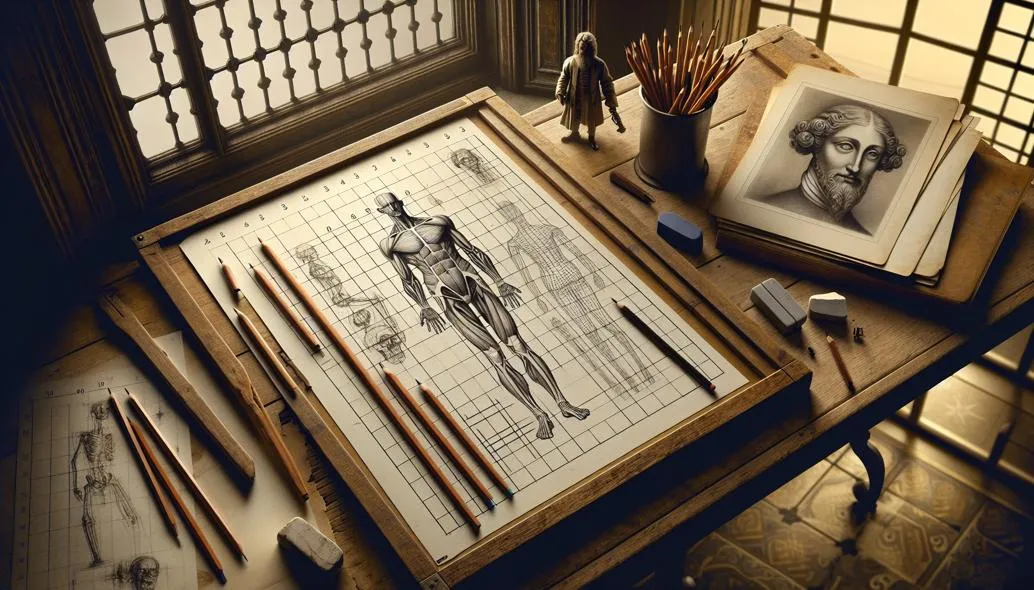
Anatomical understanding in figure drawing requires systematic approaches that coordinate complex three-dimensional human structure with accurate two-dimensional representation while maintaining both scientific accuracy and artistic expression. Grid techniques provide essential frameworks for analyzing proportional relationships, understanding structural connections, and developing observational skills necessary for convincing figure work across diverse poses, lighting conditions, and artistic applications.
My first life drawing session revealed the overwhelming complexity of human anatomy when approached without systematic understanding or construction methods. Despite careful observation, my attempts to capture proportional relationships resulted in figures that appeared structurally impossible, with limbs that seemed disconnected from torsos and heads that bore no convincing relationship to supporting bodies. Learning to integrate anatomical knowledge with systematic grid techniques transformed my approach, revealing how scientific understanding could enhance rather than constrain artistic expression.
Figure drawing presents unique challenges that combine observational accuracy with anatomical knowledge, requiring artists to understand both surface appearance and underlying structural principles. The most effective figure drawing approaches balance systematic construction with expressive interpretation, ensuring that technical accuracy supports rather than replaces artistic sensitivity and creative vision.
Fundamental Anatomy Principles and Grid Applications
If you’re studying anatomy, a grid helps you keep proportions stable while you map landmarks and forms. You can create a reference grid with our image grid generator.
Structural Understanding and Proportional Relationships
Skeletal framework and proportional systems: Human anatomy follows predictable proportional relationships based on skeletal structure that provides frameworks for systematic figure construction. Understanding these relationships enables grid applications that support rather than conflict with natural human proportions while accommodating individual variation and pose-specific modifications.
Muscular system integration and surface form:
- Major muscle groups: Understanding how muscles attach to skeleton and influence surface form
- Anatomical landmarks: Key points where bone structure affects surface appearance and proportional measurement
- Movement mechanics: How pose changes affect muscle engagement and surface form modification
- Gender variations: Proportional and structural differences requiring adapted grid approaches
- Age considerations: How human proportions change throughout life stages and their systematic representation
Three-dimensional form comprehension: Human figures must be understood as three-dimensional forms occupying space rather than flat patterns, requiring grid systems that support volumetric thinking while enabling accurate two-dimensional representation of complex spatial relationships.
Systematic Observation and Construction Methods
Grid-based proportional analysis: Professional figure drawing employs systematic proportional analysis using grid frameworks that enable accurate measurement while developing observational skills essential for advanced artistic work. These methods teach artists to see relationships rather than copying surface appearances.
Construction sequence development: Effective figure drawing benefits from systematic construction sequences that build complexity gradually while maintaining accuracy throughout the process. Grid techniques support these sequences by providing consistent reference frameworks across different construction phases.
Accuracy verification and correction methods:
- Plumb line relationships: Using vertical alignments to verify structural accuracy
- Horizontal alignments: Ensuring proper relationships across figure elements
- Triangulation methods: Using angular relationships to verify complex positional relationships
- Negative space analysis: Understanding shapes between figure elements as verification tools
- Comparative measurement: Using body part relationships to verify proportional accuracy
Professional Grid Systems for Anatomical Study
Academic Figure Drawing Methodologies
Classical proportion systems and contemporary applications: Traditional figure drawing education employs time-tested proportional systems that provide foundations for contemporary artistic development. Understanding these classical approaches enables modern applications that combine historical knowledge with contemporary artistic needs.
Life drawing integration and systematic practice: Professional figure drawing develops through systematic life drawing practice that integrates grid techniques with direct observation, creating learning experiences that build both technical competency and artistic sensitivity through sustained engagement with living models.
Academic training progressions and skill development:
- Cast drawing foundations: Using plaster casts for systematic proportion study without time pressure
- Quick gesture integration: Combining systematic construction with rapid observational sketching
- Extended pose studies: Deep anatomical investigation through sustained drawing sessions
- Comparative anatomy: Understanding human structure through comparison with animal anatomy
- Historical study: Learning from master works and traditional anatomical illustration
Specialized Anatomical Applications
Portrait and head construction using anatomical grids: Facial anatomy requires specialized grid applications that coordinate complex three-dimensional relationships while accommodating individual variation and expressive requirements. Understanding skull structure and facial musculature enables grid approaches that serve both accuracy and artistic expression.
Hands and feet: complex anatomical structures: Extremities present particular challenges due to their structural complexity and frequent foreshortening in various poses. Grid techniques help analyze these complex forms systematically while maintaining integration with overall figure proportions.
Torso construction and core anatomy:
- Ribcage and pelvis: Understanding major structural masses and their proportional relationships
- Spinal column: How backbone curvature affects overall figure gesture and surface form
- Shoulder girdle: Complex joint structure affecting arm attachment and gesture
- Hip structure: Pelvic anatomy and its influence on leg attachment and weight distribution
- Core musculature: How major trunk muscles influence surface form and pose characteristics
Advanced Anatomical Techniques with Grid Integration
Dynamic Pose Analysis and Movement Study
Action and gesture integration with systematic construction: Figure drawing must capture both structural accuracy and dynamic gesture, requiring grid approaches that support movement analysis while maintaining anatomical accuracy. Understanding how anatomy changes during movement enables systematic approaches to dynamic figure work.
Foreshortening and perspective in figure work: Complex poses often involve foreshortening that challenges traditional proportional systems. Grid techniques adapted for perspective enable accurate representation of these challenging viewpoints while maintaining anatomical credibility.
Weight distribution and balance analysis:
- Center of gravity: Understanding how body weight affects pose and structural relationships
- Support and tension: How weight-bearing affects muscle engagement and surface form
- Contrapposto and dynamic balance: Classical pose principles and their anatomical basis
- Action lines: How gesture flows through anatomical structure
- Rhythm and flow: Creating unified movement through anatomical understanding
Professional Applications and Specialized Contexts
Medical illustration and scientific accuracy: Some figure drawing applications require exceptional anatomical accuracy for educational or professional purposes. Understanding how to integrate scientific knowledge with artistic presentation serves specialized career applications.
Animation and character design applications: Contemporary figure drawing serves animation and entertainment industries requiring systematic approaches to character construction that maintain anatomical credibility while enabling stylistic interpretation and efficient production methods.
Fine art and expressive figure work:
- Contemporary figure painting: Integrating systematic construction with personal artistic vision
- Sculptural thinking: Understanding form dimensionally for three-dimensional artistic applications
- Abstract interpretation: Using anatomical knowledge as foundation for creative departure
- Cultural representation: Appropriate and respectful representation of diverse human forms
- Artistic tradition integration: Connecting contemporary practice with historical figure drawing excellence
Systematic Approach to Complex Anatomical Challenges
Individual Variation and Anatomical Diversity
Adapting systematic approaches for individual characteristics: Human anatomy exhibits significant individual variation that must be understood and represented accurately while maintaining systematic construction approaches. Grid techniques must accommodate this variation rather than forcing individual characteristics into standardized systems.
Age-related anatomical changes and representation: Human proportions and surface characteristics change throughout life stages, requiring adapted grid approaches that accurately represent these changes while maintaining systematic construction principles.
Cultural sensitivity and appropriate representation:
- Diverse body types: Understanding and respectfully representing different human forms
- Cultural contexts: Appropriate representation considerations for different cultural backgrounds
- Historical accuracy: Period-appropriate representation when working from historical sources
- Contemporary standards: Current expectations for inclusive and respectful figure representation
- Professional ethics: Maintaining appropriate standards in figure drawing practice and education
Technical Challenges and Problem-Solving
Difficult lighting conditions and form revelation: Figure drawing often involves challenging lighting that can obscure or confuse anatomical relationships. Understanding how to use grid analysis under various lighting conditions enables consistent accuracy regardless of environmental constraints.
Complex poses and extreme foreshortening: Advanced figure drawing involves poses that challenge conventional construction approaches. Systematic grid techniques adapted for complex spatial relationships enable accurate representation of these challenging situations.
Reference material limitations and solutions:
- Photographic distortion: Understanding and compensating for camera-induced proportion distortion
- Multiple reference integration: Combining information from different sources systematically
- Memory and imagination: Using systematic knowledge to create figures without direct reference
- Style adaptation: Modifying systematic approaches for different artistic styles and purposes
- Quality standards: Maintaining professional accuracy across different working conditions and constraints
Professional Development in Anatomical Figure Drawing
Educational Pathways and Skill Building
Academic training and systematic progression: Professional figure drawing development requires systematic educational approaches that build anatomical knowledge alongside artistic skills. Understanding how to structure learning enables efficient skill development and career preparation.
Self-directed study and resource utilization: Many artists develop anatomical figure drawing skills through independent study requiring systematic approaches to resource selection, practice organization, and progress assessment.
Mentorship and collaborative learning:
- Master-student relationships: Learning from experienced practitioners with systematic teaching approaches
- Peer learning groups: Collaborative study methods that support individual development
- Workshop participation: Intensive learning experiences for skill enhancement and networking
- Online education: Digital platforms providing access to systematic instruction and community
- Conference attendance: Professional development through continuing education and industry connections
Career Applications and Professional Practice
Commercial illustration and professional figure work: Contemporary figure drawing serves diverse commercial applications requiring systematic approaches that enable efficient production while maintaining professional quality standards and client satisfaction.
Fine art practice and gallery representation: Professional fine art careers increasingly require sophisticated figure drawing capabilities that demonstrate both technical competency and individual artistic vision through systematic skill development.
Educational and instructional opportunities:
- Teaching positions: Sharing systematic anatomical knowledge through formal and informal instruction
- Workshop development: Creating educational programs that transmit professional knowledge effectively
- Curriculum design: Contributing to educational program development and standards
- Mentorship programs: Guiding developing artists through systematic skill acquisition
- Professional writing: Contributing to educational literature and professional knowledge sharing
Digital Integration and Contemporary Methods
Technology-Enhanced Anatomical Study
Digital anatomy resources and reference integration: Contemporary figure drawing benefits from digital anatomical resources that provide detailed structural information while supporting traditional drawing skill development and artistic sensitivity.
3D modeling and anatomical visualization: Digital three-dimensional anatomical models enable sophisticated analysis and understanding that can enhance traditional figure drawing accuracy while maintaining essential hands-on skill development.
Hybrid traditional-digital workflows:
- Digital reference preparation: Computer-based analysis supporting traditional drawing execution
- Documentation integration: Recording traditional learning processes for analysis and improvement
- Portfolio presentation: Professional digital presentation of traditional figure drawing work
- Client communication: Effective presentation of anatomical accuracy and artistic interpretation
- Educational content: Creating instructional materials that combine systematic knowledge with practical application
Contemporary Professional Standards
Industry expectations and quality benchmarks: Professional figure drawing must meet contemporary standards that balance traditional skill requirements with current artistic and commercial expectations while maintaining cultural sensitivity and professional ethics.
Continuing education and skill maintenance: Professional figure drawing practice requires ongoing skill development and knowledge updating to maintain competitive capabilities and professional relevance throughout career development.
Professional networking and community engagement:
- Professional organizations: Participation in groups supporting figure drawing excellence and professional development
- Exhibition opportunities: Sharing work with professional audiences and potential clients
- Collaborative projects: Working with other professionals on interdisciplinary projects requiring figure drawing expertise
- Cultural contribution: Supporting artistic community development through knowledge sharing and mentorship
- International connections: Building professional relationships across cultural and geographic boundaries
Problem-Solving Advanced Anatomical Challenges
Complex Pose Construction and Movement Analysis
Multi-figure compositions and interaction analysis: Advanced figure drawing often involves multiple figures requiring systematic coordination of individual anatomical accuracy with group relationships and spatial organization.
Extreme perspective and viewpoint management: Professional figure work may require unusual viewpoints or extreme foreshortening that challenges conventional construction methods while maintaining anatomical credibility and artistic effectiveness.
Dynamic movement and action representation:
- Sports and athletic poses: Capturing peak action while maintaining anatomical accuracy
- Dance and performance: Representing expressive movement with structural credibility
- Narrative illustration: Supporting storytelling through anatomically informed figure work
- Character interaction: Coordinating multiple figures in narrative or expressive contexts
- Environmental integration: Placing figures convincingly within architectural or landscape settings
Professional Quality Control and Standards
Accuracy verification and correction methods: Professional figure drawing requires systematic approaches to quality assessment and improvement that maintain high standards while supporting continued artistic development and client satisfaction.
Style integration and artistic voice development: Successful professional practice combines systematic anatomical knowledge with individual artistic expression, requiring understanding of how technical competency supports rather than constrains creative development.
Client communication and professional presentation:
- Portfolio development: Systematic presentation of anatomical competency and artistic capability
- Client consultation: Effective communication of anatomical knowledge and artistic interpretation
- Project management: Coordinating anatomical accuracy requirements with artistic goals and commercial constraints
- Professional documentation: Recording methods and processes for consistency and quality control
- Continuous improvement: Systematic approaches to ongoing skill development and professional growth
Mastering Anatomical Figure Drawing Excellence
Using grids to understand anatomy in figure drawing represents sophisticated integration of scientific knowledge, systematic construction methods, and artistic sensitivity that serves both educational development and professional application. Through consistent application of grid techniques combined with anatomical study, artists develop both technical accuracy and the observational abilities necessary for convincing figure work across diverse applications and artistic contexts.
My experience with systematic anatomical study has taught me that scientific understanding enhances rather than constrains artistic expression by providing structural foundations that enable confident creative interpretation while ensuring technical credibility. The most accomplished figure artists combine systematic anatomical knowledge with individual artistic vision, using grid methods and anatomical understanding as tools for achieving artistic goals rather than restrictions on creative freedom.
Professional figure drawing success depends on understanding how anatomical knowledge, systematic construction methods, and artistic sensitivity work together to create compelling visual representations that serve both artistic expression and communication requirements. Through dedicated study and systematic application of grid techniques combined with anatomical understanding, artists develop the sophisticated observational abilities and technical proficiency necessary for lifelong growth in figure drawing and related professional applications.
Mastering Anatomical Grid Construction
For further study, explore grid anatomy tips and figure grid drawing.
Ready to Try the Grid Method?
Put these techniques into practice with our free grid generator tool—trusted by 170,000+ artists worldwide.
Create Your Grid Now →