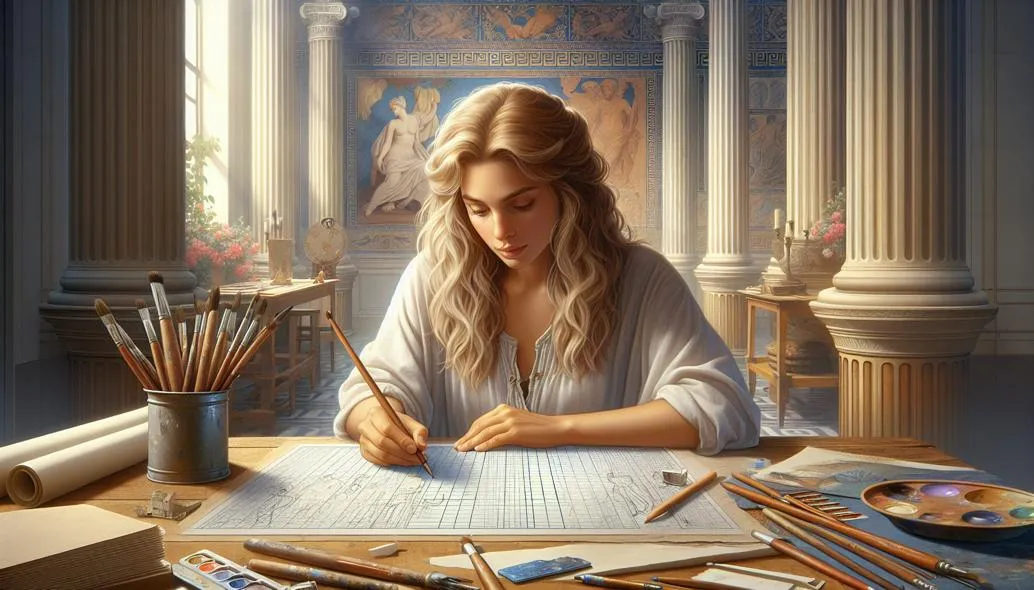
Proportion accuracy separates professional drawings from amateur attempts. The grid technique offers a systematic solution to proportion challenges that plague artists at every level. This comprehensive guide explores how grids transform proportion problems into manageable tasks, providing practical methods that deliver immediate results.
Understanding the Universal Proportion Challenge
The human brain possesses remarkable pattern recognition abilities, yet it consistently fails at accurate proportion assessment. This cognitive limitation affects artists at every skill level, from beginners struggling with basic shapes to experienced practitioners tackling complex compositions.
The Science Behind Proportion Perception
If you want more accurate proportions, a grid gives you objective checkpoints instead of “eyeballing.” You can create a reference grid with our grid for drawing.
Visual perception research reveals that humans naturally emphasize certain features while minimizing others. The brain prioritizes elements it deems important - typically eyes and mouth in portraits - while diminishing areas considered less significant, such as forehead dimensions or ear placement. This selective attention creates predictable proportion errors:
- Facial features positioned incorrectly: Eyes typically placed 25-30% too high on the head
- Size relationships distorted: Hands drawn 40-50% smaller than actual proportions
- Spatial relationships compressed: Distance between features systematically underestimated
- Peripheral elements minimized: Ears, hair volume, and neck length consistently reduced
These errors stem from evolutionary adaptations that helped humans recognize faces quickly for survival, but they hinder accurate artistic representation. Professional artists spend years training their eyes to overcome these biases, yet even masters employ measuring techniques for critical work.
Why Traditional Methods Fall Short
Conventional proportion teaching relies on idealized ratios: "The eyes sit halfway down the head" or "The body measures eight heads tall." While these guidelines provide starting points, they fail to address individual variation and the complexity of real-world subjects.
Traditional sight-sizing techniques - holding a pencil at arm's length to measure - introduce multiple variables:
- Arm position variations affect measurements
- Slight angle changes alter perceived proportions
- Eye movement during measurement causes inconsistencies
- Mental translation from measurement to paper introduces errors
Artists often spend months or years developing these skills with inconsistent results. The frustration leads many to abandon realistic drawing entirely, believing they lack "natural talent" when they simply need better methodology.
The Grid Method: A Systematic Solution
The grid technique transforms proportion challenges into manageable measurement tasks. By overlaying a precise geometric framework onto both reference and drawing surface, artists bypass perceptual biases and achieve accurate proportions through systematic comparison.
The Fundamental Principle
Grid drawing operates on a simple concept: dividing complex images into smaller, manageable sections. When an artist focuses on reproducing content within a single grid square, the brain processes simpler shape relationships rather than attempting to judge proportions across an entire composition.
This compartmentalization offers several advantages:
- Reduced cognitive load: Processing one square requires less mental effort than analyzing entire images
- Objective reference points: Grid intersections provide measurable landmarks
- Scalable accuracy: Proportions maintain consistency regardless of drawing size
- Progress tracking: Completed squares offer tangible advancement markers
How Grids Solve Specific Proportion Problems
The grid method addresses each common proportion error through systematic approaches:
Feature Placement Accuracy Grid lines create unmistakable reference points for feature positioning. Rather than estimating where eyes belong on a face, artists identify precise grid coordinates. If eyes align with grid line C3 in the reference, they must occupy the same position in the drawing.
Size Relationship Maintenance By maintaining consistent grid proportions between reference and drawing, size relationships transfer automatically. A hand occupying two grid squares in the reference will require two squares in the drawing, eliminating size estimation errors.
Spatial Distance Preservation Grid squares quantify distances between elements. The space between eyes becomes measurable units rather than subjective assessments. This objectivity ensures accurate spatial relationships throughout the composition.
Peripheral Element Inclusion Grid frameworks force attention to every image area equally. Artists cannot unconsciously minimize peripheral elements when each grid square demands equal consideration. This systematic coverage ensures complete proportional accuracy.
Practical Implementation for Real Results
Professional implementation of the grid technique requires understanding both technical precision and practical workflow. Years of teaching experience reveal that success depends more on systematic approach than artistic talent.
Essential Tools and Materials
The grid method requires minimal investment, making it accessible to artists at any budget level:
Basic Drawing Tools
- 2H pencil for grid lines: Hard enough to create light lines that won't interfere with the final drawing
- 2B or HB pencil for drawing: Provides sufficient darkness for clear work while remaining erasable
- Quality ruler: 30-40cm length accommodates most drawing sizes; metal edges ensure straight lines
- Kneaded eraser: Superior to rubber erasers for gentle grid line removal without paper damage
Paper Selection Considerations
- Weight: Minimum 140gsm prevents buckling during erasing
- Texture: Slight tooth helps graphite adhesion while allowing clean erasing
- Size: Match paper proportions to reference image to avoid distortion
Time Investment Reality Beginning artists should allocate 3-4 hours for initial grid drawings. This includes:
- Grid creation: 30-45 minutes
- Initial sketching: 60-90 minutes
- Refinement: 60-90 minutes
- Final details: 30-60 minutes
Creating the Reference Grid
Two primary methods exist for reference grid creation, each with distinct advantages:
Traditional Manual Method The manual approach teaches fundamental measuring skills:
- Precise measurement: Measure reference image dimensions to the millimeter
- Mathematical division: Divide dimensions by desired grid count (5x5 for beginners, 8x8 for intermediate)
- Accurate marking: Use sharp pencil points for precise interval marks
- Clean line drawing: Connect marks with consistent pressure for uniform lines
- Clear labeling: Number rows and letter columns for easy reference
This process typically requires 45-60 minutes but develops essential precision skills.
Digital Grid Generation Modern tools like GridMyPic streamline the process:
- Upload image in seconds
- Select appropriate grid density
- Adjust line thickness and color for visibility
- Print or display on digital device
Digital methods reduce preparation time to under 5 minutes, allowing more focus on actual drawing.
Constructing the Drawing Grid
The drawing grid represents the foundation of proportional accuracy. Common errors at this stage cascade throughout the entire drawing process.
Critical Proportion Matching The drawing grid must maintain identical proportions to the reference grid. This mathematical relationship ensures accurate transfer:
- Reference: 10cm × 15cm (2:3 ratio)
- Drawing at 2× scale: 20cm × 30cm (maintains 2:3 ratio)
- Common error: 20cm × 25cm (creates 4:5 ratio, distorting proportions)
Professional Grid Construction Process
- Calculate scale factor: Divide desired drawing dimension by reference dimension
- Apply consistently: Multiple all reference measurements by the same factor
- Verify proportions: Check that width-to-height ratio matches exactly
- Create border first: Draw precise rectangle before adding grid lines
- Measure systematically: Work from left to right, top to bottom for consistency
Strategic Square-by-Square Execution
Professional artists develop systematic approaches to grid-based drawing that maximize efficiency while maintaining accuracy.
Optimal Working Sequence
Rather than random square selection, follow strategic patterns:
- Anchor points first: Identify and draw major feature intersections
- Work in zones: Complete related squares together (all eye area squares, then nose area)
- Build connections: Link completed zones through transitional squares
- Reserve details: Leave fine details until basic proportions are established
Time Management Per Square
Different image areas require varying time investments:
- Simple background: 30-60 seconds per square
- Basic shapes: 1-2 minutes per square
- Detailed features: 3-5 minutes per square
- Critical areas (eyes, hands): 5-10 minutes per square
Handling Complex Intersections
When important details cross grid lines or occupy multiple squares:
- Subdivision technique: Mentally or lightly divide complex squares into quarters
- Multiple reference points: Mark where details cross subdivision lines
- Smooth connections: Link reference points with confident lines
- Gradual refinement: Build complex shapes through multiple light passes
Advanced Techniques for Proportion Mastery
Professional artists develop sophisticated approaches to grid-based proportion work through years of experience. These refined techniques address specific challenges that emerge as skills advance.
Grid Line Management Strategies
Proper grid line handling determines whether they enhance or hinder the drawing process:
Pencil Selection Science
- 2H pencils: Optimal hardness for light lines that erase cleanly
- H pencils: Acceptable alternative when 2H unavailable
- HB or softer: Too dark for grid lines, interfere with drawing
Strategic Erasure Timing Grid lines serve as reference points throughout the drawing process. Premature removal eliminates crucial guides:
- Maintain grid lines through 80% completion
- Erase only when lines interfere with specific details
- For paintings, leave grid lines - paint coverage eliminates them naturally
Line Weight Consistency Uniform grid lines prevent visual confusion:
- Apply consistent pressure throughout grid creation
- Use single passes rather than reinforcing lines
- Test line darkness on paper scraps before beginning
The Professional Checkpoint System
Systematic verification prevents proportion drift during extended drawing sessions:
Regular Assessment Points Every 4-5 completed squares, perform these checks:
- Grid integrity: Verify squares remain square, not rectangular
- Feature alignment: Confirm major elements match reference coordinates
- Overall proportion: View drawing from 3-4 feet distance for perspective
- Scale consistency: Measure random squares to ensure uniform size
Common Proportion Drift Patterns
- Gradual square enlargement moving right across the page
- Vertical compression in lower drawing sections
- Feature creep where elements shift from original positions
- Scale variation between detailed and simple areas
Optimizing Speed Without Sacrificing Accuracy
Professional efficiency develops through deliberate practice and strategic choices:
Time Investment Guidelines
- Initial attempts: 3-4 hours for basic portraits
- After 10 drawings: 2-3 hours with improved confidence
- After 50 drawings: 90-120 minutes for standard complexity
- Professional level: 60-90 minutes maintaining high accuracy
Efficiency Techniques
- Batch similar squares: Complete all background squares consecutively
- Develop muscle memory: Consistent hand positions reduce adjustment time
- Minimize tool changes: Complete all work with one pencil before switching
- Strategic breaks: 5-minute breaks every 30 minutes maintain focus
Subject-Specific Grid Adaptations
Different subjects require tailored grid approaches for optimal results:
Portrait Grid Specifications
- Standard faces: 6x6 grid captures essential proportions
- Detailed work: 8x8 grid for commission-quality accuracy
- Three-quarter views: 7x9 grid accommodates perspective shifts
- Profile views: 5x7 grid with vertical emphasis
Figure Drawing Grid Requirements
- Standing figures: 8x12 grid maintains body proportions
- Seated poses: 8x8 grid balances vertical and horizontal elements
- Action poses: 10x10 grid captures dynamic angles
- Multiple figures: 12x12 grid provides sufficient detail
Still Life and Landscape Grids
- Simple compositions: 5x5 grid sufficient for basic arrangements
- Complex scenes: 8x8 minimum for architectural elements
- Botanical subjects: 10x10 grid captures intricate details
- Urban landscapes: 8x10 grid balances detail with efficiency
Professional Case Studies and Applications
Real-world applications demonstrate the grid method's versatility across artistic disciplines and skill levels.
Commercial Portrait Work
Professional portrait artists frequently employ grid techniques for commissioned work where accuracy is paramount:
Client Expectation Management Clients paying for portraits expect precise likeness. Grid methods ensure:
- Accurate feature placement matching the subject
- Proper proportional relationships between elements
- Consistent quality across multiple commissions
- Reduced revision requests due to proportion errors
Workflow Integration Professional artists integrate grids seamlessly:
- Initial consultation includes grid-based sketches
- Client approval on proportions before detail work
- Final rendering maintains established proportions
- Grid references retained for any requested adjustments
Educational Applications
Art instructors worldwide utilize grid methods for teaching proportion:
Beginner Student Success Students typically achieve breakthrough results within first attempts:
- Immediate improvement over freehand attempts
- Quantifiable progress through grid density progression
- Reduced frustration and increased confidence
- Clear understanding of proportion relationships
Advanced Student Development Grid training enhances overall artistic abilities:
- Improved spatial reasoning skills
- Better understanding of measurement and scale
- Enhanced ability to analyze complex forms
- Foundation for eventual freehand accuracy
Digital Integration and Modern Applications
Contemporary artists combine traditional grid methods with digital tools:
Hybrid Workflows
- Digital grid creation for precision
- Traditional drawing execution
- Digital photography for progress documentation
- Final touches combining both mediums
Efficiency Multipliers Modern tools enhance traditional techniques:
- Instant grid generation saves preparation time
- Multiple grid options for experimentation
- Easy proportion verification through overlay comparison
- Shareable grid templates for consistent style
Mastering Complex Proportional Challenges
Advanced proportion work presents unique challenges requiring sophisticated solutions.
Multi-Element Compositions
Complex scenes with multiple focal points demand strategic approaches:
Hierarchical Grid Planning
- Establish primary grid for overall composition
- Create secondary grids for detailed areas
- Maintain consistent scale relationships
- Verify proportions across grid transitions
Proportion Priority Systems
- Identify critical proportion relationships
- Allocate grid density based on importance
- Balance detail requirements with time constraints
- Maintain overall compositional harmony
Perspective and Foreshortening
Grid methods adapt to accommodate perspective challenges:
Modified Grid Structures
- Perspective grids with converging lines
- Elliptical grids for curved surfaces
- Graduated spacing for depth representation
- Combined orthogonal and perspective elements
Foreshortening Solutions
- Photograph reference from matching viewpoint
- Apply grid to flattened photographic plane
- Transfer proportions maintaining perspective distortion
- Verify through measurement rather than perception
Achieving Natural Results
While grids ensure accuracy, artistic quality requires additional considerations:
Avoiding Mechanical Appearance
- Vary line quality within grid constraints
- Introduce subtle proportion variations for life
- Soften rigid grid boundaries in organic subjects
- Balance accuracy with artistic interpretation
Maintaining Artistic Vision Grid methods support rather than restrict creativity:
- Use grids for foundation, not final definition
- Allow artistic license within proportional accuracy
- Combine grid precision with expressive techniques
- View grids as tools, not rules
Long-Term Skill Development
The grid method serves as both immediate solution and long-term training tool.
Progressive Skill Building
Systematic progression enhances both grid and freehand abilities:
Month 1-3: Foundation Building
- Master basic grid creation and transfer
- Achieve consistent proportional accuracy
- Develop systematic working methods
- Build confidence through success
Month 4-6: Efficiency Development
- Reduce grid creation time significantly
- Increase drawing speed while maintaining accuracy
- Handle complex subjects confidently
- Begin noticing proportions without grid references
Month 7-12: Advanced Integration
- Seamlessly combine grid and freehand techniques
- Develop personal shortcuts and efficiencies
- Apply grid principles mentally without physical grids
- Achieve professional-level results consistently
Beyond the Grid
Grid training develops skills extending beyond the method itself:
Enhanced Observation
- Automatic proportion recognition
- Improved spatial relationship assessment
- Better understanding of form and structure
- Increased accuracy in all drawing approaches
Professional Applications Artists report improved abilities in:
- Quick sketching with better proportions
- Freehand drawing with grid-trained accuracy
- Teaching others through systematic approaches
- Analyzing and correcting proportion errors
Artistic Growth The discipline of grid work cultivates:
- Patience and methodical approaches
- Attention to detail and precision
- Systematic problem-solving skills
- Confidence in tackling complex subjects
Common Questions About Grid Proportion Techniques
For further study, explore grid drawing tutorial and grid portrait guide.
Ready to Try the Grid Method?
Put these techniques into practice with our free grid generator tool—trusted by 170,000+ artists worldwide.
Create Your Grid Now →