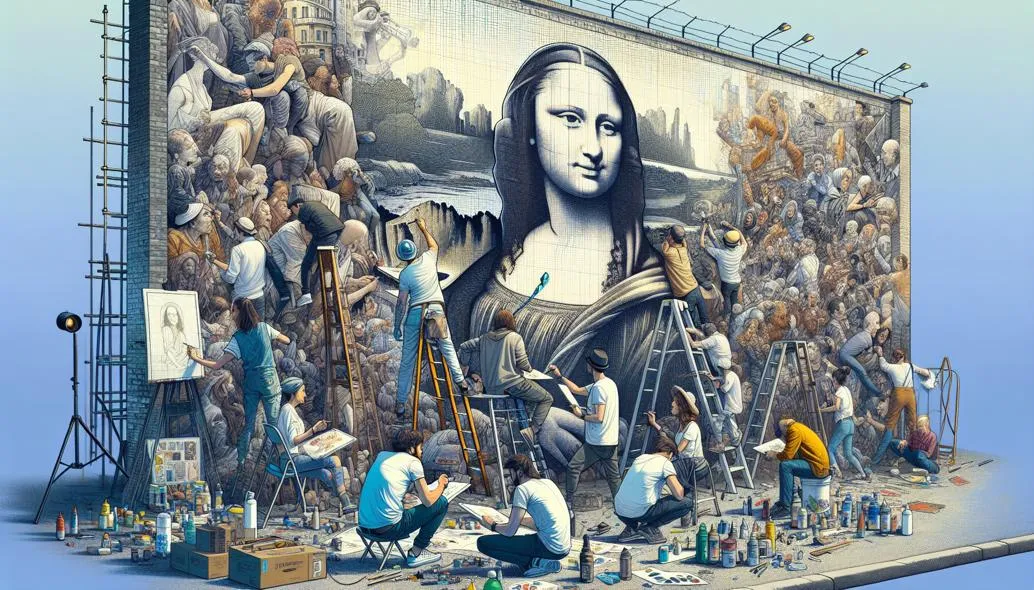
Street art demands precision at monumental scales, often on challenging surfaces. The grid method transforms ambitious designs into achievable projects, providing systematic approaches for scaling, proportion management, and working with urban architecture.
The Foundation of Large-Scale Street Art
The transition from sketchbook to building wall represents one of the most challenging aspects of street art creation. Artists must navigate not only dramatic scale changes but also environmental factors, architectural constraints, and public visibility that studio work never encounters. The grid method has emerged as the professional standard for managing these complexities, providing a systematic framework that transforms seemingly impossible projects into manageable, section-by-section achievements.
Street artists worldwide rely on grid systems to maintain accuracy across surfaces that can span hundreds of square feet. This mathematical approach to art creation bridges the gap between initial concept and final execution, ensuring that the intimate details conceived in a small sketch translate effectively to architectural scale. The method's reliability has made it indispensable for both emerging street artists and established muralists working on commissioned pieces.
Understanding Street Art's Unique Environmental Challenges
If you’re sketching for street art, a grid helps you keep proportions consistent when you’re working fast or scaling up. You can generate a reference grid with our grid for drawing.
Street art operates within an entirely different paradigm from traditional studio practice. The urban environment presents a complex matrix of challenges that demand specialized approaches and adaptive techniques. Unlike the controlled conditions of indoor spaces, street artists must contend with weather variations, surface irregularities, time constraints, and the constant presence of an audience.
Surface Complexity and Material Considerations
Urban walls rarely present ideal painting surfaces. Artists encounter brick, concrete, metal, wood, and often combinations of materials within a single piece. Each surface type responds differently to paint application, affects color appearance, and presents unique adhesion challenges. Brick walls offer natural grid patterns through mortar lines but also create texture variations that can distort fine details. Concrete surfaces may appear smooth from a distance but often feature expansion joints, patches, and weathering patterns that must be incorporated into the design strategy.
The existing condition of walls adds another layer of complexity. Previous paint layers, repairs, moisture damage, and structural elements all influence how new artwork will appear and endure. Professional street artists develop expertise in reading these surfaces, understanding how different materials will interact with their chosen mediums, and adapting their grid systems to accommodate these realities.
Scale Psychology and Perception Management
Working at monumental scale challenges human perception in fundamental ways. What appears proportionally correct when standing close to a wall often reveals distortions when viewed from intended distances. The grid method provides an objective framework that overrides these perceptual tricks, maintaining accuracy regardless of the artist's position relative to the work.
The psychological impact of scale cannot be understated. Artists accustomed to working within arm's reach suddenly find themselves managing compositions that require ladders, scaffolding, or mechanical lifts to access. This physical separation from the work demands a different mindset and working method. The grid system becomes not just a tool for accuracy but a source of confidence, providing clear benchmarks and progress indicators throughout the creation process.
Environmental Variables and Adaptive Planning
Weather conditions significantly impact street art execution. Wind affects spray control, temperature influences paint drying times, and humidity can cause unexpected color shifts. The grid method provides structure within this variability, allowing artists to work systematically even when conditions force changes in technique or scheduling.
Light conditions throughout the day create another variable requiring careful consideration. Morning light may reveal texture and detail differently than afternoon sun, while artificial street lighting can completely transform color perception. Professional street artists plan their grid work to accommodate these changes, often marking critical reference points that remain visible under various lighting conditions.
Advanced Grid Systems for Urban Canvases
The application of grid systems to urban surfaces requires sophisticated understanding of both architectural forms and artistic adaptation. Unlike the predictable flat surfaces of canvas or paper, city walls present three-dimensional challenges that demand creative solutions while maintaining the mathematical precision that makes grid methods effective.
Adapting Grid Frameworks to Complex Architecture
Urban architecture rarely provides simple rectangular surfaces. Buildings feature windows, doors, pipes, vents, electrical boxes, and countless other protrusions that interrupt the ideal painting surface. Professional street artists have developed specialized techniques for incorporating these elements into their grid systems rather than viewing them as obstacles.
The fundamental principle involves creating flexible grid zones that acknowledge architectural reality. Rather than forcing a rigid grid across an entire wall, experienced artists divide surfaces into logical sections based on architectural features. A wall with three windows might be approached as four distinct grid areas - the spaces between and around the windows - each with its own grid scale and reference system.
Curved and Angular Surfaces
Modern architecture often features curved walls, angular projections, and complex geometric forms that challenge traditional grid application. These surfaces require modified grid systems that account for perspective distortion and viewing angles. Artists working on curved surfaces often employ radial grid patterns that expand from a central point, maintaining proportional relationships while acknowledging the surface's dimensionality.
Angular surfaces, such as building corners or recessed sections, demand careful planning to maintain visual coherence. The grid must transition smoothly across angle changes, often requiring mathematical calculations to adjust spacing and proportion. Professional muralists develop custom grid solutions for each unique architectural situation, sometimes combining multiple grid types within a single composition.
Material Transition Zones
Buildings frequently feature multiple materials - brick transitioning to metal siding, concrete meeting glass, or stucco adjacent to wood. Each material presents different painting characteristics, texture considerations, and durability factors. Grid systems must account for these transitions, often adjusting scale or technique at material boundaries.
The grid method provides a framework for managing these transitions systematically. Artists map material changes during the planning phase, adjusting their grid to align with natural breaking points. This approach ensures that design elements don't awkwardly straddle material transitions, which could compromise both aesthetics and longevity.
Surface-Specific Grid Implementation Strategies
Brick Wall Mastery
Brick surfaces offer unique opportunities and challenges for grid-based work. The existing mortar lines create a natural grid that artists can either embrace or must work to override. Professional street artists have developed several approaches to brick wall grids:
The integration method uses existing mortar lines as grid guides, aligning the artistic grid with the wall's inherent structure. This approach works particularly well for geometric designs or when the brick pattern complements the artistic vision. Artists count brick courses vertically and brick lengths horizontally, using these measurements as their base unit.
The overlay method treats brick texture as a background element, establishing an independent grid system using chalk lines or string. This approach requires careful marking to ensure visibility against the varied brick surface. Artists often use bright chalk colors or temporary marking paint that contrasts with both brick and mortar tones.
Surface preparation becomes critical on brick walls. Older brick may be porous and absorbent, requiring primer application before grid marking. The texture depth of brick - often varying by an inch or more - creates shadow patterns that can obscure grid lines under certain lighting conditions. Professional artists plan grid marking sessions during optimal light conditions and often photograph their grid setup for reference.
Concrete Surface Strategies
Concrete walls, whether smooth or textured, present different challenges than brick. Smooth concrete allows for precise grid marking but may require special considerations for paint adhesion. Textured concrete, common in brutalist architecture or infrastructure walls, demands adaptive grid techniques.
Expansion joints in concrete create natural division points that smart artists incorporate into their grid planning. These joints, designed to prevent cracking as concrete expands and contracts, can serve as major grid lines or composition boundaries. Understanding the structural purpose of these features helps artists work with rather than against the architecture.
Weather-worn concrete often features staining, efflorescence, or previous paint layers that affect both appearance and paint adhesion. Grid planning must account for these variations, potentially adjusting design elements to minimize the impact of surface irregularities. Some artists incorporate weathering patterns into their designs, using the grid to systematically map and respond to existing surface conditions.
Metal Surface Adaptations
Metal surfaces, increasingly common in contemporary urban architecture, require specialized grid approaches. Corrugated metal creates a pronounced linear pattern that can either complement or conflict with artistic grids. Artists must decide whether to align with corrugation ridges or establish an independent grid system.
Temperature expansion poses unique challenges for metal surface work. Grid lines marked during cool morning hours may shift position as metal expands in afternoon heat. Professional artists account for this movement, using flexible marking systems and allowing tolerance in their grid precision. Some use magnetic markers on ferrous metals, creating repositionable grid references.
Surface preparation on metal often involves dealing with rust, oxidation, or protective coatings. These conditions affect both grid marking visibility and paint adhesion. Artists develop expertise in identifying metal types and conditions, adjusting their grid marking methods accordingly. Primer selection becomes critical, as it must bond with the metal while providing a suitable surface for grid marking.
Professional Scaling Techniques for Monumental Works
The mathematics of scaling represents the critical bridge between artistic vision and architectural reality. Street artists must master not only the basic principles of proportional enlargement but also the practical techniques for implementing these calculations on irregular surfaces under challenging conditions.
Mathematical Foundations of Scale Transfer
Professional scaling begins with precise measurement and calculation. The relationship between sketch and wall must be established with mathematical certainty before any marking begins. This process involves more than simple multiplication - it requires understanding how proportions translate across vastly different scales and how viewing distance affects perception.
Establishing Scale Ratios
The first step involves determining the optimal scale relationship between reference sketch and final wall. This decision balances several factors: the level of detail in the original design, the texture of the wall surface, the primary viewing distance, and the time available for execution. Professional artists often work with standard scale ratios that they've proven through experience.
Common scaling ratios for street art include:
- 1:10 for highly detailed work on smooth surfaces
- 1:20 for standard mural work with moderate detail
- 1:50 for large-scale pieces viewed from distance
- 1:100 for building-sized works with bold, simple designs
The chosen ratio must accommodate the smallest meaningful detail in the design. If the original sketch contains elements smaller than what can be practically rendered at wall scale, the artist must either increase the scale ratio or simplify the design during transfer.
Calculation Systems and Verification
Professional street artists develop systematic approaches to scaling calculations that minimize error and maximize efficiency. The grid method excels here because it breaks complex calculations into simple, repeatable units. Rather than scaling entire compositions, artists scale individual grid squares, maintaining accuracy through compartmentalization.
A typical calculation workflow proceeds as follows:
- Measure the sketch dimensions precisely, accounting for any borders or margins
- Measure the available wall space, noting any obstacles or boundaries
- Calculate the maximum scale that fits within constraints
- Adjust for optimal viewing distance and proportion
- Verify calculations through test measurements
- Document all measurements for team reference
Practical Scaling Examples
Consider a detailed portrait sketch measuring 11" x 14" being transferred to a wall measuring 22' x 28'. The exact 24:1 ratio creates convenient mathematics - each inch on the sketch equals exactly two feet on the wall. A 1" grid on the sketch translates to a 2' grid on the wall, allowing for straightforward mental calculation during work.
However, real-world scenarios rarely offer such convenient mathematics. A sketch measuring 9" x 12" transferred to a wall measuring 15' x 23' requires more complex calculations. The artist must decide whether to maintain aspect ratio (resulting in unused wall space) or adjust the composition to fill the available area. Most professionals maintain aspect ratio to preserve the original design's proportions, using the extra space for complementary elements or negative space.
Advanced Grid Application Techniques
The physical application of grids to large surfaces requires specialized tools, techniques, and considerable experience. Professional street artists have developed refined methodologies that balance precision with practical efficiency.
Professional Grid Marking Tools
Modern street artists employ an arsenal of specialized tools for grid creation:
Chalk Snap Lines: The workhorse of grid marking, chalk lines create temporary, visible guides that won't damage surfaces. Professional-grade lines feature high-visibility chalk in various colors, allowing artists to differentiate between major and minor grid lines. The technique requires two people for walls over 20 feet, with careful tension control to ensure straight lines.
Laser Level Systems: Technology has revolutionized grid accuracy for street art. Cross-line lasers project perfectly perpendicular reference lines across entire walls, eliminating cumulative measurement errors. Professional artists use construction-grade lasers with ranges exceeding 100 feet, mounting them on stable tripods and protecting them from vibration.
Measuring Equipment: Long tape measures (100' minimum) with standout capability reduce sagging over distance. Many artists prefer fiberglass tapes that won't stretch or conduct electricity near power lines. Digital measuring wheels provide quick verification of large distances, particularly useful for ground-level reference marks.
String Grid Systems: For complex or curved surfaces, physical string grids provide three-dimensional reference. Artists stretch weather-resistant cord between secure anchor points, creating a grid that floats inches from the wall surface. This technique works particularly well for surfaces with deep texture or multiple planes.
Systematic Marking Processes
Efficient grid application follows established protocols that minimize error accumulation:
1. Establishing Primary Axes: Before creating the full grid, artists establish perfectly perpendicular baseline axes. These primary lines, typically running through the composition's center, serve as reference for all subsequent measurements. Many artists use the "3-4-5 triangle" method to verify perpendicularity, especially on large walls where small angular errors compound dramatically.
2. Creating Reference Points: Rather than attempting to mark entire lines across vast surfaces, experienced artists first establish intersection points. These points, marked with bright chalk or temporary paint, can be verified for accuracy before connecting. This approach allows for error correction before committing to full lines.
3. Progressive Grid Development: Professional practice involves building grids progressively from major to minor divisions. Primary lines divide the wall into large sections, secondary lines create the working grid, and tertiary lines may be added in areas requiring fine detail. This hierarchical approach maintains accuracy while allowing flexibility.
4. Verification Protocols: Throughout the marking process, artists continuously verify measurements and alignments. Diagonal measurements between grid intersections confirm square accuracy. Viewing the grid from the primary viewing distance reveals any perspective distortions requiring correction.
Comprehensive Planning and Pre-Production Methods
The success of large-scale street art depends heavily on thorough preparation and strategic planning. Professional artists understand that time invested in pre-production multiplies efficiency during execution, reducing errors, minimizing material waste, and ensuring the final work matches the original vision.
Design Development Process
The journey from initial concept to wall-ready design involves multiple stages of refinement, each building upon the previous to create a comprehensive execution plan. This systematic approach transforms loose ideas into precise blueprints for large-scale implementation.
Conceptual Evolution and Refinement
The design process begins with exploratory sketches that capture the essential spirit of the piece. These initial drawings focus on overall composition, major elements, and emotional impact rather than precise details. Artists often create dozens of thumbnail sketches, exploring different approaches to the same concept before selecting the most promising direction.
Once a direction is chosen, the refinement process begins. Artists develop more detailed drawings, establishing exact proportions, defining specific elements, and resolving compositional challenges. This stage often reveals issues that weren't apparent in looser sketches - how elements interact, where focal points fall, and whether the design reads clearly at scale.
Color studies represent a critical development phase often overlooked by beginners. The way colors appear on paper or screen differs dramatically from their appearance on urban surfaces. Professional artists create multiple color variations, testing combinations under different lighting conditions. They consider how colors will interact with existing wall tones, how weather might affect appearance, and how viewing distance influences color perception.
Grid Integration Planning
The final design stage involves overlaying a precise grid system onto the refined artwork. This step requires careful consideration of scale, wall dimensions, and practical execution factors. Artists must decide on grid density - too fine and execution becomes tedious, too coarse and accuracy suffers.
Professional practice involves creating multiple grid overlays:
- A master grid for overall proportion and placement
- Detail grids for complex areas requiring precision
- Simplified grids for large color fields or atmospheric effects
- Reference grids linking sketch sections to wall zones
Digital Tools and Modern Planning Methods
Contemporary street artists leverage digital technology throughout the planning process. These tools don't replace traditional skills but enhance precision and efficiency in ways previously impossible.
Photo manipulation software allows artists to test designs on actual wall photographs. By photographing the intended surface from various angles and distances, artists can digitally apply their designs, revealing how perspective, lighting, and architectural features affect the final appearance. This process often leads to design adjustments that improve the work's impact.
Digital grid overlay systems provide mathematical precision in planning. Artists can create perfectly proportioned grids, test different scales, and generate reference materials for field use. Some artists print large-format grid references, laminate them for weather resistance, and use them as constant visual guides during execution.
Perspective correction tools help artists understand how their work will appear from primary viewing angles. What looks correct in orthographic projection may appear distorted from street level. Digital tools allow artists to pre-correct for these distortions, ensuring the final work appears properly proportioned from intended viewing positions.
Comprehensive Site Analysis
Professional site analysis goes far beyond simply measuring wall dimensions. It encompasses a thorough understanding of the physical, environmental, and social context in which the artwork will exist.
Physical Site Documentation
The foundation of site analysis involves precise documentation of physical conditions. Artists create detailed wall maps noting:
- Exact dimensions including height variations
- Surface material changes and conditions
- Architectural features and obstacles
- Existing damage, repairs, or problem areas
- Sun exposure patterns throughout the day
- Shadow patterns from nearby structures
Photography plays a crucial role in documentation. Artists capture the wall from multiple angles and distances, creating a comprehensive visual record. These photos serve multiple purposes: design development reference, grid planning aids, and progress documentation. Professional artists photograph walls at different times of day, revealing how changing light affects visibility and color appearance.
Environmental Condition Assessment
Understanding local weather patterns proves essential for scheduling and technique selection. Artists research:
- Seasonal temperature ranges affecting paint performance
- Precipitation patterns and wall water exposure
- Wind patterns that might affect spray control
- Humidity levels influencing drying times
- Air quality factors requiring respiratory protection
This environmental data influences everything from material selection to work scheduling. High humidity might necessitate different paint formulations, while prevalent winds could require adjusted spray techniques or protective screening during work.
Access and Logistics Planning
Large-scale street art often requires equipment ranging from simple ladders to complex scaffolding systems or mechanical lifts. Site analysis must evaluate:
- Ground conditions for equipment placement
- Overhead obstacles like power lines
- Access routes for equipment delivery
- Storage possibilities for materials
- Safety zones for public protection
- Electrical access for powered equipment
Artists create detailed logistics plans mapping equipment positions, establishing safe work zones, and planning material staging areas. This planning proves especially critical for projects requiring road closures or sidewalk restrictions.
Strategic Execution Methods for Large-Scale Works
The execution phase transforms careful planning into visible reality. This stage demands not only artistic skill but also project management expertise, safety awareness, and adaptive problem-solving abilities. Professional street artists develop systematic approaches that maintain quality while working efficiently under challenging conditions.
Working at Height: Safety and Precision
Large-scale street art invariably requires working at elevation, introducing complexity that goes beyond simple artistic challenges. Height affects everything from tool handling to color perception, demanding specialized techniques and unwavering attention to safety.
Equipment Selection and Setup
The choice between scaffolding, scissor lifts, boom lifts, or swing stages depends on wall configuration, project duration, and budget constraints. Each option presents unique advantages and challenges for grid-based work:
Scaffolding provides stable, extensive platforms ideal for detailed work. Artists can move freely along scaffolding levels, maintaining consistent reference to their grid system. However, scaffolding can obscure overall composition viewing and requires careful planning to avoid blocking critical sight lines during work.
Mechanical lifts offer flexibility and rapid repositioning but create challenges for grid reference. The platform movement can disorient artists, making consistent grid alignment difficult. Professional artists develop techniques for maintaining orientation, often using laser levels mounted on lift platforms to project reference lines.
Maintaining Grid Reference at Elevation
Working at height fundamentally changes an artist's relationship with their grid system. What appears aligned from ground level may look different from scaffolding height. Professional artists employ several strategies to maintain accuracy:
The primary technique involves establishing fixed reference points visible from all working positions. These might include:
- Plumb lines dropped from wall top to ground
- Laser cross-lines projected across the work surface
- Physical markers attached at grid intersections
- Ground-level grid maps with clear numbering systems
Communication systems become critical when working at height. Teams develop standardized terminology for grid references, allowing ground-level assistants to guide artists who can't see the overall composition. Some teams use wireless communication systems, enabling constant dialogue about proportion and placement.
Progressive Section Completion
Height work demands systematic progression through the composition. Random jumping between areas wastes time and increases safety risks from unnecessary equipment movement. Professional artists plan execution sequences that minimize repositioning while maintaining artistic flow.
The grid system facilitates this systematic approach. Artists complete entire grid sections before moving, ensuring consistent quality and proportion throughout. This method also provides natural breaking points for shift changes or weather interruptions, as each completed section stands independently.
Time Management and Efficiency
Street art projects often face strict time constraints due to permits, weather windows, or commission deadlines. The grid method, properly implemented, becomes a powerful time management tool enabling predictable progress and efficient resource use.
Strategic Planning for Time Optimization
Professional artists begin with realistic time estimates based on grid section complexity. Detailed areas might require several hours per grid square, while large color fields progress rapidly. By analyzing the design through the grid framework, artists can:
- Schedule complex sections during optimal conditions
- Assign team members based on skill specialization
- Plan material preparation for maximum efficiency
- Build in buffer time for weather delays
Systematic Execution Protocols
Efficiency comes from eliminating decision-making during execution. The grid system provides a clear roadmap, allowing artists to focus on technique rather than constantly referencing plans. Professional protocols include:
Pre-marking all critical grid points during optimal conditions ensures reference visibility throughout the project. Artists use weather-resistant markers or small drilled holes that remain visible even if surface marks fade. This investment of time during good conditions pays dividends when working under pressure.
Color organization by grid section reduces mixing time and ensures consistency. Artists pre-mix colors in quantities calculated for specific grid areas, labeling containers with grid references. This system minimizes waste while ensuring color matches across sections completed on different days.
Tool organization follows grid progression. Artists arrange brushes, cans, and equipment in the sequence needed for each section, eliminating time spent searching for materials. Some teams use mobile carts organized by grid zone, moving systematically across the wall.
Weather Window Management
Weather represents the most unpredictable factor in street art execution. Professional artists develop flexible systems that maximize productivity within available windows:
Critical path planning identifies elements that must be completed in specific weather conditions. For example, fine detail work requires calm conditions, while base coating can proceed in moderate wind. The grid system allows artists to jump between sections based on conditions, always maintaining progress.
Quick-setup systems minimize time lost to weather changes. Artists develop rapid deployment methods for protective coverings, tool organization systems that pack quickly, and reference materials that withstand moisture. The grid provides restart points, allowing work to resume exactly where it stopped.
Managing Public Interaction
Street art happens in public view, creating unique dynamics absent from studio work. The presence of observers affects everything from artist concentration to safety protocols. Professional artists develop strategies for managing this public dimension while maintaining focus on their work.
Community Engagement Strategies
Rather than viewing public attention as distraction, experienced street artists recognize engagement opportunities. The grid method provides an excellent educational tool, allowing artists to explain their process in terms observers can understand. Some artists:
- Post information boards explaining the grid transfer process
- Schedule specific times for public interaction
- Assign team members to handle questions
- Document public reactions for portfolio use
Safety and Crowd Management
Public spaces require constant attention to safety, both for artists and observers. Professional practice includes:
- Clear barrier systems defining safe viewing distances
- Signage explaining hazards and viewing recommendations
- Scheduled breaks for public photo opportunities
- Coordination with local authorities for crowd control
Artistic Expression Within Grid Framework
The grid method provides structure, but artistic expression must flow within and transcend that framework. Professional street artists master the balance between systematic precision and creative spontaneity, using the grid as a foundation for, not a limitation on, their artistic voice.
Scaling Artistic Style and Mark-Making
The translation of intimate brushwork to architectural scale represents one of street art's greatest challenges. A delicate brushstroke that creates texture in a small painting must be reimagined for wall-scale application while maintaining its essential character.
Understanding Scale Relationships
Professional artists recognize that simply enlarging mark-making proportionally rarely succeeds. A one-inch brushstroke scaled to two feet often appears crude and lacks the sophistication of the original. Instead, artists develop scaled interpretations that capture the spirit while adapting to the new context.
The key lies in understanding what each mark communicates. A quick, gestural stroke in a sketch might indicate movement or energy. At wall scale, this might translate to a swept spray pattern, a bold brush gesture, or even a color transition. The grid provides the placement framework, but the artist must interpret how to achieve the intended effect at scale.
Tool Selection and Adaptation
Street scale demands different tools than studio work. Professional artists build extensive tool collections suited to various scales and effects:
- Wide brushes and rollers for efficient large area coverage
- Extension poles allowing broad gestures from ground level
- Spray systems ranging from aerosol to airless sprayers
- Detail brushes for precision work within larger contexts
- Texture tools including sponges, rags, and custom implements
The grid system helps artists plan tool transitions. By analyzing each grid section's requirements, artists can organize tools systematically, switching implements at logical breaking points rather than constantly changing based on immediate needs.
Maintaining Gestural Quality
Large-scale work can easily become stiff and mechanical, losing the spontaneity that gives art life. Professional street artists develop techniques for maintaining gestural quality within the grid framework:
Physical warm-ups before painting help artists find their rhythm. Just as musicians practice scales, visual artists benefit from movement exercises that prepare their bodies for large-scale mark-making. Some artists practice gestures on paper at the intended wall scale, building muscle memory for the actual execution.
The grid provides anchor points while allowing freedom between them. Artists might precisely place the start and end of a sweeping line according to grid references but allow the line itself to flow naturally. This combination of precision and spontaneity creates dynamic work that feels both controlled and alive.
Strategic Detail Distribution
Not every area of a large mural requires the same level of detail. Professional artists understand how viewing distance and human attention patterns influence where detail is most effective. The grid system facilitates strategic planning of detail distribution.
Focal Point Development
Every successful composition has primary focal points that draw initial attention. In street art, these areas often coincide with average eye level from primary viewing positions. Artists concentrate their finest detail work in these zones, knowing viewers will naturally examine them closely.
The grid helps quantify this distribution. Artists might designate certain grid sections as primary detail zones, others as secondary, and some as atmospheric or background. This systematic approach ensures appropriate time and effort allocation across the entire composition.
Distance Viewing Considerations
Street art must function at multiple viewing distances. What reads clearly from across a street might dissolve into chaos when viewed up close, while detailed areas might disappear entirely from distance. Professional artists plan for this multi-scale viewing:
- Far viewing (50+ feet): Bold shapes, strong value contrasts, clear silhouettes
- Middle distance (15-50 feet): Secondary details, color variations, major textures
- Close viewing (under 15 feet): Fine details, subtle color mixing, surface textures
The grid system allows artists to assign different treatment strategies to different zones based on typical viewing patterns. Areas primarily visible from distance receive bold, simplified treatment, while zones at eye level for passing pedestrians might feature intricate detail work.
Texture Suggestion Techniques
Large-scale texture creation requires different approaches than small-scale rendering. Rather than attempting to paint every brick in a wall or leaf on a tree, professional artists develop suggestion techniques that create texture impression without laborious detail.
The grid provides a framework for systematic texture application. Artists might fully render texture in one grid square, then systematically reduce detail in surrounding squares, creating a gradient from specific to suggested. This approach saves time while maintaining visual richness.
Common texture suggestion techniques include:
- Pattern interruption: Full detail in select areas with simplified pattern elsewhere
- Edge definition: Sharp detail at edges fading to suggestion in centers
- Value variation: Using light/dark patterns to suggest form without line detail
- Color temperature: Warm/cool shifts creating depth without specific rendering
Color Strategy and Application
Color behavior at architectural scale differs significantly from studio expectations. The grid method provides a systematic approach to color planning and application that ensures consistency across vast surfaces while allowing for artistic variation.
Large Area Color Management
Covering hundreds of square feet with consistent color requires both planning and technique. Professional artists approach large color areas systematically:
Base blocking establishes overall color relationships quickly. Using the grid as a guide, artists apply base colors to entire sections before adding detail. This approach allows evaluation of overall color balance early in the process, when adjustments remain relatively simple.
Color mixing strategies must account for scale. Mixing enough paint for large areas while maintaining consistency requires careful planning. Artists often pre-mix quantities based on grid section calculations, storing excess in labeled containers for touch-ups or adjacent areas.
The grid system facilitates color notation. Artists develop shorthand systems noting color mixtures for each grid section, ensuring they can match colors days or weeks later. Some photograph mixed colors next to grid references, creating visual recipes for future matching.
Gradient and Transition Planning
Smooth color transitions across large surfaces require systematic approaches. The grid provides measurement framework for planning gradients:
Mathematical gradient planning divides transitions into grid-based steps. For example, a sky gradient across 20 feet might use 10 grid sections, with each section representing a measured color shift. This systematic approach ensures smooth transitions without abrupt changes.
Atmospheric effects benefit particularly from grid-based planning. Fog, smoke, or light effects that must appear natural while being painted systematically can be mapped across grid sections with predetermined opacity levels or color shifts.
Color Temperature Management
Large outdoor surfaces experience dramatic light changes throughout the day. Morning light might make colors appear cool, while afternoon sun warms them considerably. Professional artists plan for these shifts:
- Testing colors under various light conditions
- Adjusting mixtures to appear correct under primary viewing conditions
- Planning execution sequence to maintain consistency
- Using the grid to track areas painted under different light
Overcoming Common Street Art Grid Challenges
Professional street artists encounter predictable challenges when applying grid methods to urban surfaces. Understanding these common obstacles and their solutions helps artists prepare effectively and maintain confidence when difficulties arise.
Perspective Distortion and Viewing Angle Corrections
The three-dimensional nature of urban environments creates complex perspective challenges absent from flat studio surfaces. Buildings are viewed from various angles, distances, and elevations, each creating different perspective distortions that can undermine carefully planned proportions.
Understanding Viewer Perspective
Most street art is viewed from below and at an angle, rather than straight-on at eye level. This viewing reality means that perfectly proportioned grid transfers often appear distorted to observers. The top of a building-height mural might be viewed at a 45-degree angle or steeper, causing significant foreshortening.
Professional artists map primary viewing positions during site analysis. They identify:
- Most common pedestrian viewing points
- Vehicle passenger perspectives
- Long-distance viewing angles
- Optimal photography positions
This mapping informs decisions about proportion adjustment. Some artists create separate sketches showing how the design should appear from key viewing positions, then reverse-engineer the distortions needed on the actual wall surface.
Anamorphic Techniques
Advanced practitioners employ anamorphic projection principles, deliberately distorting their grid to create proper proportions from specific viewing angles. This technique requires:
- Photographing the wall from the primary viewing position
- Creating the design as it should appear from that viewpoint
- Projecting the design onto the wall photograph
- Mapping how the grid must distort to achieve the correct view
- Applying the distorted grid to the actual wall
While complex, this approach creates stunning effects where murals appear to leap from walls or create perfect proportions despite extreme viewing angles. The grid method makes such precision possible by providing measurable reference points throughout the distortion process.
Practical Correction Methods
Not every project requires full anamorphic treatment. Professional artists employ various practical corrections:
- Progressive enlargement: Gradually increasing scale toward the top of tall murals
- Selective distortion: Adjusting only critical elements like faces or text
- Viewing zone optimization: Designing for the most common viewing distance
- Multi-perspective solutions: Creating compositions that work from various angles
Managing Surface Irregularities
Urban walls rarely provide perfectly flat painting surfaces. From subtle undulations to dramatic protrusions, surface irregularities challenge grid accuracy and artistic execution. Professional artists view these irregularities not as obstacles but as characteristics to incorporate into their work.
Comprehensive Surface Mapping
Before applying any grid, thorough surface analysis reveals irregularities that might affect the work. Artists use several mapping techniques:
String line testing involves stretching tight strings across the wall at various heights and orientations. Gaps between string and wall reveal surface undulations. Artists mark these variations on their planning documents, noting both location and severity.
Light raking uses portable lights positioned to cast shadows across the surface. This technique reveals subtle irregularities invisible under normal lighting. Evening or early morning sun provides natural raking light for this analysis.
Physical measurement with straight edges and levels quantifies irregularities. Artists measure deviation from plane at grid intersection points, creating topographical maps of their painting surface.
Adaptive Grid Strategies
Once irregularities are mapped, artists adapt their grid system to accommodate surface reality:
Flexible grid zones allow the grid to follow surface contours rather than fighting them. On a wall with a subtle bow, the grid might curve slightly to maintain consistent surface contact. This approach works well for organic designs where slight distortions won't be noticed.
Bridging techniques maintain grid accuracy across irregularities. Artists might use straight edges or string lines to bridge depressions, marking the true grid line while acknowledging the surface drops away beneath. This maintains proportion while accepting surface variation.
Design integration incorporates irregularities into the artistic concept. A protruding pipe might become a tree trunk, a surface depression might house a shadow. By planning these integrations during design phase, artists transform problems into features.
Overcoming Scale Intimidation
The sheer size of street art projects can overwhelm artists accustomed to intimate scale work. Standing before a blank wall stretching stories above creates psychological barriers that grid methods help overcome through systematic compartmentalization.
Psychological Strategies
Professional artists recognize that scale intimidation is primarily mental rather than technical. They develop strategies to maintain confidence:
Section-focused thinking trains the mind to see individual grid squares rather than overwhelming totality. Artists consciously limit their attention to the current working section, trusting the grid system to maintain overall coherence.
Progress documentation provides tangible evidence of advancement. Photographing the work at regular intervals, particularly at grid section completions, creates a visual record of achievement. Reviewing this documentation reinforces capability and progress.
Milestone celebration acknowledges achievements throughout the project. Completing major grid sections, finishing particular challenges, or reaching percentage milestones deserves recognition. This positive reinforcement maintains motivation across long projects.
Team Dynamics
Large projects benefit from team approaches that distribute both work and psychological load:
Skill-based assignment matches team members to grid sections suited to their strengths. Detail specialists focus on complex areas while others handle large color fields. This optimization builds confidence through success.
Rotation systems prevent fatigue and maintain fresh perspectives. Team members switch between different types of work - detailed sections, broad areas, ground-level support. This variety prevents both physical and mental exhaustion.
Collective problem-solving transforms challenges into team-building opportunities. When difficulties arise, group discussion often reveals solutions individuals might miss. The shared responsibility reduces individual pressure.
Professional Development and Best Practices
The transition from aspiring street artist to professional practitioner requires systematic skill development, strategic documentation, and business acumen. The grid method provides a foundation for this growth, offering measurable progress markers and portfolio-building opportunities.
Strategic Documentation Methods
Professional documentation serves multiple purposes beyond simple progress recording. It builds portfolios, attracts clients, protects against disputes, and provides learning materials for future projects. Systematic documentation using grid references creates particularly valuable records.
Comprehensive Photography Protocols
Professional street artists develop standardized photography routines that capture both process and results:
Pre-production documentation includes photographing the blank wall from multiple angles, recording surface conditions, and capturing lighting at different times. These images prove invaluable for future reference and client presentations. Grid overlay photos showing the planned scale relationship help clients visualize the final work.
Process documentation tracks daily progress with consistent photography positions. Artists establish fixed photo points aligned with grid references, ensuring comparable images throughout the project. Time-lapse photography has become increasingly popular, with cameras positioned to capture entire grid sections filling with art over days or weeks.
Detail photography captures the nuance that wide shots miss. Professional artists photograph each completed grid section individually, creating high-resolution records of their technique. These detail shots prove invaluable for:
- Portfolio presentations showing skill level
- Social media content maintaining audience engagement
- Technical reference for color matching
- Insurance documentation if damage occurs
Final documentation requires particular attention. Artists capture the completed work under various lighting conditions, from multiple angles, and at different distances. They create both artistic beauty shots and technical documentation showing the entire piece clearly. Many professionals hire architectural photographers for final documentation, recognizing the value of expert imaging.
Color and Technique Recording
Beyond visual documentation, professionals maintain detailed written records:
Color formulation logs record exact paint mixtures for each grid section. Artists develop notation systems capturing brand, color names, mixing ratios, and any medium modifications. This information proves invaluable for touch-ups, similar projects, or teaching purposes.
Technique notes document specific methods used in different sections. Which brushes created certain textures, spray techniques for gradients, or tools for special effects - all recorded with grid references. These notes become personal technique libraries, consulted for future projects.
Time tracking by grid section provides valuable data for estimating future projects. Knowing that detailed portrait sections average four hours per square meter while sky gradients progress at twenty square meters per hour enables accurate project planning and pricing.
Advanced Collaboration Strategies
Large-scale street art often requires team execution. Managing multiple artists while maintaining cohesive style demands sophisticated coordination systems, with the grid method providing essential organizational structure.
Team Organization and Roles
Professional projects assign team members specific roles that maximize efficiency:
Lead artists maintain overall vision and handle critical elements like faces or focal points. They establish style guides showing technique examples for different elements, ensuring consistency across team members. The grid system allows them to assign specific sections based on skill levels and specialties.
Section specialists take ownership of major grid zones. One artist might handle all architectural elements, another manages organic forms, while someone else focuses on atmospheric effects. This specialization improves both quality and efficiency.
Support team members handle base coating, grid marking, material preparation, and documentation. These roles, while less glamorous, prove essential for smooth project flow. Experienced teams rotate members through support roles, preventing burnout and building comprehensive skills.
Style Consistency Maintenance
Maintaining consistent style across multiple artists challenges even experienced teams. Professional approaches include:
Technique workshops before project commencement where the lead artist demonstrates specific approaches. Team members practice techniques on sample boards, with grid sections helping quantify consistency. These sessions establish shared vocabulary and standards.
Reference boards positioned on-site show technique examples for quick consultation. Organized by grid section types - sky treatment, skin tones, architectural details - these boards ensure team members can verify their approach matches project standards.
Regular alignment checks bring the team together to view work from intended distances. The grid system facilitates these reviews by providing clear reference points for discussion. Teams might gather at specific times daily to evaluate overall progress and consistency.
Cross-checking systems pair artists to review each other's sections before the lead artist's final approval. This peer review catches inconsistencies early while building team cohesion. Grid references make feedback specific and actionable.
Legal Framework and Community Relations
Professional street art exists within complex legal and social frameworks. Understanding and navigating these systems distinguishes professionals from amateurs, with proper planning preventing costly problems.
Navigating Legal Requirements
The legal landscape for street art varies dramatically by location, but professionals develop systematic approaches to compliance:
Permission Documentation
Written agreements with property owners form the foundation of legal protection. Professional artists maintain standard contracts covering:
- Exact wall areas authorized (defined by grid coordinates)
- Design approval processes and revision limits
- Timeline and weather delay provisions
- Payment schedules tied to grid section completion
- Maintenance and warranty terms
- Insurance requirements and liability allocation
Municipal Compliance
Cities increasingly regulate large-scale murals through permit systems. Professional artists research requirements early, as permits can take weeks or months. Common requirements include:
- Design review by arts commissions
- Historic district considerations
- Sign ordinances that may classify murals as advertising
- Building permits for scaffolding or lifts
- Traffic control plans for sidewalk closures
The grid system helps with permit applications by providing precise area calculations and enabling clear communication about project scope. Some cities require grid overlays showing how murals relate to architectural features.
Insurance Considerations
Professional street artists carry comprehensive insurance covering:
- General liability for public protection
- Professional liability for design errors
- Equipment coverage for tools and lifts
- Workers compensation for team members
- Completion bonds for large commissions
Insurance companies often require detailed project plans, where grid documentation proves invaluable for demonstrating professional approaches and risk mitigation.
Building Community Support
Successful street artists recognize that community support can make or break projects. Professional approaches to community engagement create advocates rather than opponents.
Early Engagement Strategies
Before paint touches wall, professionals engage local communities:
- Presenting designs at community meetings
- Incorporating local historical or cultural elements
- Offering workshops for youth participation
- Creating opportunities for resident input
The grid method facilitates community engagement by making designs understandable to non-artists. Showing how sketches translate to walls through grid scaling helps residents visualize final results.
Building Your Street Art Practice
The journey from first wall to established street artist follows predictable stages. Understanding this progression helps artists set realistic goals and build systematically toward professional practice.
Progressive Skill Development
Professional street artists recommend a structured approach to building large-scale capabilities:
Foundation Phase: Small-Scale Mastery
Beginning with manageable surfaces allows artists to develop core skills without overwhelming logistics:
- Garage doors and small walls (under 100 square feet) provide ideal starting surfaces
- Garden walls and sheds offer private practice spaces for technique development
- Community boards and legal walls introduce public working dynamics
- Interior murals allow weather-independent skill building
During this phase, artists master basic grid transfer, develop efficient working methods, and build confidence in their scaling abilities. The manageable scale allows for complete projects in single sessions, providing quick satisfaction and portfolio pieces.
Expansion Phase: Single-Story Projects
With foundation skills established, artists progress to more substantial works:
- Single-story building walls introduce height considerations
- Longer walls require multi-day planning and execution
- Public commissions bring deadline and stakeholder management
- Varied surfaces expand technical capabilities
This phase challenges artists to develop project management skills alongside artistic growth. Grid systems become more complex, often incorporating multiple scales and detail levels. Artists learn weather management, material calculation, and client communication.
Professional Phase: Major Installations
Established artists tackle projects requiring comprehensive planning and execution:
- Multi-story buildings demand sophisticated equipment and safety protocols
- Complex architectural surfaces require adaptive grid strategies
- High-visibility locations bring media attention and public scrutiny
- Team-based projects develop leadership and coordination abilities
At this level, the grid method becomes second nature, with artists intuitively adapting systems to each unique challenge. Portfolio development focuses on documenting not just finished works but the professional process that creates them.
Master Phase: Innovative Applications
Experienced artists push boundaries and develop signature approaches:
- Anamorphic installations creating dimensional illusions
- Multi-surface compositions spanning various architectural elements
- Interactive or responsive works incorporating environmental factors
- Experimental techniques advancing the medium
Masters often develop proprietary grid systems adapted to their unique style or preferred subjects. They might create custom tools, develop innovative marking methods, or pioneer new scaling techniques that advance the field.
Essential Equipment Investment
Building a professional street art practice requires strategic equipment investment. Quality tools improve efficiency, safety, and finished results while demonstrating professionalism to clients.
Measurement and Marking Systems
Professional-grade measurement tools form the foundation of accurate grid work:
- Laser distance meters for quick, accurate wall measurement
- 100+ foot tape measures in both standard and metric
- Construction-grade levels ensuring true horizontal and vertical
- Chalk line reels with high-visibility chalk in multiple colors
- Weather-resistant markers for permanent reference points
Safety Equipment
Professional practice demands uncompromising safety standards:
- OSHA-approved harnesses for elevated work
- Industrial respirators with appropriate cartridges
- Safety glasses and face shields for spray work
- High-visibility clothing for traffic areas
- First aid supplies including eye wash stations
Application Tools
Quality painting implements adapted for large-scale work:
- Extension poles in various lengths for reach
- Professional spray equipment from aerosol to airless systems
- Wide brush selection including specialty texturing tools
- Rolling systems for efficient large area coverage
- Detail brushes maintaining quality at scale
Documentation Equipment
Professional documentation requires dedicated tools:
- Digital cameras with wide-angle capabilities
- Tripods for consistent progress photography
- Weatherproof storage for reference materials
- Tablet devices for digital reference viewing
- Portable lighting for detail work and documentation
Conclusion: Mastering Scale Through Systematic Practice
The grid method transforms the seemingly impossible challenge of creating building-sized artworks into a manageable, systematic process. Through careful planning, mathematical precision, and adaptive techniques, street artists worldwide use this time-tested approach to bring their visions to architectural scale.
Success in street art requires more than artistic skill - it demands project management capability, technical problem-solving, and professional discipline. The grid method provides the framework within which these various skills integrate, creating a comprehensive approach to large-scale urban art creation.
For artists beginning their street art journey, the grid method offers a proven path from small experiments to major installations. Each project builds upon previous experience, with the systematic nature of grid work creating measurable skill progression. Whether working alone on a garage door or leading a team on a multi-story mural, the fundamental principles remain constant: careful planning, precise measurement, and systematic execution.
The urban environment presents unique canvases that challenge and inspire artists to work at scales unimaginable in traditional settings. Through mastery of grid techniques adapted to street art's specific demands, artists transform blank walls into cultural landmarks, bringing beauty, meaning, and community identity to urban spaces worldwide.
Common Questions About Grid Methods for Street Art
For further study, explore large artworks guide.
Ready to Try the Grid Method?
Put these techniques into practice with our free grid generator tool—trusted by 170,000+ artists worldwide.
Create Your Grid Now →