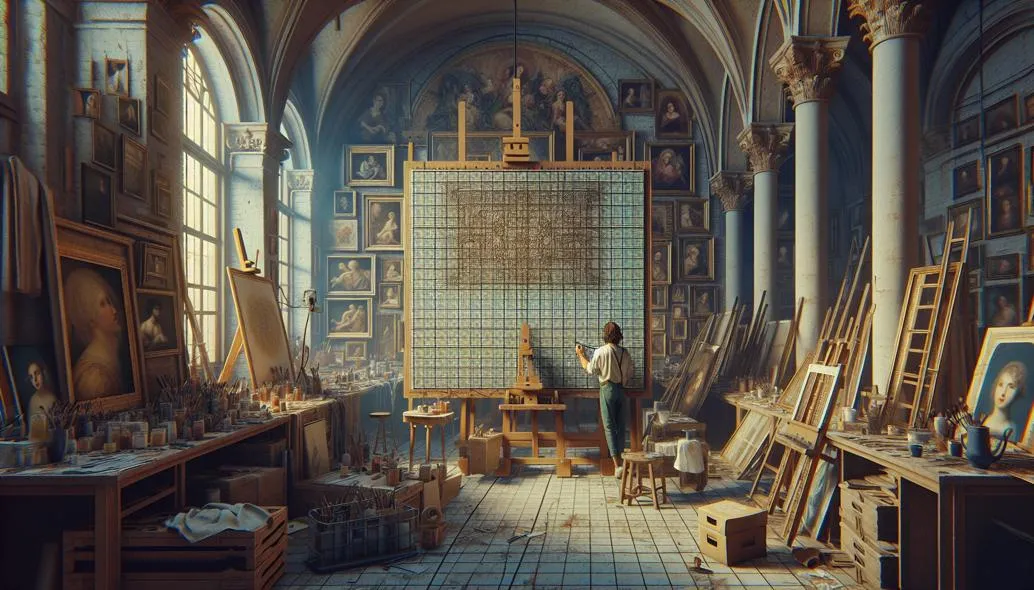
Complex drawing reproduction requires systematic approaches that transform overwhelming compositions into manageable construction sequences while maintaining accurate proportional relationships and preserving essential artistic qualities. Grid techniques provide essential frameworks for analyzing composition hierarchy, coordinating multiple elements, and developing the methodical construction skills necessary for successful reproduction of sophisticated artwork across various styles and complexity levels.
My first attempt at reproducing a complex Renaissance drawing resulted in a overwhelming experience that taught me harsh lessons about approaching sophisticated artwork without systematic methods. Despite reasonable drawing abilities, the intricate relationships between architectural elements, multiple figures, and detailed ornamentation created confusion that led to proportion errors and compositional breakdown. Learning to use methodical grid techniques for complex composition analysis transformed my approach, revealing that successful reproduction depends on systematic breakdown strategies rather than attempting to manage entire compositions simultaneously.
Complex drawings present unique challenges that extend beyond simple subject reproduction, requiring artists to coordinate multiple elements, maintain proportional relationships across diverse components, and preserve the essential character that distinguishes sophisticated artwork from simple studies. The most challenging complex drawings often combine multiple subjects, environmental elements, and detailed areas that demand systematic coordination to reproduce successfully.
Understanding Complex Drawing Challenges
If you’re reproducing a complex drawing, a grid gives you clear checkpoints so placement doesn’t drift. You can create one with our grid for drawing.
Compositional Complexity Analysis
Multi-element coordination requirements: Complex drawings typically combine multiple subjects, environmental elements, and detailed areas that must maintain accurate proportional relationships throughout the reproduction process. Understanding how to identify and prioritize these different elements enables systematic approaches that prevent overwhelming confusion during construction.
Hierarchical structure recognition:
- Primary elements: Major subjects or focal points requiring highest accuracy priority
- Secondary components: Supporting elements that must coordinate with primary subjects
- Background structures: Environmental elements providing context and spatial relationships
- Detail areas: Intricate sections requiring concentrated attention and specialized techniques
- Transitional zones: Areas where different elements interact and must be coordinated carefully
Scale relationship management: Complex compositions often incorporate elements at different scales—foreground details, middle-ground subjects, and background environments—that must maintain convincing spatial relationships. Grid analysis helps identify and preserve these critical scale relationships during reproduction.
Technical Reproduction Challenges
Reference material limitations: Complex drawing reproduction often involves working from reproductions of original artwork, creating additional challenges including color variations, detail loss, and scale uncertainties. Understanding how to work with imperfect reference materials while maintaining accuracy requires systematic approaches to information extraction and verification.
Construction sequence planning: Complex drawings require careful planning of construction sequences that build complexity systematically while maintaining accuracy throughout the process. Poor sequence planning can result in accumulated errors that become difficult to correct in advanced construction stages.
Quality control coordination:
- Proportional verification: Systematic checking of accuracy across multiple composition elements
- Construction consistency: Maintaining uniform quality standards throughout extended reproduction processes
- Detail integration: Ensuring that detailed areas support rather than conflict with overall composition
- Artistic unity: Preserving essential character while achieving technical accuracy
- Progress documentation: Recording development stages for consistency verification and problem identification
Professional Grid Systems for Complex Composition Breakdown
Hierarchical Grid Construction Methods
Master grid establishment: Complex reproduction begins with establishing master grid systems that coordinate overall composition while providing frameworks for detailed analysis. Master grids should align with major compositional divisions and structural elements rather than arbitrary geometric patterns.
Subdivision strategies for different complexity levels: Different areas of complex compositions require different levels of grid subdivision. Detailed areas benefit from fine grid divisions, while broader areas can be managed with larger grid sections. This adaptive approach focuses measurement precision where accuracy is most critical.
Multi-scale grid coordination:
- Composition-wide grids: Overall proportional relationships across entire artwork
- Section-specific grids: Detailed analysis for complex areas requiring concentrated attention
- Element-specific grids: Individual subject analysis within larger compositional contexts
- Detail grids: Fine subdivision for intricate patterns, textures, and ornamental elements
- Integration grids: Boundary areas where different elements interact and must be coordinated
Systematic Analysis and Planning Methods
Compositional structure identification: Before beginning any grid construction, successful complex reproduction requires careful analysis of compositional structure, identifying major elements, their relationships, and the logical construction sequence that will maintain accuracy throughout the reproduction process.
Priority establishment for construction sequence: Complex reproductions benefit from systematic priority establishment that determines which elements should be constructed first, which require coordination with other elements, and which can be completed independently without affecting overall accuracy.
Resource allocation planning:
- Time distribution: Allocating appropriate time for different complexity levels
- Attention management: Planning concentration periods for detailed areas
- Material preparation: Ensuring appropriate tools and materials for different construction phases
- Reference organization: Systematic arrangement of source materials for efficient access
- Quality checkpoints: Establishing verification points throughout construction process
Advanced Complex Reproduction Techniques
Multi-Element Coordination Strategies
Spatial relationship management: Complex drawings often incorporate multiple subjects that must maintain accurate spatial relationships throughout the reproduction process. Understanding how to coordinate these relationships systematically prevents proportion drift and ensures convincing three-dimensional space representation.
Ground plane establishment and maintenance: Many complex compositions include multiple subjects sharing common ground planes or environmental contexts. Grid techniques help establish and maintain these shared spatial relationships while allowing individual subjects to be constructed with appropriate detail and accuracy.
Scale consistency across diverse elements:
- Figure scaling: Maintaining consistent scale relationships between human subjects
- Architectural proportions: Ensuring building elements maintain accurate structural relationships
- Environmental scaling: Coordinating landscape and environmental elements appropriately
- Detail proportion: Managing ornamental and decorative elements at appropriate scales
- Atmospheric effects: Adjusting element prominence based on spatial position and artistic intent
Specialized Complex Drawing Categories
Architectural and urban scenes: Complex architectural subjects require understanding of perspective principles, structural relationships, and proportional systems that govern building construction. Grid analysis helps coordinate these systematic relationships while managing ornamental details and environmental integration.
Multiple figure compositions: Compositions including multiple human figures present unique challenges including individual proportion accuracy, interactive relationships, and coordinated positioning. Grid systems help maintain individual accuracy while ensuring convincing group relationships.
Natural environment complexity:
- Landscape integration: Coordinating multiple natural elements including terrain, vegetation, and atmospheric effects
- Organic pattern management: Systematic approaches to irregular natural patterns and textures
- Seasonal variation: Understanding how environmental conditions affect natural element appearance
- Weather effects: Incorporating atmospheric conditions that influence composition appearance
- Wildlife integration: Coordinating animal subjects with environmental contexts appropriately
Methodical Construction Sequences for Complex Work
Progressive Complexity Building
Foundation establishment: Complex reproduction success depends on establishing solid foundations that support increasing complexity without compromising overall accuracy. Understanding proper foundation establishment prevents problems that become difficult to correct in advanced construction stages.
Construction phase coordination: Professional complex reproduction typically involves multiple construction phases that build complexity systematically while maintaining quality control throughout the process. Poor phase coordination can result in inconsistencies that compromise overall reproduction quality.
Quality verification at each development stage:
- Initial construction: Verifying basic proportional relationships and major element placement
- Progressive development: Checking accuracy as complexity increases
- Detail integration: Ensuring detailed areas support overall composition
- Final verification: Comprehensive accuracy assessment before completion
- Documentation review: Recording successful methods for future reference
Specialized Construction Methods
Detail area management: Complex drawings often include areas of extraordinary detail that require specialized construction approaches. Understanding how to manage these areas systematically while maintaining integration with overall composition prevents detail work from overwhelming or fragmenting the reproduction.
Pattern and ornament reproduction: Decorative elements in complex drawings require systematic approaches that capture essential characteristics while maintaining appropriate scale and integration. Grid techniques help analyze and reproduce complex patterns accurately while preserving artistic unity.
Texture coordination across diverse surfaces:
- Surface variation: Managing different texture treatments within single compositions
- Scale appropriate texturing: Adjusting texture detail for different viewing distances
- Artistic interpretation: Balancing accuracy with appropriate artistic enhancement
- Technical demonstration: Showing skill without overwhelming artistic content
- Unity maintenance: Ensuring texture variety supports rather than fragments composition
Professional Applications and Career Development
Commercial Complex Reproduction Work
Publishing and illustration applications: Complex drawing reproduction serves various commercial purposes including book illustration, educational materials, and historical documentation. Understanding professional requirements and client expectations supports career development in commercial reproduction work.
Museum and educational applications: Cultural institutions require accurate reproductions of complex artwork for educational and preservation purposes. This specialized work demands both technical accuracy and understanding of historical and cultural contexts.
Digital media and contemporary applications:
- Website illustration: Complex reproduction for digital presentation and educational content
- Educational technology: Interactive materials requiring accurate historical artwork reproduction
- Documentary support: Accurate reproductions for film, television, and digital documentary projects
- Cultural preservation: Recording and reproducing artwork at risk of deterioration or loss
- Academic research: Supporting scholarly investigation through accurate reproduction work
Teaching and Educational Opportunities
Complex reproduction instruction: Teaching complex reproduction requires combining technical knowledge with effective communication skills. Understanding how to break down sophisticated reproduction processes into manageable teaching segments supports educational opportunities.
Workshop development for advanced techniques: Complex reproduction workshops serve experienced artists seeking to expand their technical abilities. Understanding how to design and deliver advanced instruction requires both technical expertise and sophisticated teaching approaches.
Professional development and continuing education:
- Advanced technique workshops: Specialized instruction for experienced practitioners
- Historical method studies: Understanding traditional approaches to complex reproduction
- Contemporary integration: Combining traditional methods with current technologies
- Portfolio development: Creating work that demonstrates advanced technical capabilities
- Professional networking: Building relationships within specialized reproduction communities
Problem-Solving Complex Reproduction Challenges
Common Complex Drawing Problems
Proportion drift in multi-element compositions: Complex reproductions are susceptible to gradual proportion drift where small errors accumulate across the composition, resulting in overall distortion despite locally accurate areas. Understanding how to prevent and correct these problems maintains professional quality throughout extended construction processes.
Detail overwhelm and composition fragmentation: Complex drawings can become overwhelming when artists attempt to manage all elements simultaneously without systematic approaches. This often results in fragmented work where individual areas are well-executed but fail to create unified compositions.
Reference coordination difficulties:
- Multiple source integration: Combining information from different references while maintaining consistency
- Quality variation: Working with references of different quality levels and resolution
- Historical accuracy: Ensuring reproduction accuracy when working from historical sources
- Scale uncertainty: Managing reproductions when original artwork scale is unknown
- Cultural interpretation: Appropriate handling of artwork from different cultural contexts
Advanced Problem-Solving Techniques
Mid-process correction strategies: Despite careful planning, complex reproductions sometimes require significant corrections during construction. Understanding how to implement corrections systematically while maintaining overall quality prevents project failure and supports learning from construction challenges.
Quality recovery methods: When accuracy problems are discovered in complex reproduction work, systematic approaches to assessment and correction can often salvage projects that might otherwise require complete reconstruction.
Professional collaboration and consultation:
- Expert review: Consulting specialists for challenging technical or historical accuracy questions
- Collaborative verification: Multiple perspectives for error detection and quality assessment
- Professional standards: Understanding industry expectations for different reproduction applications
- Client communication: Effective presentation of technical challenges and solution approaches
- Peer learning: Participating in professional communities for ongoing skill development
Digital Integration and Contemporary Methods
Technology-Assisted Complex Reproduction
Digital analysis and planning tools: Contemporary complex reproduction benefits from digital tools that support traditional construction methods. Image analysis software, proportion measurement applications, and digital grid overlay systems enhance traditional reproduction approaches without replacing fundamental skills.
Hybrid traditional-digital workflows: Many professional reproduction artists combine digital planning and analysis with traditional execution methods. Understanding how to integrate these approaches maximizes both efficiency and artistic quality while maintaining traditional drawing strengths.
Documentation and presentation technologies:
- Process recording: Digital documentation of systematic construction methods
- Portfolio presentation: Professional digital presentation of traditional reproduction work
- Educational content: Creating instructional materials demonstrating complex reproduction techniques
- Client communication: Effective presentation of work progress and technical approaches
- Professional development: Using documentation for skill analysis and improvement
Contemporary Professional Standards
Quality expectations in digital age: Contemporary complex reproduction work must meet higher accuracy standards due to digital magnification and reproduction capabilities. Understanding current professional expectations helps artists develop appropriate skill levels for contemporary applications.
Market applications and opportunities: Digital media creation, educational technology, and cultural preservation provide expanding opportunities for artists with advanced complex reproduction skills. Understanding these markets helps guide skill development and career planning.
Professional development and continuing education:
- Technology integration: Understanding appropriate use of digital tools in traditional workflows
- Professional standards: Meeting contemporary accuracy and presentation expectations
- Continuing education: Staying current with evolving tools and techniques
- Professional networking: Building relationships within expanding reproduction markets
- Skill documentation: Creating portfolios that demonstrate advanced technical capabilities
Mastering Complex Drawing Reproduction Excellence
Breaking down complex drawings with grids for easier reproduction represents sophisticated integration of analytical skills, systematic construction methods, and artistic sensitivity that serves both educational development and professional application. Through consistent application of hierarchical analysis combined with methodical construction sequences, artists develop both technical proficiency and the organizational abilities necessary for managing sophisticated reproduction projects.
My experience with systematic complex reproduction has taught me that methodical approaches enhance rather than constrain artistic expression, providing analytical frameworks that enable confident interpretation while ensuring technical accuracy. The challenge of complex reproduction requires systematic understanding that supports rather than replaces artistic sensitivity and creative problem-solving abilities.
Professional complex reproduction success depends on understanding how analytical skills, systematic construction methods, and artistic vision work together to create reproductions that maintain both technical accuracy and essential artistic character. Through dedicated study and systematic application of grid techniques, artists develop the sophisticated analytical abilities and construction skills necessary for lifelong growth in complex reproduction work and related professional applications.
Mastering Complex Drawing Reproduction
For further study, explore grid anatomy tips and grid still life guide.
Ready to Try the Grid Method?
Put these techniques into practice with our free grid generator tool—trusted by 170,000+ artists worldwide.
Create Your Grid Now →